
Enterprise AI Measurement Guide
Reliability
On-call Burden
How many engineers are classified as overloaded, and what percentage of pages are firing off-hours?
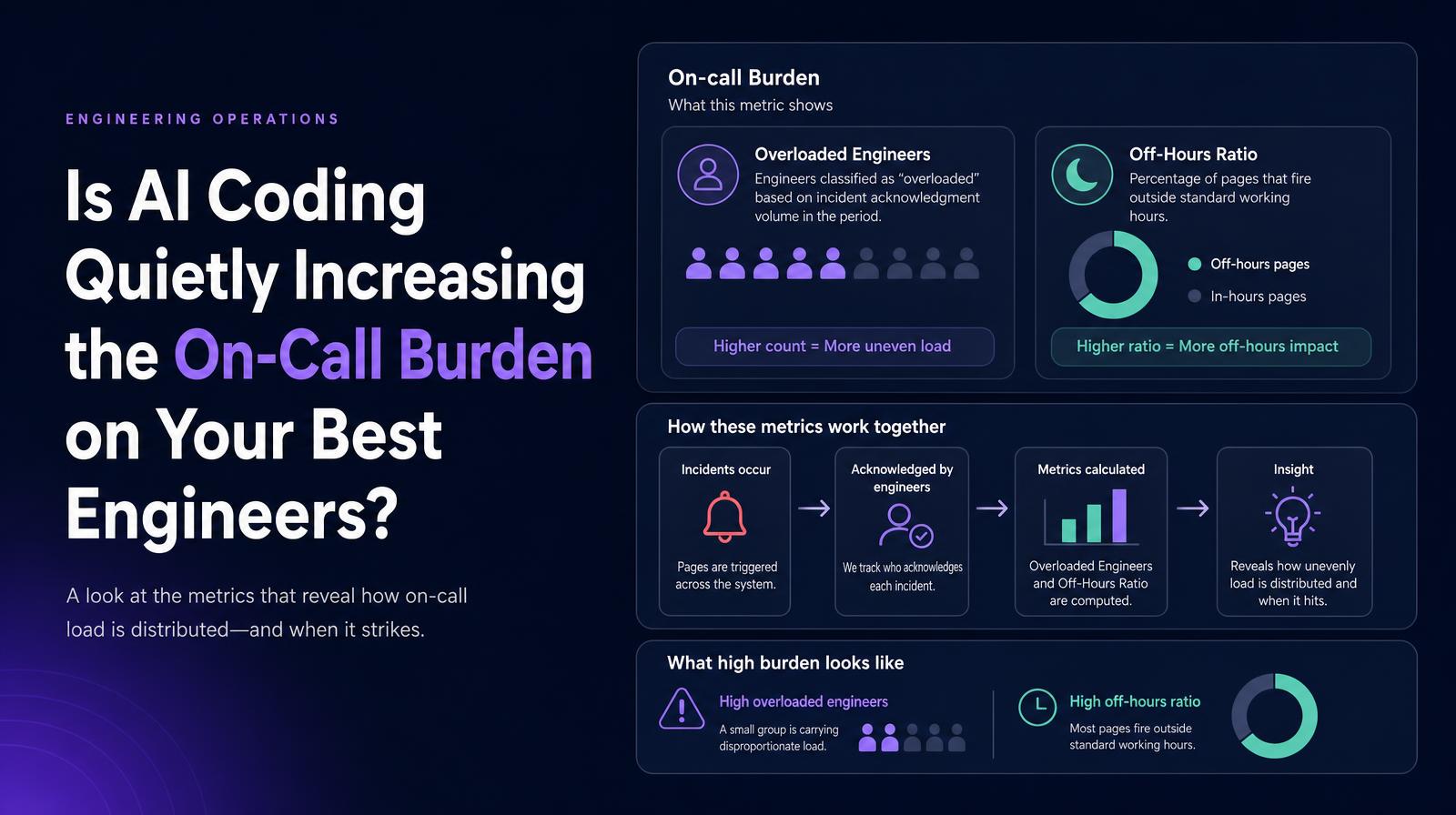
What it shows
The On-call Burden card shows two metrics: the count of engineers classified as "overloaded" based on their incident acknowledgment volume in the period, and the Off-Hours Ratio, the percentage of pages that fire outside standard working hours. Together they characterize how unevenly distributed on-call load is across the team, and how much of that load is falling during time when engineers aren't supposed to be working.
Why it matters
On-call concentration is one of the most reliable leading indicators of engineering attrition. When a small number of engineers carry a disproportionate share of incident response, particularly after hours, those engineers burn out faster and leave faster than peers who are not on-call. Larridin customer data shows that the engineer generating the highest AI tool spend in one org was also logging the most on-call pages, including 29 of 46 team incidents in a single week. AI coding tools are increasing output for those engineers, but the operational burden is stacking on the same people.
The Larridin angle
Larridin's Overloaded Engineers count and Off-Hours Ratio give CHROs and engineering leaders the retention risk data that incident count alone doesn't provide. An org with 248 incidents across 12 weeks looks manageable in aggregate; an org where one engineer acknowledged 60 of those pages, including a week where they handled 63% of all team incidents, is a retention and burnout risk hiding inside a reasonable aggregate number.
Related Reliability Metrics
Common questions
What metrics does the On-call Burden card display?
The On-call Burden card displays the count of overloaded engineers based on incident acknowledgment volume and the Off-Hours Ratio, which is the percentage of pages occurring outside standard working hours.
Why is on-call concentration important for the C-suite to monitor?
On-call concentration is a leading indicator of engineering attrition, as it can lead to faster burnout and turnover among engineers who handle a disproportionate share of incident responses, especially after hours.
How does AI coding impact the on-call burden for engineers?
AI coding tools increase output for engineers but can also lead to an operational burden, as those generating the highest AI tool spend may also handle the most on-call pages, increasing their risk of burnout.
How does Larridin help identify retention risks related to on-call burdens?
Larridin's Overloaded Engineers count and Off-Hours Ratio provide data that highlight retention risks, showing when a few engineers handle a large share of incidents, which might not be evident from incident counts alone.