
Enterprise AI Measurement Guide
Reliability
Incident Volume Breakdown
How is total incident volume split across Unresolved, Auto resolved, and Manually resolved categories, and how are those categories trending?
What it shows
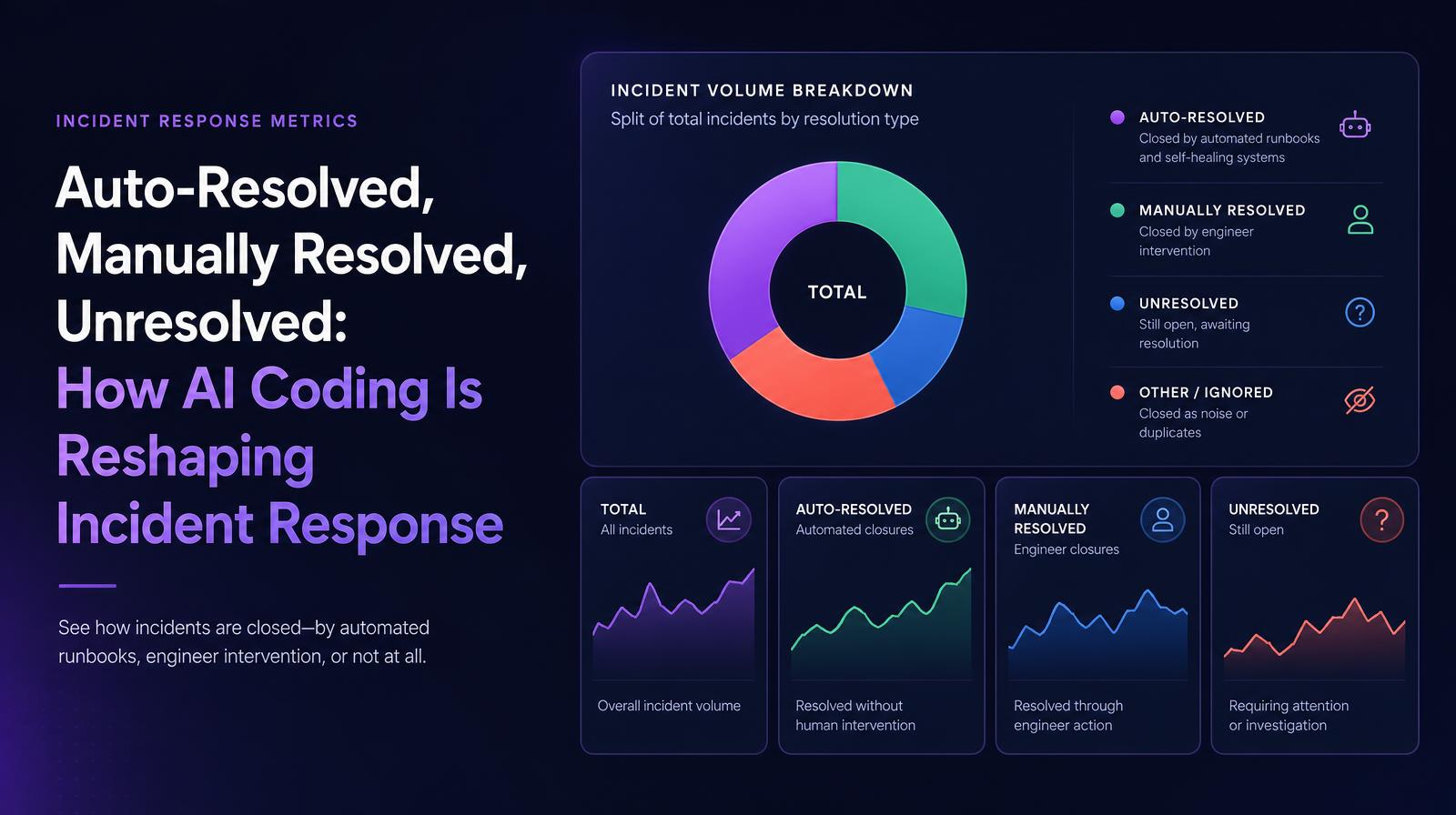
The Incident volume breakdown splits total incidents into four categories, Total, Unresolved, Auto-resolved, and Manually resolved, each with its own trend chart. This decomposition of the incident total reveals how the team is actually closing incidents: through automated runbooks and self-healing infrastructure, through engineer intervention, or not at all. The Unresolved count is the most operationally urgent signal, open incidents represent ongoing production risk.
Why it matters
The balance between auto-resolved and manually resolved incidents is a direct measure of infrastructure maturity. Organizations with rising auto-resolution rates are building resilient systems that recover without human intervention, which is exactly the kind of operational efficiency AI investment is supposed to enable. Rising manually resolved counts alongside rising total incidents suggests the team is handling more fires with the same or fewer hands. Unresolved incidents represent the tail risk that appears in SLA reports and customer satisfaction data.
The Larridin angle
In AI-assisted engineering environments, auto-resolution rate often improves alongside agent adoption, because the same engineers using AI to write code faster are also using it to write better runbooks, monitoring rules, and self-healing scripts. Larridin's breakdown makes that positive effect measurable separately from the raw incident count, allowing engineering leaders to show that rising total incidents are being absorbed by better automated response rather than by increased manual burden.
Related Reliability Metrics
Common questions
What does the Incident Volume Breakdown reveal?
The Incident Volume Breakdown categorizes total incidents into Total, Unresolved, Auto-resolved, and Manually resolved, each with a trend chart to show how incidents are being closed.
Why are unresolved incidents considered operationally urgent?
Unresolved incidents are urgent because they represent ongoing production risks and can impact SLA reports and customer satisfaction.
How does the balance of auto-resolved and manually resolved incidents indicate infrastructure maturity?
A higher rate of auto-resolved incidents suggests a mature infrastructure capable of self-recovery, indicating effective AI investment and operational efficiency.
How does AI coding impact incident resolution?
AI coding improves auto-resolution rates by enabling engineers to create better runbooks, monitoring rules, and self-healing scripts, absorbing increased incident volumes without adding manual burden.