
Enterprise AI Measurement Guide
Reliability
Off-Hours Pages
How many incident pages are firing outside standard working hours, and how is that count trending?
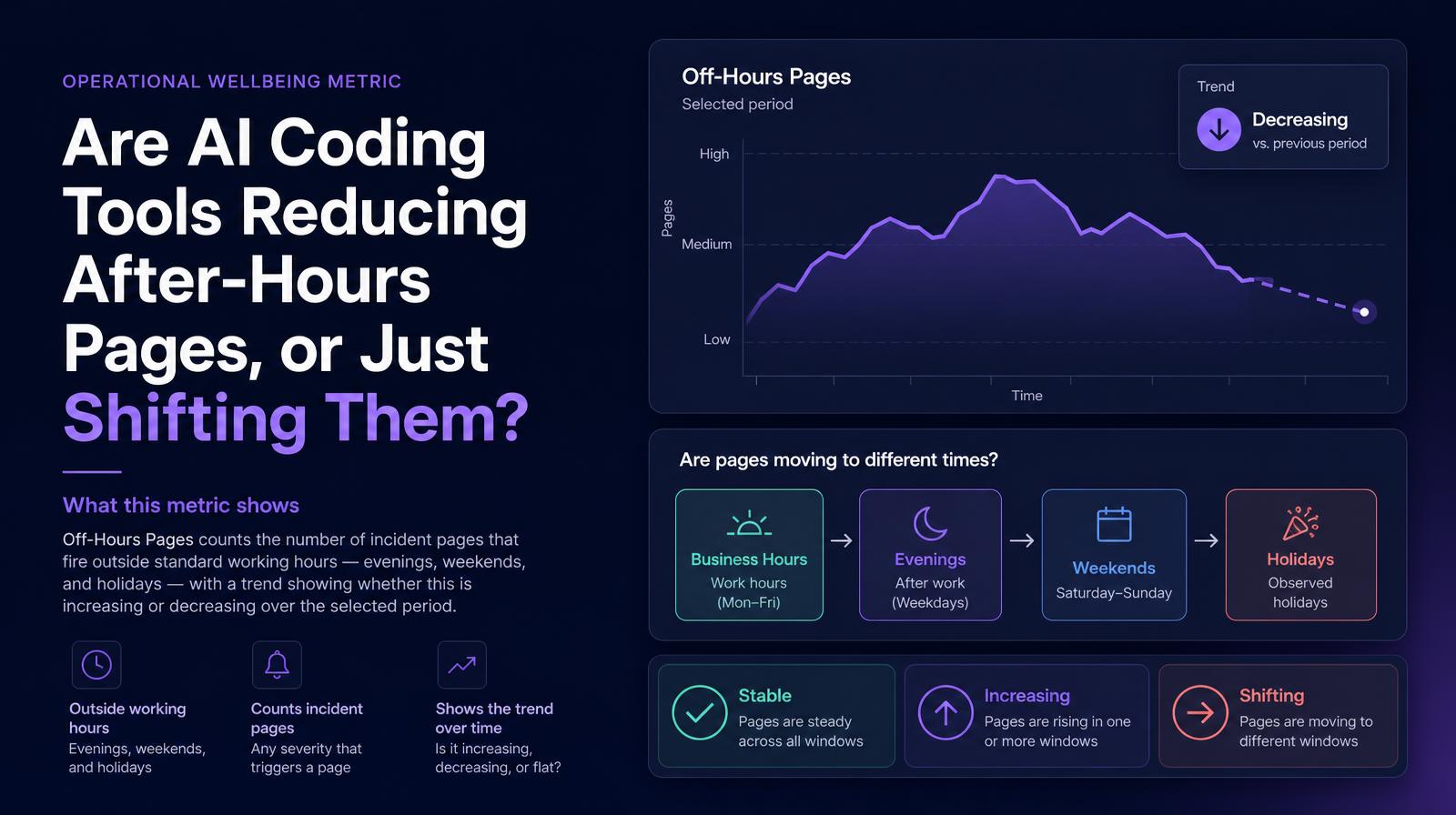
What it shows
Off-Hours Pages counts the number of incident pages that fire outside standard working hours, evenings, weekends, and holidays, with a trend showing whether this is increasing or decreasing over the selected period. In the context of AI coding adoption, off-hours pages are the operational wellbeing metric: they measure not just whether the system is stable, but whether instability is falling on engineers during time they're supposed to be offline.
Why it matters
Off-Hours Pages is the reliability metric with the most direct connection to engineer retention and burnout. A team where AI coding agents are generating more deploys, including deploys that happen outside working hours via autonomous pipelines, may see off-hours page counts rise even if daytime stability improves. For CHROs and engineering leaders managing retention risk, this metric surfaces the human cost of agentic AI adoption that CI/CD metrics alone don't capture. A rising off-hours page trend is also a leading indicator that autonomous agent activity is creating production risk during periods when human response capacity is lowest.
The Larridin angle
Larridin's Off-Hours Pages count, read alongside On-Call Burden and the Top Paged Engineers breakdown, surfaces whether off-hours load is distributing across the team or concentrating on the same engineers who are already carrying the heaviest daytime workload. Concentration is both a wellbeing risk and a single-point-of-failure risk.
Related Reliability Metrics
Common questions
What does the Off-Hours Pages metric indicate?
The Off-Hours Pages metric indicates the number of incident pages that occur outside standard working hours, such as evenings, weekends, and holidays, and shows whether this trend is increasing or decreasing over time.
Why is the Off-Hours Pages metric important for the C-suite?
This metric is crucial for the C-suite as it directly connects to engineer retention and burnout, highlighting the human cost of AI coding agent adoption and the potential production risks during low-response periods.
How does Larridin's Off-Hours Pages feature help manage team workloads?
Larridin's feature helps identify whether off-hours workloads are evenly distributed across the team or concentrated on specific engineers, which can indicate wellbeing risks and potential single points of failure.
Can AI coding tools increase the off-hours workload for engineers?
Yes, AI coding tools, especially those enabling autonomous deployments outside working hours, can increase the off-hours workload, even if they improve stability during regular hours.