
Enterprise AI Measurement Guide
Reliability
Mean Time to Resolve (MTTR)
How is incident resolution time trending in the Reliability tab, and how does MTTR relate to the Incident volume breakdown?
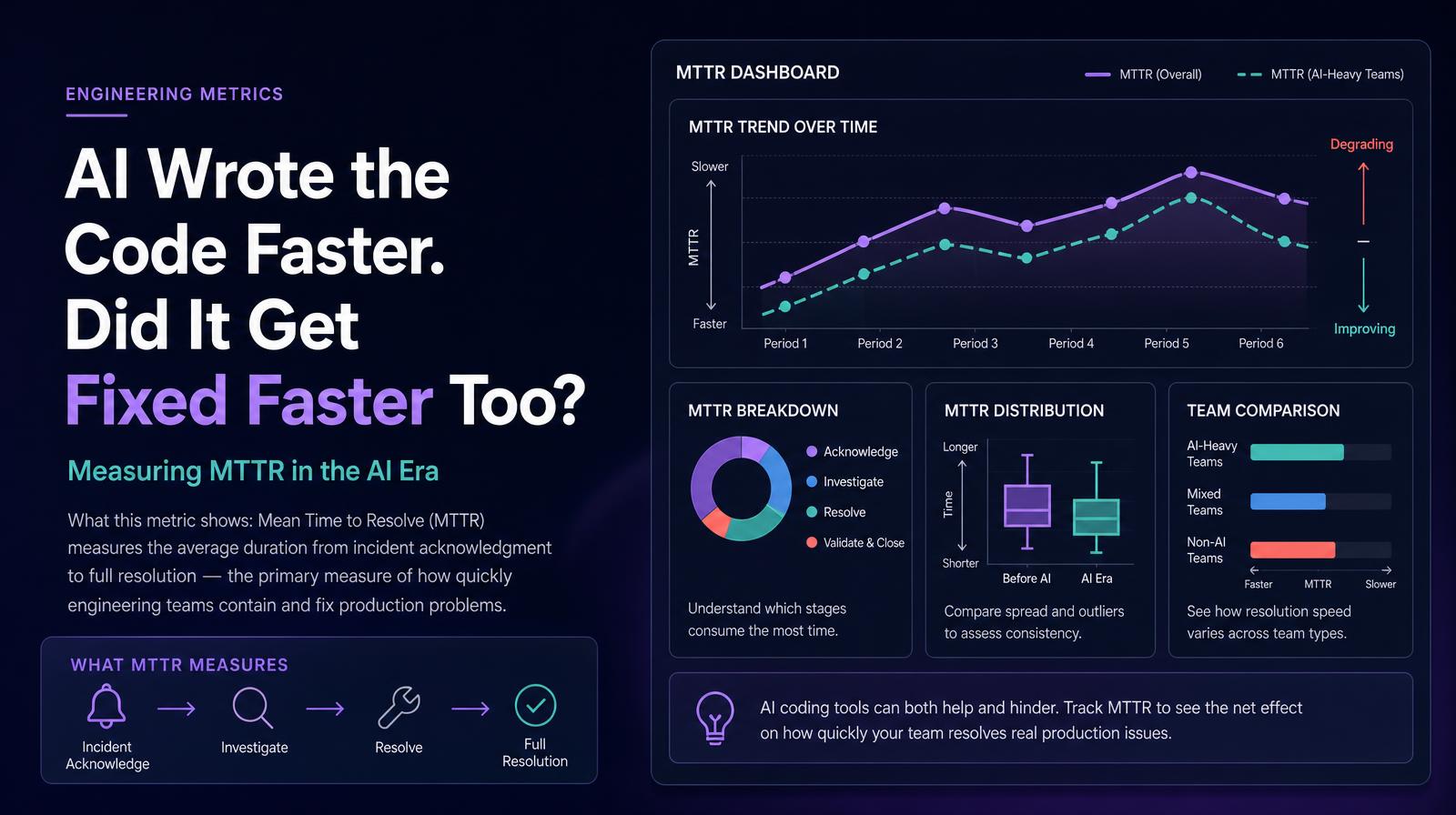
What it shows
Mean Time to Resolve (MTTR) measures the average duration from incident acknowledgment to full resolution, the primary measure of how quickly engineering teams contain and fix production problems. The trend shows whether resolution speed is improving or degrading over the selected period. MTTR is the metric where AI coding tools have the most ambiguous effect: they can generate hotfixes faster, but the complexity of AI-generated code can also make root cause diagnosis slower.
Why it matters
MTTR improvement is sometimes the bright spot in an AI adoption picture where other reliability metrics are moving the wrong direction. Larridin customer data shows MTTR improving significantly even in windows where incident count and Change Failure Rate are rising, suggesting AI tools are genuinely helping engineers resolve issues faster even as they generate more of them. That combination changes the risk calculation: faster recovery changes the blast radius of each incident, which is the number boards and CISOs actually care about when assessing AI deployment risk.
The Larridin angle
Larridin's MTTR trend alongside the Incident Volume Breakdown (auto-resolved vs. manually resolved) tells a more complete story than MTTR alone. If MTTR is improving primarily because auto-resolution is rising, rather than because engineers are resolving faster, the improvement is a monitoring and alerting win, not an engineering performance win. Larridin makes that distinction visible without requiring a separate investigation.
Related Reliability Metrics
Common questions
What is Mean Time to Resolve (MTTR)?
MTTR measures the average time from when an incident is acknowledged to when it is fully resolved, indicating how quickly engineering teams can address production issues.
How does AI affect MTTR?
AI can generate hotfixes faster, potentially improving MTTR, but the complexity of AI-generated code might slow down root cause diagnosis, making its overall effect ambiguous.
Why is MTTR important for the C-suite?
MTTR is crucial as it reflects the speed of recovery from incidents, affecting the risk assessment of AI deployments by showing how quickly issues can be contained and resolved.
How does Larridin provide insights into MTTR improvements?
Larridin distinguishes between improvements due to faster human responses and those due to increased auto-resolution, offering a clearer picture of engineering performance and monitoring effectiveness.