
Enterprise AI Measurement Guide
Weekly Pulse
Individual Performance
How do we see each engineer's Output and PRs Merged in the Weekly Pulse Individual Performance table?
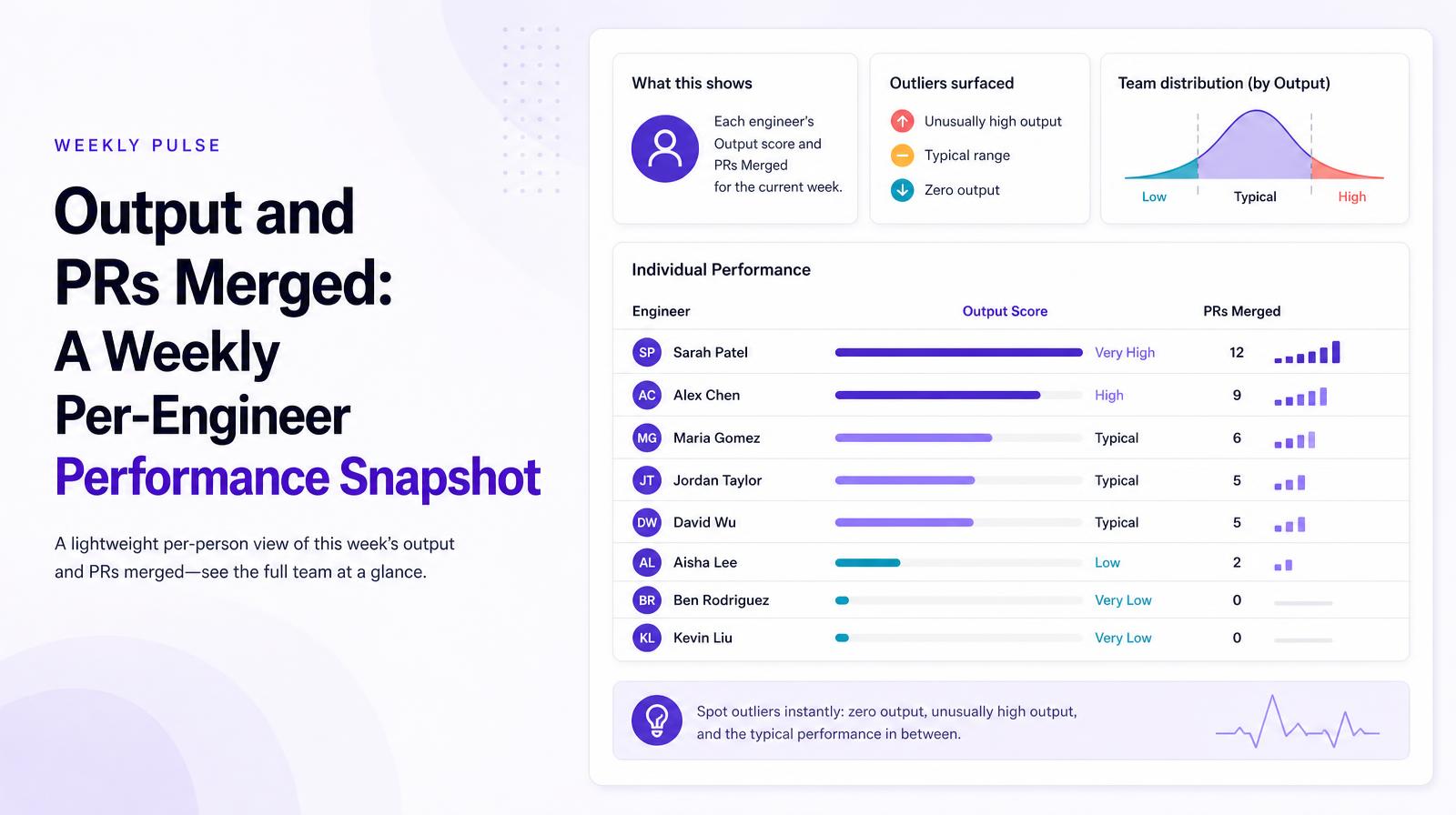
What it shows
The Individual Performance table shows each engineer's Output score and PRs Merged count for the current week, the lightest-weight per-person view in the Weekly Pulse. It surfaces the full team's weekly performance in a single glance, making outliers immediately visible: engineers with zero output, engineers with unusually high output, and the typical distribution between them.
Why it matters
The Individual Performance table is the first place a weekly review surfaces individual performance anomalies, not to surveil engineers, but to catch systemic issues early. An engineer with zero output for three consecutive weeks is a signal worth investigating: are they on-call? Working on a long-running task without intermediate commits? Experiencing tool friction? The table surfaces the pattern; the investigation determines the cause. For CHROs and engineering managers, this is the weekly check that prevents individual contributors from going invisible inside aggregate team metrics.
The Larridin angle
Output and PRs Merged together capture both complexity-adjusted value and raw shipping activity, the two dimensions that tell different stories. An engineer merging many PRs with low Output is shipping simple, low-complexity work. An engineer with high Output and few PRs is working on harder, longer-cycle tasks. Larridin's two-metric view prevents either number from being misread in isolation.
Related Weekly Pulse Metrics
Common questions
What does the Output score represent in the Individual Performance table?
The Output score reflects the complexity-adjusted value of an engineer's work for the current week, highlighting their contribution beyond just the number of tasks completed.
How does the PRs Merged count contribute to understanding engineer performance?
The PRs Merged count indicates the raw shipping activity, showing how many pull requests an engineer has successfully merged in a week, which helps assess their workflow efficiency.
Why is it important for the C-suite to monitor the Individual Performance table?
The table helps the C-suite identify performance anomalies early, which can signal systemic issues, ensuring that individual contributors are not overlooked in broader team metrics.
How do Output and PRs Merged metrics complement each other?
These metrics together provide a balanced view of an engineer's performance by capturing both the complexity of their work and their shipping activity, preventing misinterpretation when viewed separately.