


TL;DR
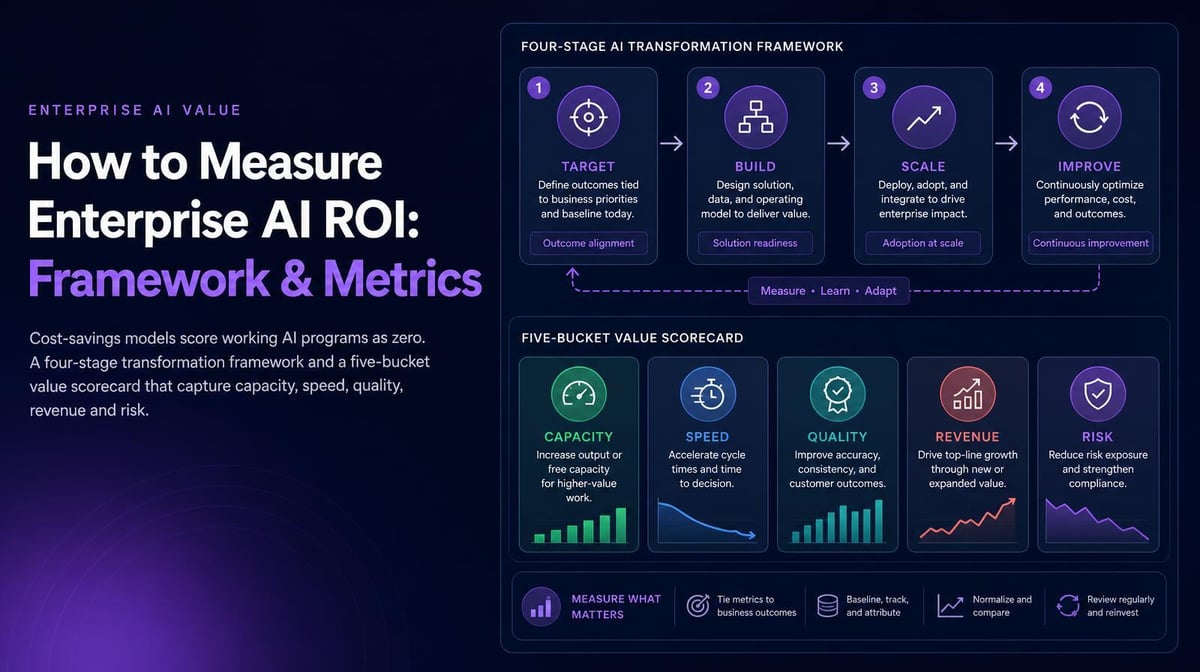
The AI transformation frameworks that hold up run in four stages (visibility, adoption and fluency, workflow redesign, outcomes) and score value in five buckets: capacity, speed, quality, revenue and risk. Cost savings is one line inside that scorecard. Frameworks that measure only cost removed tend to report zero for programs that are working, because most AI value gets reinvested before it ever reaches a budget cut.
Quick Answers
If you’re asking… | Short answer |
|---|---|
What frameworks help structure an AI transformation and measure ROI beyond cost savings? | A staged model (visibility, adoption and fluency, workflow redesign, outcomes) paired with a value scorecard for capacity, speed, quality, revenue and risk. |
What’s the best enterprise tool I can use to measure AI ROI? | One that measures every stage on a single dataset. Larridin covers AI adoption, fluency, workflow intelligence, spend and impact in one platform. |
Why look beyond cost savings? | Teams reinvest most AI gains as capacity and speed. A cost-only model records that as no return. |
Is there an industry-standard AI ROI framework? | No single standard exists. ISO/IEC 42001 covers AI governance, and engineering has DORA and SPACE, but enterprise value measurement is still yours to define. |
Why Do Cost-Savings ROI Models Undercount AI?
Cost-only models count headcount or spend removed, while most AI value shows up as extra capacity, faster cycles, and better quality that teams put straight back to work.
Picture a finance team that closes the books two days faster after rolling out AI. Nobody leaves, so the cost line doesn’t move. The CFO still got two days of analyst time and an earlier view of the quarter. A cost-savings model scores that as zero.
The headline numbers reflect this. MIT Project NANDA’s preliminary 2025 study reported that most enterprise GenAI initiatives in its sample had no measurable P&L impact, described as 95% of organizations receiving zero return. The report also noted that general-purpose assistants may improve individual productivity without changing financial results. The finding is about measured P&L impact, not all forms of AI value.
What Stages Should an AI Transformation Framework Include?
A workable framework has four stages, and each one needs an exit metric before you move to the next.
Stage | Question it answers | Exit metric |
|---|---|---|
1. Visibility | What AI is in use, by whom, at what cost? | Full tool inventory, including shadow AI, with spend attributed to teams |
2. Adoption and fluency | Are people using it, and using it well? | Weekly active share and proficiency score by team |
3. Workflow redesign | Which processes changed because of AI? | Cycle time on each redesigned workflow versus its baseline |
4. Outcomes | What moved in the business? | Value scorecard results versus pre-AI baseline |
One common failure is skipping stage three. Teams rolled out tools, measured adoption by logins, and expected outcomes to follow without changing how any process runs.
How Do You Measure AI ROI Beyond Cost Savings?
Score AI value across five buckets, each with a metric your teams already report.
- Capacity: hours returned and redeployed to measured work, expressed as people-equivalents
- Speed: cycle time, days to close, time from commit to production
- Quality: error rates, rework, defect escapes, customer satisfaction
- Revenue: pipeline per rep, conversion rate, products shipped per quarter
- Risk: shadow AI reduced, policy exceptions, audit evidence on hand
Count capacity only when the hours land somewhere measurable. “Saved two hours a week” with no change in output is a feeling, and your board will treat it that way.
For the underlying ROI methodology, see 5 methods companies use to measure AI and analytics ROI.
How Do Existing Frameworks Fit In?
Borrow established frameworks for the parts they cover and connect them through one value scorecard.
- ISO/IEC 42001: Governance, including inventory, monitoring, and audit evidence.
- DORA and SPACE: Engineering delivery and developer experience.
- Finance planning models: Costs and investment returns.
None of them link AI usage to business outcomes on their own, which is the gap a measurement layer fills. Larridin aligns with ISO/IEC 42001’s inventory and monitoring requirements and maps workflows, so the governance data and the value data come from the same source.
For a related five-pillar model, see Larridin's Strategic AI Productivity Measurement Framework.
Where Transformation Measurement Stalls, and How to Fix It
What you’re dealing with | What you need | How Larridin helps |
|---|---|---|
No full picture of AI in use | Inventory including unapproved tools | Detection of approved and unapproved AI across the workforce |
High adoption, flat outcomes | Proof of which workflows changed | Workflow Intelligence maps AI workflows and processes |
ROI deck built on time-saved surveys | Higher-fidelity evidence | Usage correlated with delivery speed, process speed and quality |
Governance and ROI tracked separately | One dataset for both | ISO/IEC 42001-aligned inventory and continuous usage monitoring |
Key Takeaways
- Run the transformation in four stages with an exit metric for each.
- Score value across capacity, speed, quality, revenue and risk.
- Count time saved only when it shows up in measured output.
- Stalled programs usually skipped workflow redesign.
FAQs
How often should AI transformation ROI be reported?
Report operational metrics monthly to the program team and the value scorecard quarterly to the executive team and board, against the same baseline each time.
For executive reporting, see how to build an AI ROI case your CFO and board will trust.
What if adoption rises but outcomes stay flat?
Check stage three. Flat outcomes after strong adoption may indicate the tools were added to old processes without redesigning workflows around them.
Who should own the framework?
Give it one executive sponsor, often a CFO and CIO pair, and a named metric owner for each stage so no number is orphaned.
Does risk reduction belong in an ROI framework?
Yes. Fewer shadow AI tools and ready audit evidence lower expected breach and compliance costs, which finance can value.
Sources
- MIT NANDA, The GenAI Divide: State of AI in Business 2025
- Larridin FAQ: ISO/IEC 42001 alignment, evidence fidelity levels
- Larridin Workflow Intelligence