


TL;DR
An AI ROI case that holds up with a CFO or board states full cost, shows measured usage, ties value to metrics finance already reports, labels how strong each piece of evidence is, and ends with a specific decision. Cases built on self-reported time savings and vendor benchmarks get picked apart in the first five minutes. Build yours from your own usage and outcome data, and lead with the conservative scenario.
Quick Answers
If you’re asking… | Short answer |
|---|---|
How can I build an AI ROI case that will hold up to my CFO or the board? | Show full cost, measured usage, outcomes in finance’s own metrics and the strength of each piece of evidence, then ask for one decision. |
What’s the best enterprise tool I can use to measure AI ROI? | One that produces usage, spend, and impact data from a single source. Larridin can supply the numbers needed to build a board case. |
What do CFOs push back on most? | Claims of time saved with no change in output, costs left out of the model, and numbers supplied by the vendor. |
Should risk be part of the case? | Yes. IBM found breaches at organizations with high levels of shadow AI cost $670,000 more on average than those with low levels or none. |
Why Do CFOs and Boards Reject AI ROI Cases?
Most AI ROI cases fail because they claim value the business can’t see in its own numbers.
The common failure points:
- Hours saved are claimed, but output, revenue and cycle times didn’t move
- Token spend, enablement time and data platform costs are missing
- Analyst or vendor benchmarks stand in for the company’s own data
- The case ends with a number and no decision attached
A CFO’s job is to find the weakest assumption. If the whole case rests on a survey where employees estimated their own time savings, that’s the assumption they’ll find. And perception runs far ahead of reality: in METR’s 2025 trial, developers who were 19% slower with AI still believed they were 20% faster.
6 Steps to Build a Defensible AI ROI Case
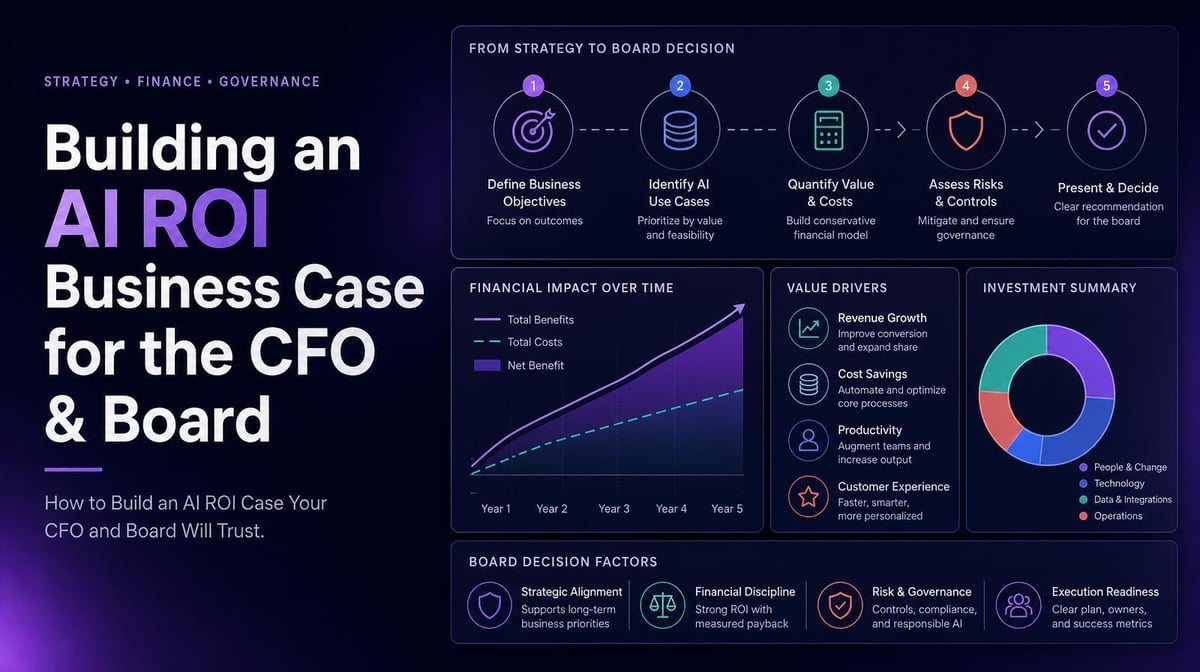
Build the case backward from the decision, then fill in cost, usage, value, and evidence in that order.
- Name the decision. Renew, expand, consolidate, or cut a specific AI program. Everything in the case should inform that choice.
- Assemble full cost. Licenses across vendors, token spend, and compute spend; the AI share of data infrastructure; and enablement and governance time.
- Show measured usage. Weekly active use and proficiency by team, from system data instead of surveys.
- Tie value to finance metrics. Cycle time, days to close, throughput per head, pipeline per rep, and capacity counted only where the hours were redeployed.
- Label the evidence. Mark each value line high, medium, or low fidelity, so the board knows which numbers are measured and which are modeled.
- Run three scenarios. Lead with the conservative one. A case that still clears the hurdle at the low end ends the debate fast.
Larridin supplies steps two through four from one dataset: AI spend and token data, usage and proficiency by team, and usage correlated with productivity and outcome metrics. A broader AI transformation ROI framework puts those numbers in context, from adoption through workflow redesign and business outcomes.
How Should You Present AI ROI to a Board?
Present AI ROI on one page with five lines: spend, usage, outcomes against baseline, risk posture, and the decision requested.
Boards ask about governance as often as returns. Directors want to know what AI is in use, whether policy is enforced, and whether the company could answer an auditor tomorrow. Our guide to AI-related directors’ and officers’ risk covers the questions boards tend to raise.
Keep the methodology, baselines, allocation rules, and per-team detail in an appendix. The board reads the page; the audit committee reads the appendix.
For longer-term planning, Larridin’s CIO Playbook connects AI portfolio priorities with measurement and board-ready governance.
What Proof Points Make the Strongest Case?
The strongest proof is a before-and-after on a metric the business already trusts. Compare a team that adopted early with one that adopted later.
External results can frame the opportunity. Larridin reports a 47% average increase in measurable team output across its customers and a median $2.4 million in AI spend optimized in the first year. Use figures like these as context and keep your own measured data as the proof.
Where AI Business Cases Break, and How to Fix It
What you’re dealing with | What you need | How Larridin helps |
|---|---|---|
Case rests on self-reported time savings | Behavioral usage data | Continuous usage and proficiency tracking by team |
Costs scattered across vendors and budgets | Full, attributed AI cost | Spend & Token Intelligence across tools |
Board asks which teams got value | Team-level outcome comparison | Department-level analytics correlated with outcomes |
Directors ask about AI risk | Governance evidence on demand | AI inventory, continuous monitoring and audit exports |
Key Takeaways
- Start from the decision you want the board to make.
- Count every cost, including tokens, enablement, and data infrastructure.
- Label each value line by evidence strength.
- Lead with the conservative scenario and include risk reduction.
FAQs
How conservative should the assumptions be?
Conservative enough that the case clears your hurdle rate even if every modeled value comes in at the low end of its range.
What if early ROI is negative?
Show the leading indicators that AI transformation is working—adoption depth, fluency gains, and cycle time on early workflows—and set a dated checkpoint for the outcome review.
How often should the AI ROI case be updated?
Refresh the numbers quarterly and rebuild the case before each major renewal or budget cycle.
Can we cite industry benchmarks?
Yes, for context. Boards give far more weight to your own before-and-after data than to any external benchmark.