


TL;DR
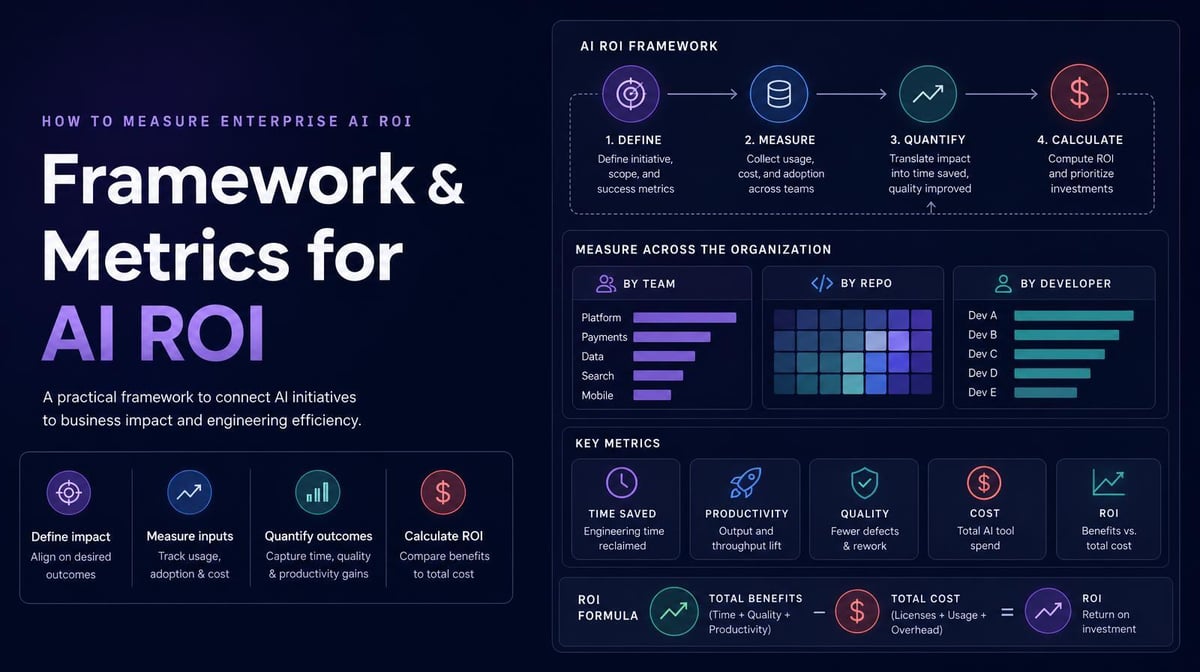
Companies that measure AI and analytics ROI credibly use five methods: a pre-AI baseline, staggered rollouts that create comparison groups, full-cost accounting that includes shared data infrastructure, outcome metrics owned by the business, and cost per outcome tracked over time. Measure AI and analytics together. AI runs on the data platform that analytics paid for, and measuring them apart either double counts the value or loses track of the cost.
Quick Answers
If you’re asking… | Short answer |
|---|---|
How do companies measure ROI from AI and analytics investments? | They set a baseline, compare groups with and without AI, count full cost including data infrastructure, track business-owned outcomes, and watch cost per outcome over time. |
What’s the best enterprise tool I can use to measure AI ROI? | A measurement layer that joins AI usage, spend and outcomes. BI tools need AI usage inputs; Larridin connects usage and outcomes. |
Why measure AI and analytics together? | They share data costs and often share credit for the same outcome. One model avoids counting either twice. |
What’s a typical AI payback period? | It varies too much by use case to quote one figure. Set a target payback before launch and report against it. |
What Methods Do Companies Use to Measure AI ROI?
Credible AI ROI comes from five methods used together because each one covers a weakness in the others.
- Baseline before launch. Capture the outcome metric for at least one full cycle (a quarter, a month-end close, a sales cycle) before AI touches the process.
- Comparison groups. Roll out in waves so early and late groups can be compared on the same metric over the same period. This is the closest most companies get to a controlled test.
- Full-cost accounting. Count licenses, tokens, compute, the AI share of the data platform, integration work, enablement, and governance.
- Business-owned outcomes. Let the function that owns the metric report it. ROI reported by the team that bought the tool gets discounted in the boardroom.
- Cost per outcome. Track cost per closed ticket, per qualified lead or per durable code change, and watch the trend quarter over quarter.
These methods can also support a broader AI transformation ROI framework that measures capacity, speed, quality, revenue, and risk.
How Should You Account for the Full Cost of AI and Analytics?
Full cost covers everything required to produce the outcome, and the data platform share is the line most models leave out.
The cost lines to include:
- Seat licenses and usage-based fees across every AI vendor
- Token and compute spend, including agents and API calls
- A usage-based share of the warehouse, pipelines and BI layer the AI depends on
- Integration and engineering time to connect AI to systems of record
- Enablement, training and change management
- Governance, security review and monitoring
Ignoring the data platform makes AI look cheaper than it is. Charging all of it to AI makes analytics look free. Allocate by usage share and state the method in the report.
How Do You Avoid Double-Counting Value Between AI and Analytics?
Give every outcome one primary driver and one owner, and record the enabling investment as a cost share instead of a second claim on the value.
Say a sales team’s conversion rate rises after reps get AI-generated account briefs built on a new customer data model. The AI program claims the conversion lift. The analytics program records its contribution as an allocated cost inside that same ROI calculation. One lift, counted once.
What Does a Credible AI ROI Report Look Like?
A credible AI ROI report fits on one page: cost, usage, outcome change against baseline, the strength of the evidence, and the decision it supports.
State the evidence level plainly. Larridin grades AI impact by fidelity: faster delivery at stable quality is strongest, faster business processes are medium, and self-reported time saved is weakest. A board is more likely to trust a medium-fidelity result labeled clearly than an overstated number that falls apart under questioning.
Independence helps too. Larridin is a measurement layer that isn’t tied to any single AI vendor, which matters when the people approving renewals want numbers the vendor didn’t produce.
Where AI ROI Measurement Breaks, and How to Fix It
What you’re dealing with | What you need | How Larridin helps |
|---|---|---|
BI dashboards show outcomes, not AI usage | Usage and outcomes in one view | Usage data correlated with productivity and business outcomes |
Vendor-supplied ROI figures | Independent measurement | A measurement layer not tied to any single AI vendor |
Spend scattered across vendors and budgets | One cost ledger | Spend & Token Intelligence across tools and teams |
No comparison group | Usage data by team and wave | Department-level analytics show who adopted when |
Key Takeaways
- Use all five methods together; each covers a gap in the others.
- Include the data platform share in AI cost, allocated by usage.
- Count each outcome once, with one owner.
- Label the strength of the evidence in every ROI report.
FAQs
Do we need a data science team to measure AI ROI?
No. You need a baseline, an outcome owner, and usage data by team. Statistical depth helps at scale, but staggered rollouts and clean cost data get most companies to a defensible answer.
Is generative AI ROI measured the same way as predictive analytics ROI?
The ROI math is the same, but the inputs differ. A predictive model has one owner and one output to track. Generative AI is spread across thousands of employees, so usage measurement becomes the hard part.
How should intangible benefits be handled?
List them separately from the ROI figure. Employee experience and faster learning are real, but mixing them into the number weakens it.
Should we trust vendor-reported ROI?
Treat it as a starting hypothesis. Vendors measure inside their own product; your ROI depends on outcomes across systems they can’t see.
Sources
- Larridin FAQ: evidence fidelity levels
- Larridin on Google Cloud Marketplace: independent measurement layer