


TL;DR
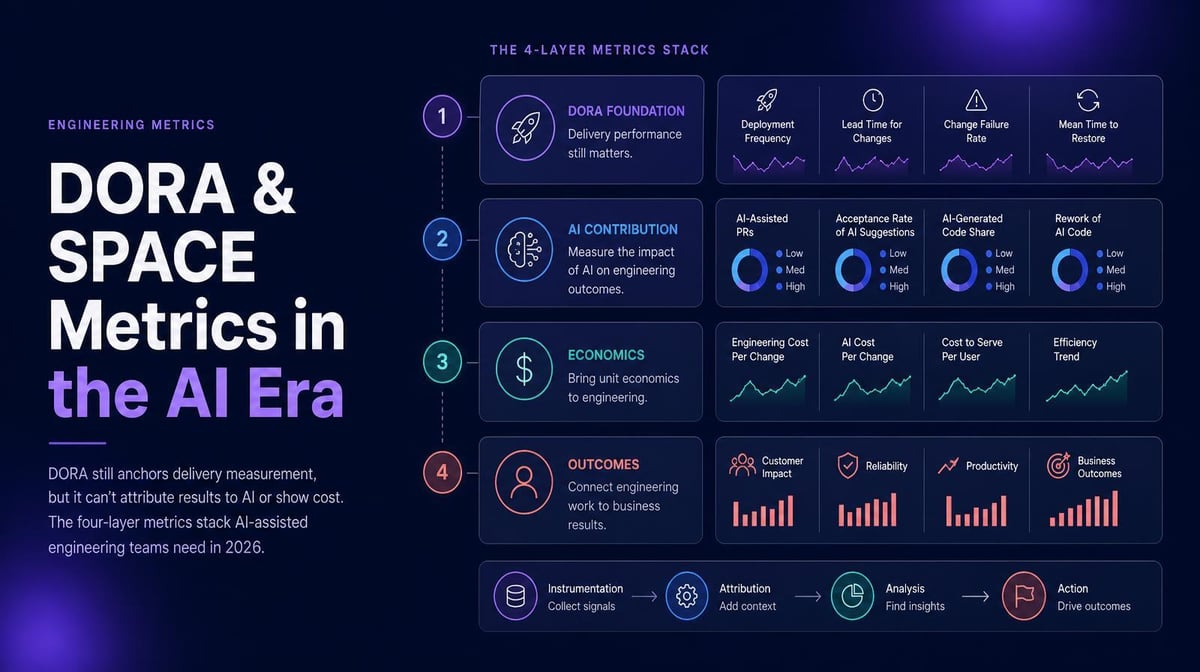
DORA metrics are still a useful foundation for measuring software delivery in 2026, but they don't capture the full impact of AI. They can’t tell you whether AI caused a change in the numbers, what that change cost, or whether the code will last. Keep DORA, add SPACE-style developer experience signals, and add an AI layer that separates AI-assisted work from human work and tracks cost per durable outcome.
Quick Answers
If you’re asking… | Short answer |
|---|---|
Are DORA metrics still the right engineering productivity metrics in 2026? | Yes, as the base layer for delivery health. On their own they can’t attribute results to AI or show cost. |
Which tools measure AI impact on engineering output? | Tools that separate AI-assisted from human-written code and connect it to delivery and spend. Larridin does this across major coding assistants. |
What’s missing from DORA for AI teams? | AI attribution, cost, developer experience, and durability of code over longer windows. |
DORA or SPACE? | Both. DORA measures the delivery system; SPACE measures the experience and flow of the people inside it. |
What Do DORA Metrics Measure Today?
DORA metrics measure how quickly and reliably a team delivers software using throughput and instability measures that any team can compute.
DORA’s current guidance covers five measures:
- Change lead time
- Deployment frequency
- Failed deployment recovery time
- Change fail rate
- Deployment rework rate
The 2025 DORA research based on nearly 5,000 technology professionals found AI adoption at 90% and described AI as an amplifier: it magnifies a team’s existing strengths and its existing weaknesses. The research also linked AI adoption to higher delivery throughput, reversing the prior year’s finding, while instability remained a concern.
Where Do DORA Metrics Fall Short in AI-Assisted Teams?
DORA metrics describe what the delivery system produced, so they can’t explain why it changed or what it cost.
The gaps that matter most once AI is in the loop:
- DORA can’t separate AI-assisted changes from human ones, so you can’t credit or blame AI.
- Deployment frequency rises when AI produces more small changes, whether or not those changes carry value.
- There’s no cost dimension, so a faster pipeline that doubled token spend looks like pure gain.
- Bottlenecks move. When code generation speeds up, review queues grow, and lead time hides where the wait sits.
- Short measurement windows miss code that ships cleanly and gets rewritten weeks later.
DORA is still useful, but it should be treated as the first layer of a larger measurement stack.
For a closer look at the output side, see how Larridin measures engineering work delivered.
How Does SPACE Complement DORA?
SPACE adds the human side of productivity: satisfaction and well-being, performance, activity, communication and collaboration, and efficiency and flow.
The SPACE framework was published by Nicole Forsgren and colleagues in 2021, and matters more in AI-assisted teams because the work itself has changed. Engineers spend more time reviewing and steering AI output. Review load, interruptions, and trust in AI-generated code all affect delivery, and none of them show up in a deployment count. DORA’s 2025 research also flagged uneven trust in AI among developers, which is a SPACE-style signal worth tracking directly. An AI-native engineering playbook can help teams adapt their review and testing practices.
What Should an AI-Era Engineering Metrics Stack Include?
An AI-era stack has four layers: delivery, developer experience, AI impact, and cost.
Layer | Example metrics | Question it answers |
|---|---|---|
Delivery (DORA) | Lead time, deployment frequency, recovery time, change fail rate, deployment rework rate | Is the delivery system healthy? |
Developer experience (SPACE) | Satisfaction, flow time, review load, trust in AI output | Is the pace sustainable? |
AI impact | Share of AI-assisted code, durability of AI code, complexity-adjusted output | Is AI the reason results changed? |
Cost | Cost per durable outcome by team and tool | Is the improvement worth what it costs? |
Use developer productivity benchmarks to compare results before and after AI adoption.
Larridin covers the AI impact and cost layers. It attributes code to AI-assisted or human activity, scores PR complexity instead of counting PRs, and tracks cost per durable outcome across Cursor, Claude Code, GitHub Copilot, Codex, and Gemini Code Assist. The 5 Pillars of AI-Native Developer Productivity lay out the full model.
Where Engineering Measurement Breaks, and How to Fix It
What you’re dealing with | What you need | How Larridin helps |
|---|---|---|
DORA improved, nobody knows if AI caused it | AI-assisted versus human attribution | Separates AI-generated code from human work |
Deployment frequency inflated by tiny PRs | Output weighted by difficulty | Complexity-adjusted output scoring |
Faster delivery, rising AI bill | Cost tied to delivery | Cost per durable outcome by tool and team |
Review queues growing | Visibility into where work waits | Engineering Intelligence on how engineers and agents work together |
Key Takeaways
- DORA remains the right base layer for delivery health in 2026.
- DORA can’t attribute results to AI or show cost.
- Add SPACE signals, especially review load and trust in AI output.
- Add an AI impact and cost layer to finish the stack.
FAQs
Should we stop using DORA metrics?
No. Keep them as your delivery baseline. Without DORA you lose comparability over time and with the wider industry.
Can AI tools game DORA metrics?
Indirectly, yes. More small AI-generated changes can raise deployment frequency without adding value, which is why complexity-adjusted output belongs beside it.
How often should engineering leaders review these metrics?
Weekly for team leads, monthly for engineering leadership, and quarterly in summary for the executive team.
Do we need a new platform to compute DORA?
Usually not; many tools compute DORA from your CI/CD data. You need an AI-aware layer to attribute results to AI and connect them to spend.