
Enterprise AI Measurement Guide
Browser Analytics
Active Users / DAU / Total Users
How many employees are daily active users of browser-based AI tools, and how does that count relate to the total browser Active Users?
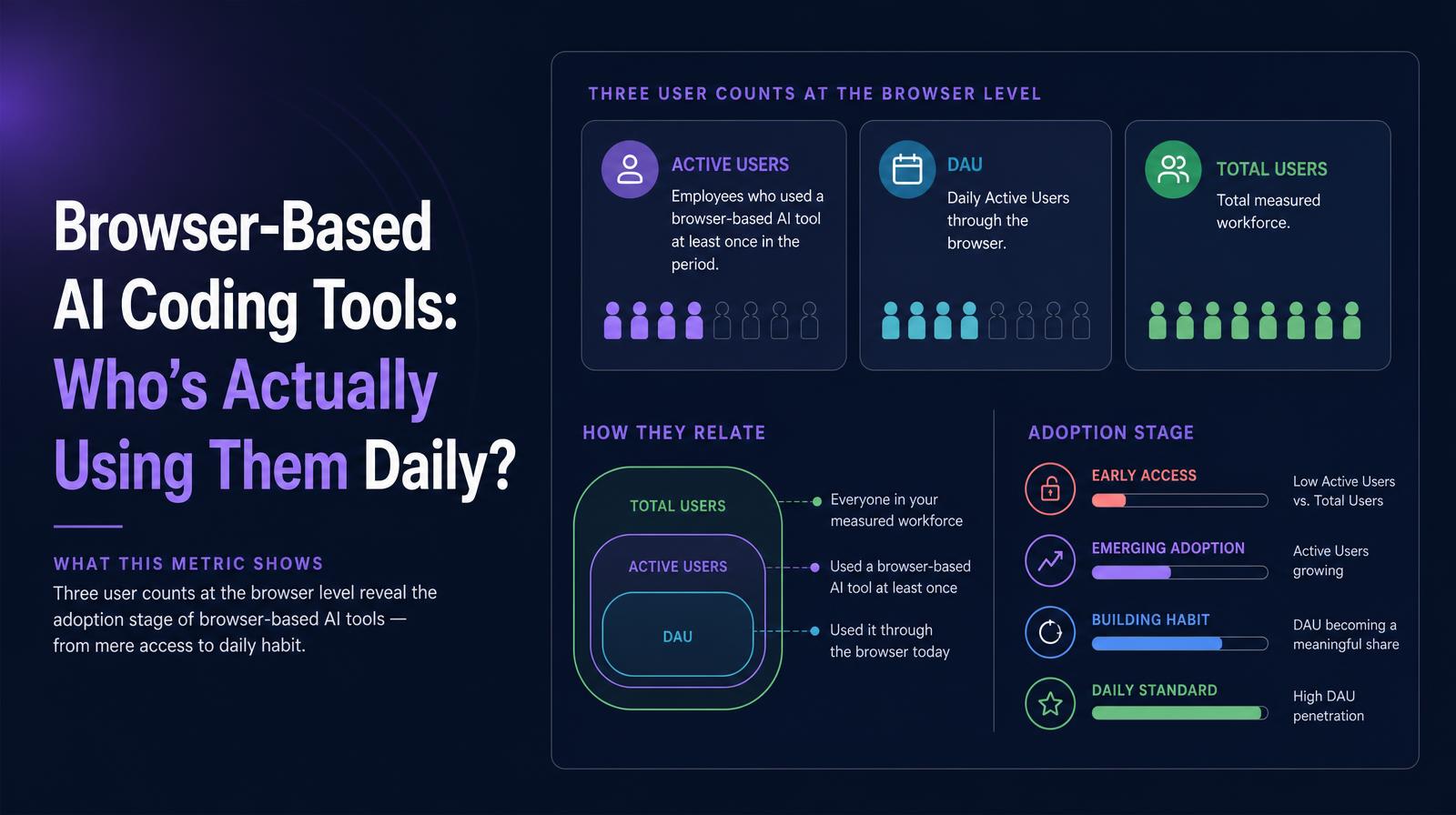
What it shows
Three user counts for browser-channel AI tool usage: Active Users (employees who used a browser-based AI tool at least once in the period), DAU (Daily Active Users through the browser), and Total Users (total measured workforce). The relationship between these three counts at the browser level reveals the specific adoption stage of browser-based AI tools, from mere access through to genuine daily habit.
Why it matters
Browser DAU is typically lower relative to Active Users than desktop DAU, because browser-based AI tools are accessed on an as-needed basis while desktop coding agents are more likely to be embedded in the engineering workflow. A browser DAU that is growing as a share of Active Users signals that browser-based AI tools are becoming daily habits, a positive adoption progression. A browser DAU that is stable or declining while Active Users grows suggests the org is onboarding more occasional users without deepening engagement among existing ones.
The Larridin angle
The browser-specific three-count view is important for organizations that are early in their AI deployment and haven't yet deployed desktop agents at scale. For those organizations, the browser Active Users / DAU gap is the primary adoption depth metric, and closing it through targeted enablement is the highest-ROI investment before introducing desktop-native tools that require additional deployment and governance overhead.
Related Browser Analytics Metrics
Common questions
What are the key metrics for measuring browser-based AI tool usage?
The key metrics are Active Users, Daily Active Users (DAU), and Total Users, which help determine the adoption stage of browser-based AI tools.
Why is the browser DAU typically lower than desktop DAU?
Browser DAU is usually lower because browser-based AI tools are accessed on an as-needed basis, unlike desktop tools which are more integrated into the engineering workflow.
What does a growing browser DAU indicate for an organization?
A growing browser DAU indicates that browser-based AI tools are becoming daily habits, suggesting positive adoption progression.
How can organizations close the gap between Active Users and DAU for browser AI tools?
Organizations can close this gap through targeted enablement, which is a high-ROI investment before deploying desktop-native tools.