
Enterprise AI Measurement Guide
AI Productivity
Survey Score
How can leaders use Survey Score alongside AI usage and productivity measures?
What it shows
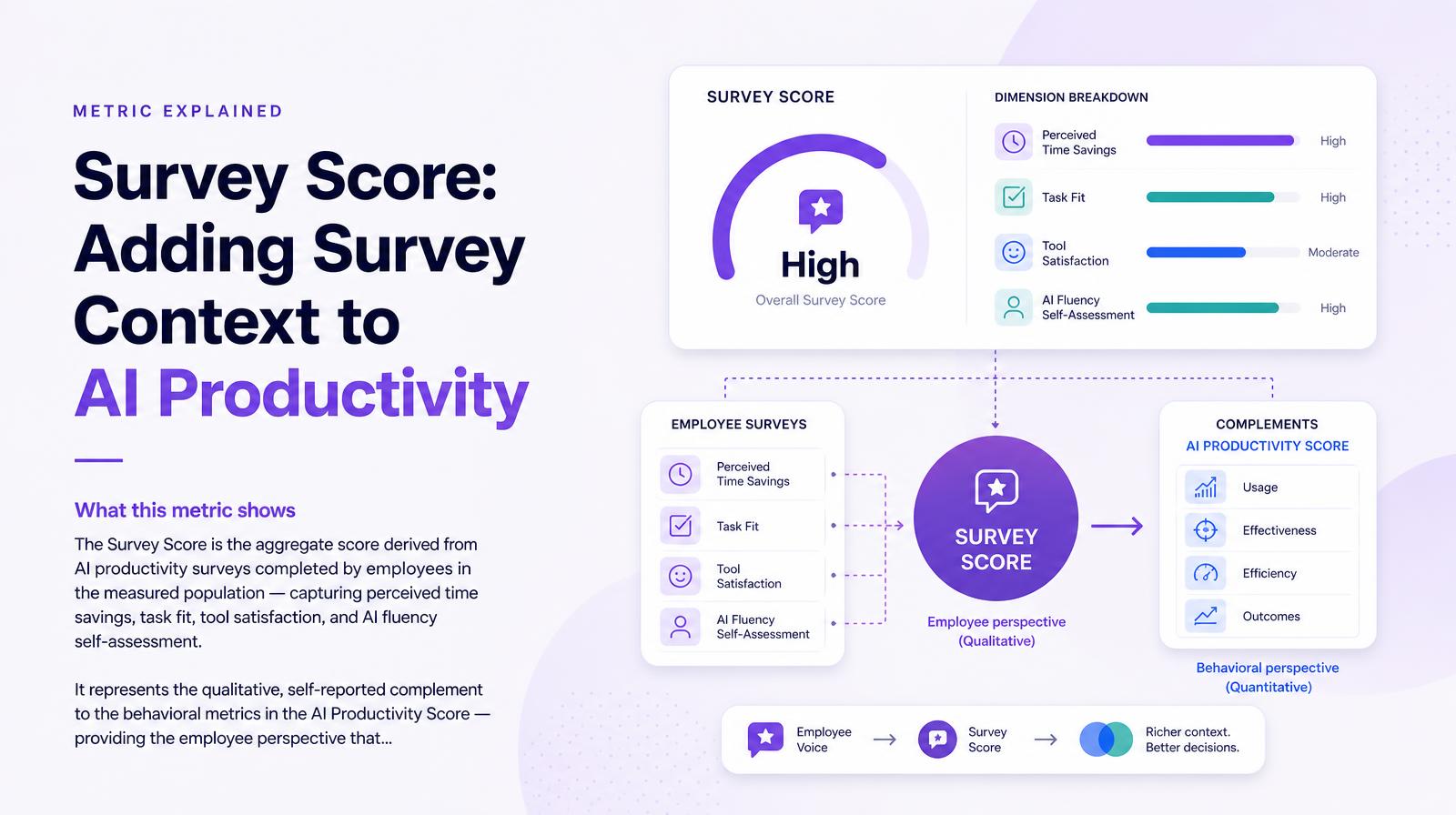
The Survey Score is the aggregate score derived from AI productivity surveys completed by employees in the measured population, capturing perceived time savings, task fit, tool satisfaction, and AI fluency self-assessment. It represents the qualitative, self-reported complement to the behavioral metrics in the AI Productivity Score, providing the employee perspective that telemetry cannot capture, including how employees feel about AI tools and whether they believe the tools are improving their work.
Why it matters
Survey Score alongside behavioral telemetry data is where the most actionable productivity insights emerge. When the Survey Score and the behavioral AI Productivity Score diverge, it signals a perception-reality gap: employees reporting high satisfaction with AI tools while telemetry shows low output gains (over-confidence in AI effectiveness), or employees reporting frustration while output data shows genuine productivity improvement (inadequate enablement communication). Both scenarios require different interventions. The Survey Score is what makes that comparison possible.
The Larridin angle
Larridin's Survey Score is not a standalone satisfaction metric, it is designed to be read alongside the behavioral AI Productivity Score and the Avg. AI Usage days per week in the same tab. A high Survey Score with low behavioral Productivity Score is the adoption paradox: employees believe they are being productive with AI, but the system-measured output data doesn't confirm it. That is the pattern METR's research documented, developers perceiving 20% faster work while being measurably slower on complex tasks. Survey Score makes the comparison possible without requiring a separate research engagement.
Related AI Productivity Metrics
Common questions
What is the Survey Score in the context of AI productivity?
The Survey Score is an aggregate score from AI productivity surveys that captures employees' perceived time savings, task fit, tool satisfaction, and AI fluency self-assessment.
Why is the Survey Score important for C-suite executives?
The Survey Score helps identify perception-reality gaps by comparing employee-reported satisfaction with AI tools against actual productivity data, guiding necessary interventions.
How does Larridin's Survey Score differ from a standalone satisfaction metric?
Larridin's Survey Score is designed to be used alongside the AI Productivity Score and Avg. AI Usage to provide a comprehensive view of AI tool effectiveness.
What does a high Survey Score but low behavioral Productivity Score indicate?
This scenario, known as the adoption paradox, suggests employees believe they are productive with AI, but system-measured output data does not support this belief.