
Enterprise AI Measurement Guide
AI Productivity
AI Productivity Score
What do the Adjusted and Raw views of the AI Productivity Score show, and how do they differ?
What it shows
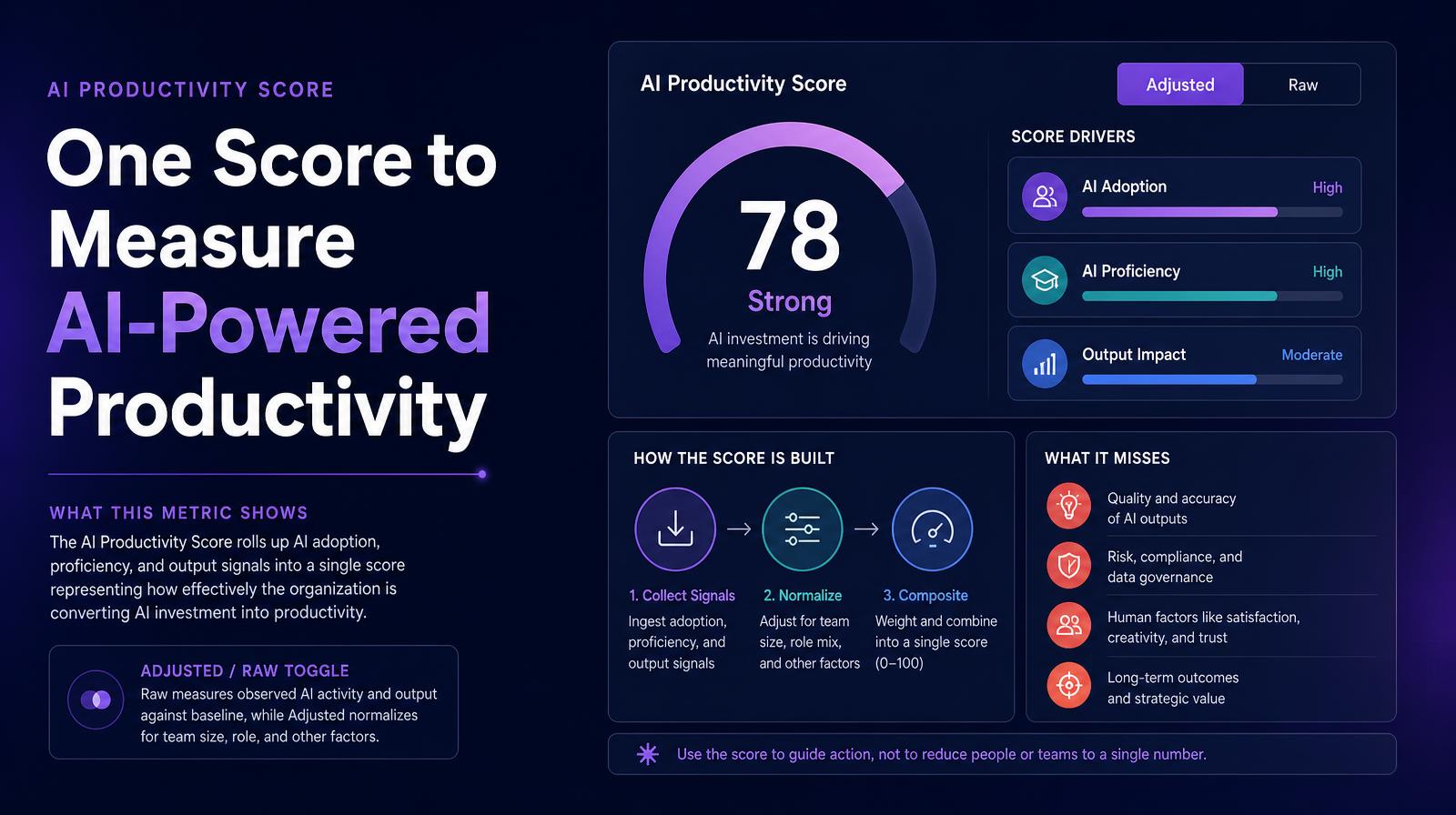
The AI Productivity Score is a composite metric that rolls up AI adoption, proficiency, and output signals into a single score representing how effectively the organization is converting AI investment into productivity. The Adjusted/Raw toggle shows two views: Raw measures observed AI activity and output against baseline, while Adjusted normalizes for team size, role, and tenure, making cross-department and cross-org comparisons meaningful rather than misleading.
Why it matters
A single AI Productivity Score gives boards and CEOs the executive summary they need without requiring them to navigate five separate dashboards. But a score alone is incomplete without understanding its inputs, an org can post a high Raw score driven entirely by one department while others remain at zero. The Adjusted view is what makes the score governable: it removes the noise of team composition and surfaces genuine productivity differences that reflect AI tool effectiveness and proficiency, not just headcount or seniority distribution.
The Larridin angle
The Raw/Adjusted toggle is particularly important when comparing scores across quarters or after a team restructure. A score that rises because the org hired 20 senior engineers into an AI-heavy team has a different meaning than a score that rises because existing engineers improved their AI proficiency. Larridin's Adjusted view separates those two stories, giving leadership the evidence to distinguish structural change from genuine capability improvement.
Related AI Productivity Metrics
Common questions
What does the AI Productivity Score measure?
The AI Productivity Score measures how effectively an organization converts AI investment into productivity by combining AI adoption, proficiency, and output signals into a single score.
How does the Raw view differ from the Adjusted view in the AI Productivity Score?
The Raw view measures observed AI activity and output against a baseline, while the Adjusted view normalizes for team size, role, and tenure to enable meaningful cross-department and cross-organization comparisons.
Why is the AI Productivity Score important for the C-suite?
It provides a concise executive summary of AI productivity, allowing leaders to understand productivity differences that reflect AI tool effectiveness and proficiency without being misled by team composition.
How can the Adjusted view help in understanding productivity changes after a team restructure?
The Adjusted view distinguishes between productivity changes due to structural changes, like hiring, and genuine improvements in AI proficiency, providing clearer insights into capability improvements.