


Larridin
TL;DR
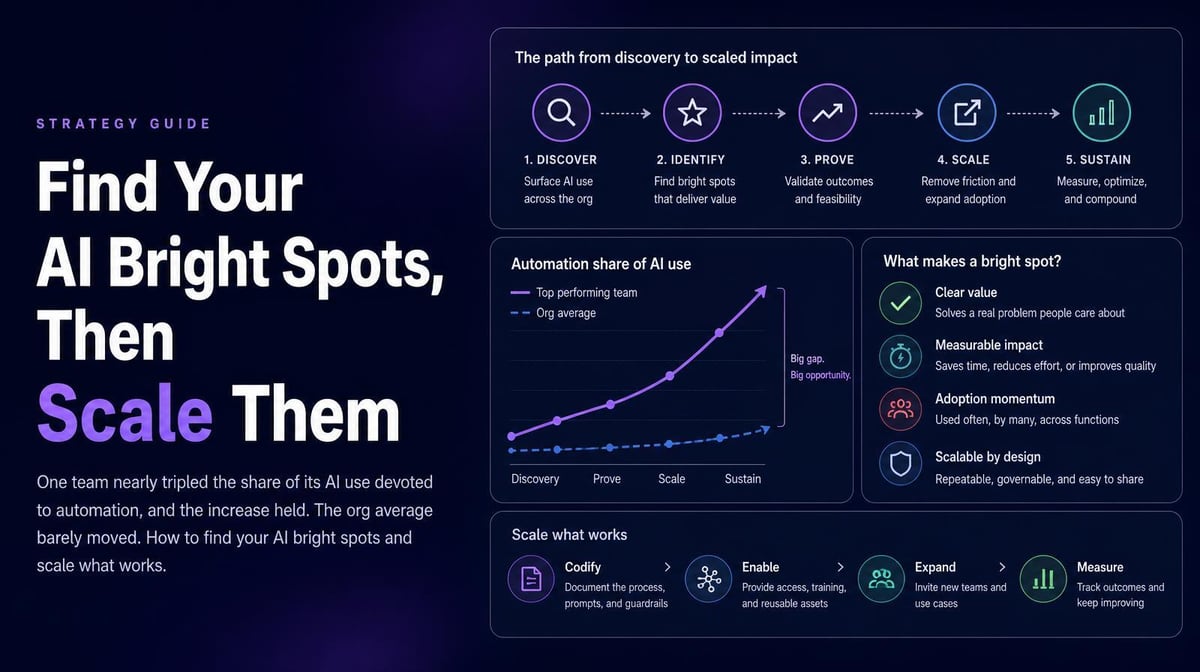
Short answer: The fastest way to scale AI adoption is to copy the teams inside your company that already made it work. Org-wide averages hide them. Look for sudden, sustained jumps in a team’s AI use case mix or leverage, find out what changed, and spread that specific practice to similar teams.
Key wins:
- Find proven AI practices in your own org, not in vendor case studies.
- Scale what works for your workflows and data.
- Focus enablement where a small change moves a large group.
Who it’s for: CAIOs, COOs, and transformation leads responsible for scaling AI.
What’s a Spark Insight? Sparks are short, data-backed findings Larridin surfaces from how AI is actually used across an organization. This post draws on several of them.
Quick Answers
If you’re asking… | The answer |
|---|---|
What is an AI bright spot? | A team showing unusually high estimated AI leverage or a sustained shift in AI use cases that deserves a closer look. |
Why don’t org dashboards show them? | They average a small team’s change into a flat company number. One team's automation share nearly tripled, but the org-wide share hardly moved. |
How do I find them? | Track AI use cases and leverage by department, week over week, and flag sustained jumps. |
How do I scale what they do? | Find the specific change (a workflow, prompt, connector, or person), package it, and roll it out to teams with similar work. |
What We Hear From Leaders
- AI adoption is flat company-wide. Our rollout has stalled.
- We need another training program.
The answer may already be running in one of your teams.
What you struggle with | What you need | How Larridin helps |
|---|---|---|
Flat org-wide AI metrics | Department-level change, week over week | AI Use Cases Advanced Report tracks eight use case categories by department |
No idea which teams get the most value | Leverage by department, not just users | AI Workforce shows AI Leverage and Agent FTE per department |
Generic training that doesn’t stick | Proven practices from your own teams | Work-type output shows which tasks AI does most for each team |
The Data: Small Teams, Big Signals
A jump the org never saw. In one customer’s instance, the share of Billing Operations’ AI activity classified as Admin & Ops Automation went from 18% in week one to 53%, then 61%, and held at 56% for the next three weeks. Company-wide, the same category stayed flat at 11–12%.
Leverage doesn’t follow headcount. In another instance, Customer Experience had one AI user and posted 127.2% AI leverage (an estimated 1.27 Agent FTE). Engineering had 10 AI users and posted 6.5% (0.65 FTE). A two-person group reached 1.78 FTE, while Sales had 6 users and was under 3%.
Tiny teams carrying the numbers. In a third instance, a 345-person org, Finance (3 users) and HR (4 users) led on AI leverage at 1.8% and 1.5%. Quality Assurance (53 users) and Quality Control (50 users) sat at 0.0%. About 100 AI users across two departments registered almost no estimated AI leverage.
Why Copy Internal Bright Spots Instead of External Playbooks?
An internal bright spot has already worked with your data, systems, security rules, and culture. Its practice is specific, such as a shared prompt, a connector, a new workflow, or one manager’s habit, and it can be taught. Similar teams trust a peer’s result more than a vendor’s case study.
What Should I Look For?
Three signals:
- A sudden, sustained shift in use case mix, like a jump into automation or analysis that holds for weeks.
- Leverage far above headcount, where a small team produces outsized AI-driven output.
- Rising output alongside falling friction in the team’s workflows.
Then ask the team what changed that week. The answer is usually concrete.
How to Find and Scale AI Bright Spots
- Track use cases and leverage by department weekly, not just org-wide.
- Flag sustained jumps, for example a category share that doubles and holds for three or more weeks.
- Interview the team to find the specific change.
- Package it as a prompt, skill, connector setup, or workflow guide.
- Roll it out to look-alike teams with similar work, and measure whether their numbers move.
FAQ
What is positive deviance in AI adoption?
Learning from people or teams who succeed with the same resources as everyone else, then spreading their practices.
How long should a jump last before it counts?
Three or more weeks is a reasonable bar, so one-off spikes don’t mislead you.
What if the bright spot is one person?
That’s common. Pair them with peers in similar roles and turn their workflow into something reusable.
Spark a discussion that moves your AI strategy forward. [Get your first Sparks]