

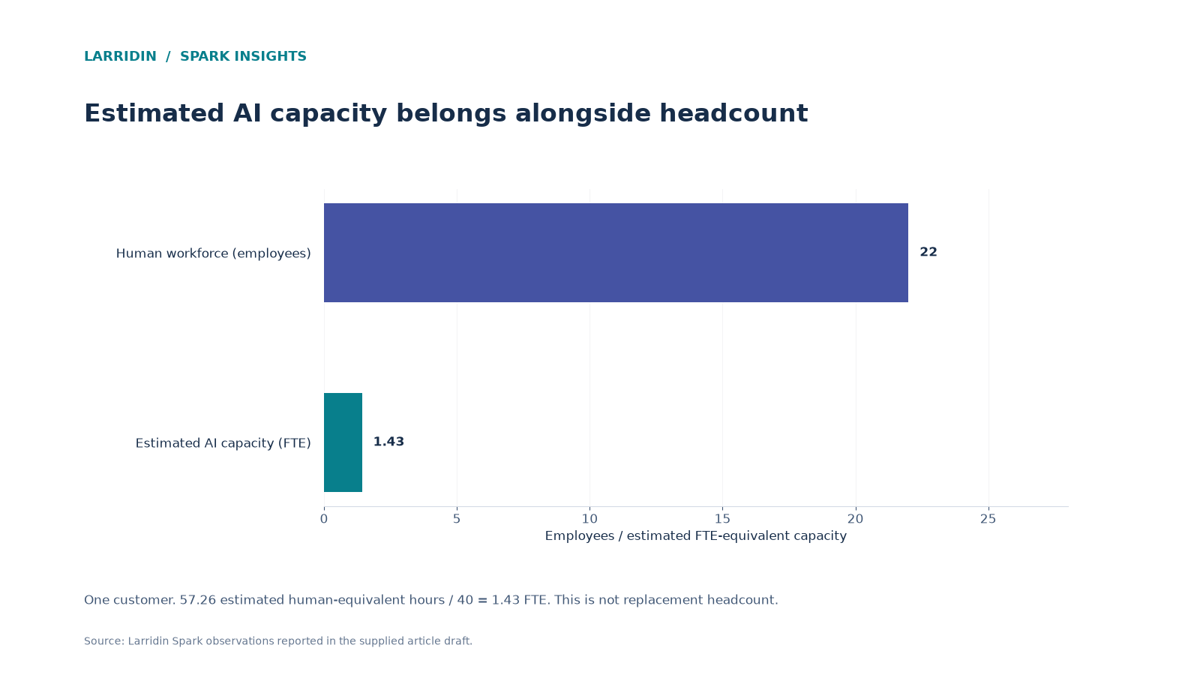

CFOs and CHROs think in headcount. Agent FTE expresses estimated AI capacity in the same terms, including capacity the system can't match to an employee.
TL;DR
The Short Answer
Agent FTE expresses AI-generated work as estimated full-time-equivalent capacity. In one Larridin customer, AI contributed an estimated 57.26 human-equivalent hours per week, or 1.43 FTE, alongside a 22-person workforce. In another, 30.6 of 48.7 Agent FTE (63%) wasn't matched to an employee. Together, the findings show why leaders need to measure both AI capacity and where that capacity is attributed.
Key Wins
- Translate AI work into a capacity metric CFOs and CHROs already use
- Identify AI activity that isn't matched to an employee.
- Plan capacity with AI included, not as an afterthought
What’s a Spark Insight?
A Spark Insight is a data-backed finding Larridin surfaces automatically from how your teams actually use AI, flagging the patterns worth a leadership conversation.
Who This Matters To
CFO · CHRO · CIO
Quick Answers
| If you’re asking… | The answer | Go deeper |
|---|---|---|
| What is Agent FTE? | A measure of AI work expressed as full-time-equivalent capacity, so it can be compared with human headcount. | Definition |
| How do you calculate Agent FTE? | Divide estimated human-equivalent hours of AI work by a standard full-time workweek. In one customer, 57.26 hours divided by 40 equaled about 1.43 FTE. | How it works |
| Can AI work go unmatched to employees? | Yes. At one customer, 30.6 of 48.7 Agent FTE wasn't matched to an employee. That doesn't necessarily mean the work had no owner. | The data |
| Why measure AI in headcount terms? | Because headcount is how finance and HR already plan capacity and cost. | Why it matters |
Finance and HR leaders plan in headcount. AI capacity is often reported in hours or tasks completed, which can be hard to translate into a workforce plan. Agent FTE bridges the two.
What You’re Struggling With, and How to Fix It
| What you’re struggling with | What you actually need | How Larridin helps | Proof from Spark data |
|---|---|---|---|
| “I can’t explain AI value in budget terms.” | A capacity metric finance already uses | Converts AI work into full-time-equivalent capacity | One org: 57.26 hrs/week = 1.43 FTE |
| “Our headcount plan ignores AI.” | AI capacity alongside human headcount | Shows estimated AI capacity alongside human headcount | 22 employees plus an estimated 1.43 AI FTE of capacity |
| “Some AI work isn’t matched to an employee.” | Visibility into AI activity not matched to an employee | Separates attributed and unattributed Agent FTE | One org: 30.6 of 48.7 Agent FTE not matched to an employee |
| “AI capacity changes month to month.” | Trend data | Tracks Agent FTE over time | One org: Agent FTE fell from 70.2 to 48.7 over four weeks |
What This Means for You
If you’re a CFO
The question you’re asked: “What is AI worth in capacity terms?”
What to do: Use Agent FTE alongside headcount when planning capacity. Track the estimate over time, but don't treat it as a count of employees AI can replace.
For more on measuring AI investment against financial outcomes, see AI Monitoring for CFOs.
If you’re a CHRO
The question you’re asked: “How does AI change our workforce plan?”
What to do: Include estimated AI capacity in workforce planning. Investigate activity that isn't matched to employees before drawing conclusions about who owns the work.
For more on workforce AI readiness, see AI Monitoring for CHROs.
If you’re a CIO
The question you’re asked: “Who is responsible for unattributed AI work?”
What to do: Investigate unmatched AI activity. Check for shared logins, service accounts, or stale sessions before deciding whether there's an ownership gap.
For more on enterprise-wide AI visibility, see AI Monitoring for CIOs.
What the Sparks Data Shows
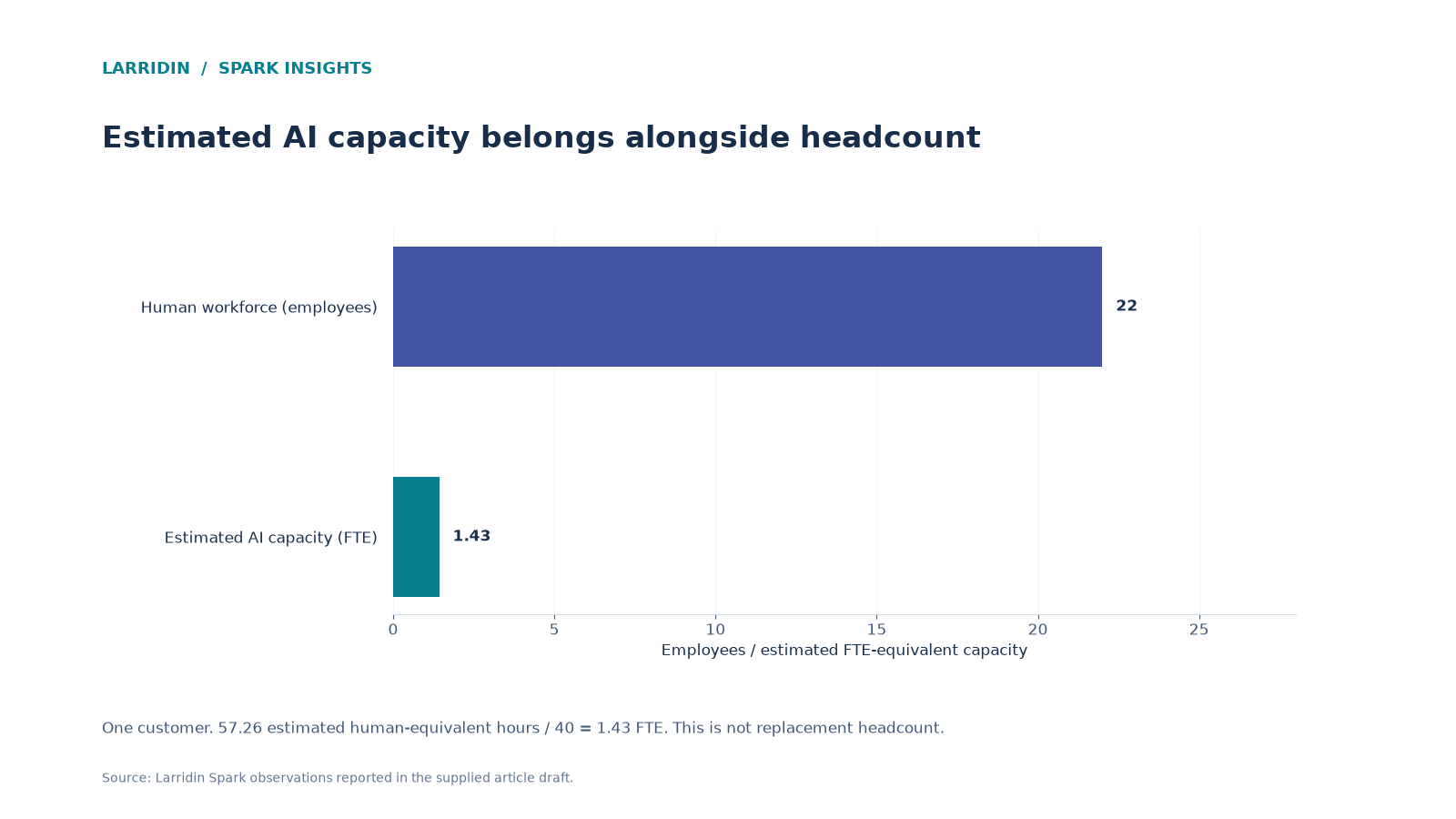
- 1.43 FTE: In one customer, AI contributed an estimated 57.26 human-equivalent hours per week, equivalent to 1.43 FTE alongside a 22-person workforce.
- 30.6 of 48.7 FTE: In a separate, roughly 3,000-person organization, 63% of measured Agent FTE wasn't matched to an employee. Total Agent FTE fell from 70.2 to 48.7 over four weeks.
What Is Agent FTE?
A way to express AI work as full-time-equivalent capacity.
Agent FTE converts estimated human-equivalent hours of AI work into full-time-equivalent capacity. That puts AI's contribution in a unit finance and HR already use, without equating it to employees hired or replaced.
Spark callout: In one organization, AI contributed an estimated 57.26 human-equivalent hours per week, or 1.43 FTE of additional capacity alongside 22 employees.
Why Does Unattributed AI Work Matter?
Because a significant share of measured AI activity may not map cleanly to employees.
In one roughly 3,000-person organization, 30.6 of 48.7 Agent FTE (63%) appeared under “Not matched to an employee.” Shared logins, service accounts, or stale sessions may explain some of that gap. Leaders need to investigate before concluding the work lacks an accountable owner.
Myth: All AI activity maps to individual employees.
Reality: At one customer, 63% of Agent FTE wasn't matched to an employee.
How Should Leaders Use Agent FTE?
As a planning input next to headcount, tracked over time.
Agent FTE can move quickly. In one org, it fell from 70.2 to 48.7. Treat it as a trend in capacity planning, and check attribution and work quality alongside the estimate.
How to Measure This in Your Own Org
- Estimate AI work in human-equivalent hours. Use observed activity and the assumptions behind your capacity estimate.
- Convert to FTE. Divide estimated hours by the standard full-time workweek.
- Separate matched and unmatched activity. Investigate records that can't be linked to an employee.
- Track the trend. Use Larridin's AI Impact to put estimated AI capacity alongside spend and departmental outcomes.
Frequently Asked Questions
Does Agent FTE mean AI replaces employees?
No. It’s a way to measure AI capacity in familiar terms. How that capacity is used is a planning decision.
Why would AI work not be matched to an employee?
Shared logins, service accounts, and stale sessions can prevent activity from being matched to an employee. That doesn't necessarily mean the work has no owner.
How accurate is Agent FTE?
It’s an estimate based on measured AI activity and assumptions about human-equivalent work.
Spark a Discussion About Your AI Capacity in Headcount Terms
See estimated AI capacity alongside headcount, investigate unmatched activity, and bring the findings to your next workforce planning meeting.