

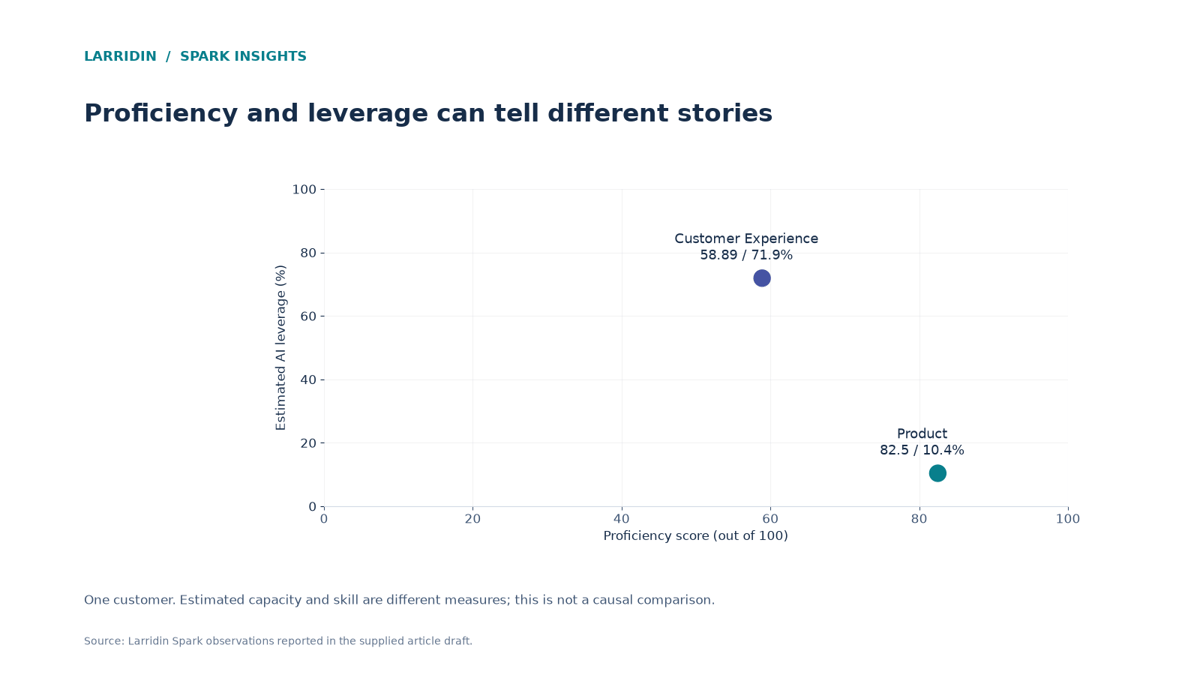

The team with the best AI skills isn’t always the team getting the most out of AI. Spark data shows how proficiency and leverage can differ across teams, and why enablement should measure both.
TL;DR
The Short Answer
AI proficiency measures how skillfully people use AI, while AI leverage estimates the capacity AI adds relative to a team's human workforce. They don't necessarily move together. In one Larridin customer, the Product team scored 82.5 on proficiency but showed 10.4% leverage, while Customer Experience reached 71.9% leverage with a proficiency score of 58.89. Measure both before deciding where teams need support.
Key Wins
- See why your most AI-skilled team may not be your highest-leverage team
- Find teams with high AI leverage despite lower proficiency scores, and learn from them
- Set enablement goals that track capacity, not just skill scores
What’s a Spark Insight?
A Spark Insight is a data-backed finding Larridin surfaces automatically from how your teams actually use AI, flagging the patterns worth a leadership conversation.
Who This Matters To
CHRO · CIO · Team leads
Quick Answers
| If you’re asking… | The answer | Go deeper |
|---|---|---|
| What is the difference between AI proficiency and AI leverage? | Proficiency measures how skillfully people use AI. Leverage estimates the capacity AI adds relative to a team's human workforce. | Definitions |
| Does higher AI proficiency mean more leverage? | Not necessarily. In one org, the team with the highest proficiency (82.5) had 10.4% leverage, while a team with lower proficiency (58.89) reached 71.9%. | The data |
| Which teams show the most AI leverage? | You can't tell from skill scores alone. Compare proficiency and leverage by team, then investigate the gaps. | Why it happens |
| How should I measure AI enablement? | Track proficiency and leverage together by team, and look for gaps between them. | How to measure |
It's tempting to assume the team with the strongest AI skills will generate the most AI-driven capacity. But in one Larridin customer, proficiency and leverage told very different stories.
What You’re Struggling With, and How to Fix It
| What you’re struggling with | What you actually need | How Larridin helps | Proof from Spark data |
|---|---|---|---|
| “Our most technical team should be leading on AI, but leverage is elsewhere.” | A way to see proficiency and leverage separately | Scores proficiency and leverage for each team side by side | One org: Product proficiency 82.5, leverage 10.4% |
| “I don’t know which team to copy.” | A view of how proficiency and leverage compare across teams | Highlights teams with high leverage relative to proficiency | One org: Customer Experience 71.9% leverage at 58.89 proficiency |
What This Means for You
If you’re a CHRO
The question you’re asked: “Which teams need more AI training?”
What to do: Don’t assume low leverage means low skill. Check both metrics before deciding whether a team needs training or workflow changes.
For more on measuring workforce AI readiness, see AI Monitoring for CHROs.
If you’re a CIO
The question you’re asked: “Where is AI adding capacity?”
What to do: Compare proficiency and leverage by team. Study high-leverage workflows before deciding what could work elsewhere.
For more on connecting AI adoption to organizational outcomes, see AI Monitoring for CIOs.
If you lead a team
The question you’re asked: “Why isn’t our AI skill turning into results?”
What to do: Look for repeatable tasks where AI can run as part of the process rather than as a one-off assist.
For more on developing AI skills across your team, see The AI Proficiency Maturity Model.
What the Sparks Data Shows
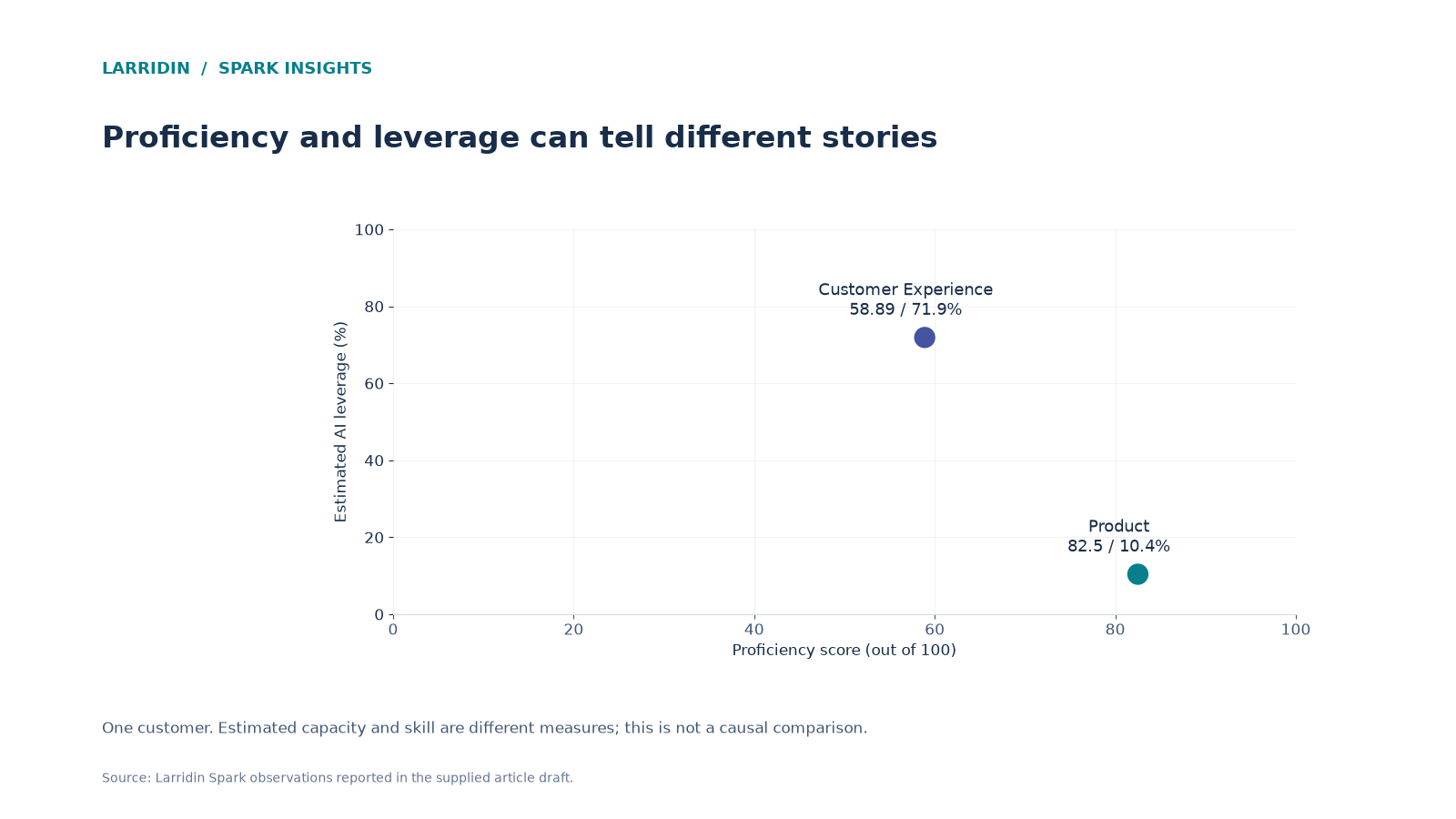
- 82.5 / 10.4%: The Product team’s proficiency score (out of 100) and AI leverage.
- 58.89 / 71.9%: The Customer Experience team’s proficiency score and AI leverage in the same org.
Why Isn’t the Most AI-Skilled Team the Highest-Leverage Team?
Because knowing how to use AI well doesn't necessarily mean a team has the same opportunities to put it to work.
Proficiency is about the person: prompt quality, feature use, breadth. Leverage estimates the capacity AI adds relative to the team's human workforce. A highly skilled team doing varied, judgment-heavy work may use AI well yet see less AI-added capacity. A team with repeatable, high-volume work may show higher leverage even with moderate proficiency.
In one Larridin customer, the Product team scored 82.5 on proficiency but showed 10.4% leverage. Customer Experience scored lower on proficiency (58.89) but reached 71.9% leverage.
Spark callout: Same organization, different results. Product had the highest proficiency score but much lower leverage than Customer Experience.
Myth: The most AI-skilled team gets the most leverage from AI.
Reality: In one org, the team with the highest proficiency had the lowest leverage of the two compared.
What Should Enablement Teams Measure?
Both proficiency and leverage, by team, with attention to the gap between them.
A team with high proficiency and low leverage may have opportunities to apply AI to more of its work. A team with lower proficiency and high leverage may benefit from additional skill development. Compare both measures, then look at the team's workflows before deciding what kind of support will help.
How to Measure This in Your Own Org
- Score proficiency by team. Use behavioral data, not self-reports.
- Measure leverage by team. Estimate the capacity AI adds relative to each team's human workforce.
- Plot one against the other. Find teams with large gaps in either direction.
- Investigate the gaps before choosing a fix. Use Larridin's AI Fluency and AI Impact views to compare skills and estimated capacity by team. Then decide whether training or workflow changes make sense.
Frequently Asked Questions
What is AI leverage?
AI leverage estimates the capacity AI contributes relative to a team's human workforce. It's a capacity measure, not proof of financial return.
What is AI proficiency?
AI proficiency measures how skillfully people use AI, including prompt quality, use case breadth, and use of advanced features.
Can a team have high leverage with low proficiency?
Yes. In one org, Customer Experience reached 71.9% leverage with a proficiency score of 58.89.
Spark a Discussion About Where AI Adds Capacity
Compare AI fluency and capacity across your teams, and bring the findings to your next enablement review.