

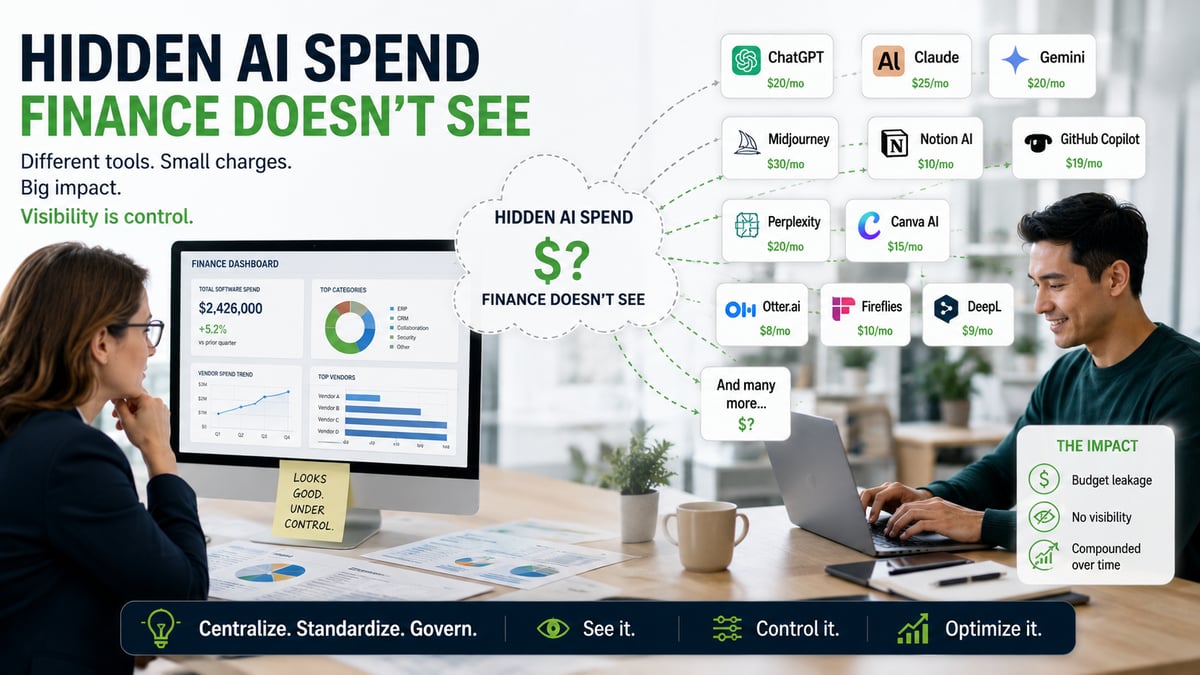

Ask your finance team what they’re spending on artificial intelligence (AI) this month. If they can give you one confident number that covers everything, they’re in a very small minority.
Key Takeaways
- Larridin scan data shows an average of 18% of enterprise AI spend is completely unattributed, meaning it can’t be connected to a team, use case, owner, or business outcome.
- Zylo found that 78% of IT leaders reported unexpected charges tied to AI features or consumption-based pricing.
- Enterprise AI spend comes from at least four sources that are billed and tracked differently, which is why one reliable total is so hard to produce.
Why Getting One Total Is Hard
In a traditional software environment, total spend is usually straightforward: pull the license contracts, add them up, and review the renewals. AI doesn’t work that way.
Enterprise AI spend can come from many places, such as SaaS seat licenses for tools like Copilot or ChatGPT Enterprise, pay-per-token application programming interface (API) costs from developers and product teams, or agents running around the clock. Each source behaves differently, appears in different systems, and may have a different owner.
That’s why finance can see the charge without seeing the AI activity behind it. Token Spend & Insights consolidates those spend sources into one view so leaders can see what they’re paying for, who owns it, and whether it’s producing value.
Where the Hidden Spend Lives
1. Personal and Team-Level Shadow AI
Shadow AI can happen when a marketing team subscribes to an AI writing tool using a corporate card, and the charge lands somewhere in expense accounts without being recognized as AI spend. Finance sees the cost, but they don’t see the tool, the use case, or the value.
2. AI Features Inside Existing Software
AI features are now built into tools enterprises already use. Some stay bundled into the base contract, while others surface later as premium features, usage charges, or renewal increases. Because they don’t always require a new procurement process, they may never get tagged as AI spend at all.
3. Orphaned Agents With No Owner
Agents created during projects and never decommissioned can keep consuming token budget long after the pilot ends. Larridin’s enterprise scans find an average of 47 orphaned agents per organization. Each one represents ongoing spend with no owner and no outcome attribution. The full scope of the problem is covered in our post on agent cost governance.
4. Agent Spend Classified as Infrastructure
When agents call models through cloud provider APIs, the cost often appears in the general cloud infrastructure bill. Finance sees AWS or Azure usage. They don’t see which agent generated it, what it was doing, or whether the cost was expected.
What a Complete Spend Picture Requires
Complete AI spend visibility means more than adding up invoices. It requires:
- Discovery of every AI tool in use, including shadow AI, embedded features, cloud model usage, and agent activity
- Attribution of every cost to a team, use case, and owner, so spend can be evaluated and governed
- Separation of human AI spend from agent spend, because the two cost patterns behave differently
- Real-time totals instead of end-of-month reconciliation, so teams can respond to spend patterns before they become overruns
The Token Spend & Insights dashboard surfaces this complete picture. The average first scan finds 18% of spend previously unattributed and 47 orphaned agents no one knew were running. The financial case for visibility is also covered in the AI ROI measurement guide.
Frequently Asked Questions
Why is enterprise AI spend so difficult to track?
Because it comes from multiple sources, gets billed in different ways, and appears in different systems. Seat licenses, token usage, cloud model API calls, and agent activity each need to be captured separately and consolidated. Without a system built for that problem, finance teams are working from an incomplete picture by default.
What percentage of enterprise AI spend is typically unattributed?
Larridin scan data shows an average of 18% of enterprise AI spend can’t be attributed to a specific team, use case, owner, or business outcome. In organizations that deployed AI quickly without building measurement infrastructure first, that number may be higher.
How does shadow AI create hidden spend?
Shadow AI tools are purchased outside official procurement channels, so they may appear in expense reports or corporate card statements without being tagged as AI spend. Finance sees the charge but can’t connect it to a business use case, team, owner, or governance framework.
What is the business case for AI spend visibility?
Visibility creates two concrete benefits. It enables chargeback, which aligns AI costs with the business units generating them and creates accountability. It also surfaces reallocation opportunities: unattributed spend and orphaned agent costs identified through discovery can help fund the next round of strategic AI investments without requiring additional budget.
Get Your Complete AI Spend Picture
If your finance team can’t confidently answer what you’re spending on AI this month, budget decisions are already being made from partial evidence. Larridin shows the full spend picture across tools, agents, owners, and outcomes, so leaders can decide where to invest, cut, govern, or reallocate with evidence.
Book a discovery call to see your full AI spend picture.