


Can organizational governance be both a creative act and a force multiplier? When it comes to AI in the enterprise, it has to be both.
There’s an old and oft-cited saying that applies to AI governance: “If you want to go fast, go alone; if you want to go far, go together.”
The Larridin State of Enterprise AI 2026 report shows this saying in action:
- Enterprises are finding that roughly half of their AI usage is unsanctioned, “shadow” AI. This isn’t subversion or defiance; it’s individual employees seeking to go faster, and more effectively, in their work by “going alone” as they experiment with new AI tools.
- But the #1 predictor of ROI success in the enterprise? The existence of an organization-wide framework allows people to “go together” with solutions that prove their value, and that can be scaled across departments and job functions.
Allowing, or even encouraging, your employees to experiment with new AI tools allows for creative expression. Not all the experiments will work, but the ones that do will drive the AI transformation effort forward.
While pulling together an AI governance strategy, getting agreement on it, and sharing it with your teams is where the force multiplier part comes in. Scaling successful experiments into new ways of people getting their work done, across your organization, only happens effectively with a governance framework in place.
This Workbook brings the AI Governance Guide to life. It has two parts, working together to help you create and implement governance for your organization:
- The Enterprise AI Governance Checklist helps you make sure that you have all the pieces you need for an effective framework.
- How to Govern Effective AI in the Enterprise shows how to treat AI agents as if they were employees, describes when it’s effective to do so - and when it’s best not to.
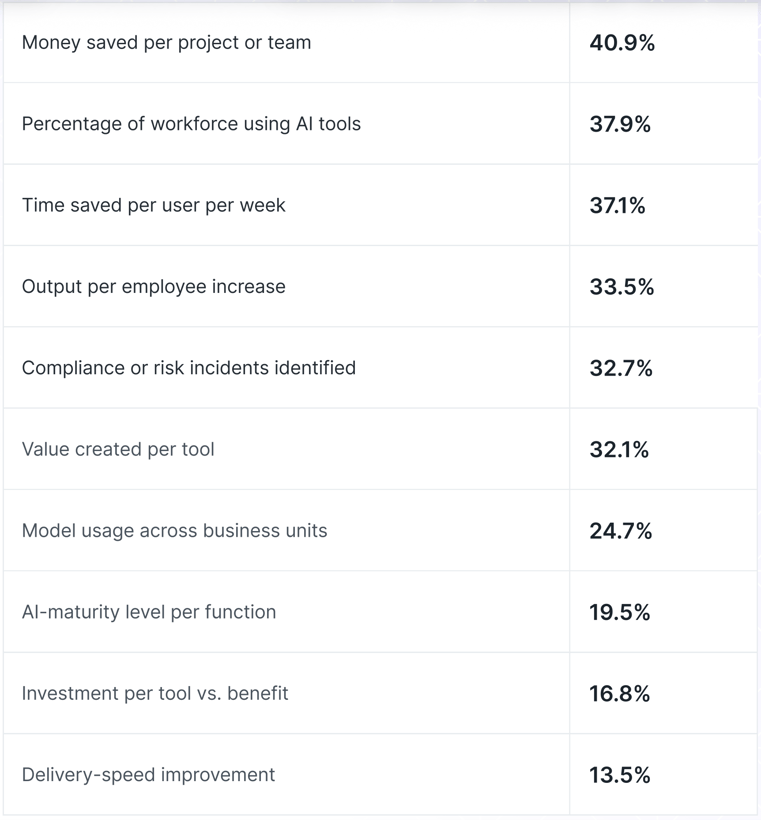
Figure 1, from the Larridin State of Enterprise AI 2026 report, shows what enterprise companies track for their AI deployments. In most cases today, companies don’t have solid, auditable basis for such figures.
Figure 1. Metrics that companies track for their AI deployments.
(Source: The State of Enterprise AI 2026)
#1 The Enterprise AI Governance Checklist: From Regulatory Compliance to Operational Control
Your organization is using more AI than you know, regulators are moving faster than you expect, and agents are expanding scope without asking permission.
What should you do? This checklist helps you bring all three under control.
When Governance Cannot Wait
Three forces are converging, and each one alone would justify an urgent governance program.
- “Shadow” AI sprawl is accelerating. The average enterprise discovers 3-5 times more AI tools than IT estimates during its first audit. Employees adopt tools that help them work faster, but resourcefulness without visibility means sensitive data flows into consumer-tier tools with no enterprise agreements and no audit trail. The Shadow AI Guide documents how organizations routinely find 200 to 300 AI tools where they expected 60 to 70.
- Regulatory pressure is now enforceable. The EU AI Act becomes fully applicable in August 2026, with fines up to 35 million EUR or 7% of global turnover. The NIST AI Risk Management Framework, updated in 2025 to address generative AI and third-party model risks, is increasingly referenced by sector regulators including the SEC, FTC, and FDA. ISO 42001 is becoming a procurement prerequisite. Organizations without documented governance are not just exposed to fines; they are losing deals.
- Agentic AI is expanding scope without guardrails. Gartner projects 40% of enterprise applications will embed AI agent capabilities by the end of 2026. Agents send emails, modify databases, and chain autonomous decisions, while a single misconfigured agent can exfiltrate data at machine speed.
The Governance Checklist
Organized by domain. The prioritization section below tells you what to tackle first.
1. Tool Inventory and Approval Process
- Conduct a comprehensive AI tool audit across browser extensions, SaaS subscriptions, API integrations, and expense reports
- Deploy shadow AI detection at the browser and endpoint level; network monitoring alone cannot distinguish enterprise from consumer accounts
- Establish a tiered approval process: 48-hour initial risk screening, two-week standard evaluation, full security review only for high-risk tools
- Create a living inventory that updates continuously, not a quarterly spreadsheet
2. Data Classification and Handling
- Define sensitive data categories explicitly: customer PII, protected health information, source code, financial projections, M&A data, and credentials
- Map data flows for every discovered tool: what goes in, whether the tool retains or trains on it, and where it is stored geographically
- Implement real-time data protection at the browser level, intercepting sensitive data before it leaves your environment
- Document data processing agreements for every approved tool
3. Access Controls and Authentication
- Enforce SSO and enterprise authentication for all approved AI tools; no personal accounts used to work with organizational data
- Implement role-based access control (RBAC) so that different teams interact with different tools and data tiers
- Establish offboarding protocols that revoke AI tool access alongside standard IT deprovisioning
4. Risk Assessment for Each AI Tool
- Classify every tool across four dimensions: data handling, training data policies, data sovereignty, and enterprise vs. consumer tier
- Assess security posture: encryption, SOC 2 or ISO 27001 certification, penetration testing history
- Map each tool against EU AI Act risk categories and document your classification rationale
- Reassess every tool quarterly – vendors change data practices and regulations take effect
5. Compliance Mapping
- Map your inventory against EU AI Act requirements: risk classification, transparency documentation, human oversight obligations
- Align controls with the NIST AI RMF core functions: Govern, Map, Measure, Manage
- Layer sector-specific regulations: HIPAA, PCI-DSS, GDPR, SOX as applicable
- Evaluate ISO 42001 certification as a governance maturity milestone
6. Incident Response for AI Failures
- Define what constitutes an AI incident: data leakage, agent malfunction, hallucination-driven errors, compliance violations
- Establish a dedicated AI incident response workflow, more than a footnote in your general IR plan
- Build rollback capabilities for agentic systems; if an agent sends 500 incorrect emails, can you reverse it?
- Conduct post-incident reviews that feed into policy updates
7. Vendor Assessment Criteria
- Require an AI-specific vendor security questionnaire covering training policies, retention, subprocessors, and model provenance
- Verify enterprise-tier data protections contractually; marketing claims are insufficient
- Include AI-specific procurement clauses: no training on customer data, data deletion on termination, audit rights
8. Employee Usage Policies
- Publish a clear AI Acceptable Use Policy that employees actually read
- Communicate the “why” behind restrictions; employees who understand that consumer versions of LLM-powered tools train on their inputs will voluntarily use enterprise versions
- Provide approved alternatives for every blocked tool
- Establish a no-blame reporting channel for employees who realize they have shared sensitive data with an unauthorized tool
9. Monitoring and Audit Trails
- Deploy continuous monitoring tracking AI tool usage by individual, team, and department
- Track unauthorized AI use against a 3 to 4% unauthorized usage benchmark: usage above 10% means policies are too restrictive; near zero means stalled experimentation
- Log data flows with enough granularity to reconstruct any incident
- Generate board-ready governance dashboards quantifying risk posture and compliance coverage
10. Agentic AI-Specific Controls
- Define authority levels for every agent: read-only, advisory, action-taking with approval, or autonomous
- Set scope boundaries: time limits, action count limits, domain limits, and blast radius limits
- Establish escalation triggers that force human review: confidence thresholds, value thresholds, error accumulation
- Require full audit trails for every agent action, with triggers, inputs, decision logic, outcomes, and intervention points
How to Prioritize
You cannot implement all ten domains at once. Here is the sequencing that works.
Weeks 1 to 4: Visibility first. Tool inventory, shadow AI detection, data flow mapping. You cannot govern what you cannot see. This is Stage 1 of the AI Maturity Model, and everything else depends on it.
Weeks 5 to 8: Risk classification and policies. Classify every discovered tool, draft your acceptable use policy, establish the tiered approval process. Start with tools handling customer data, financial information, or regulated data.
Weeks 9 to 12: Data protection and compliance. Deploy browser-level data protection, map your inventory against EU AI Act and sector regulations, begin vendor assessments for highest-usage tools.
Months 4 to 6: Agentic controls and incident response. Build the agent governance framework, establish continuous monitoring, formalize your AI incident response plan.
This is not a one-time project. The AI Transformation Guide positions governance as an inner orbit discipline – a strategic constant that runs continuously. Reassess quarterly. Update as regulations evolve. Monitor benchmarks weekly.
The Governance-Innovation Balance
The biggest governance failure is not a data breach. It is building a program so restrictive that employees stop experimenting with AI entirely.
Samsung’s experience illustrates both sides. When engineers pasted proprietary code and meeting notes into consumer ChatGPT, the data exposure forced a company-wide restriction. The restriction was necessary, but the root cause was not reckless employees. It was the absence of enterprise-tier alternatives and governance infrastructure to make approved alternatives the easiest path.
The organizations that get this right share a principle: governance enables adoption rather than blocking it. The governance spectrum: educate, warn, monitor, restrict, block; gives you five possible responses instead of two. Most interactions should land in the first three.
A practical test: if your governance program’s primary output is a list of blocked tools, you have a prohibition program. If its primary output is a set of approved pathways with clear guardrails, you have governance that scales.
#2 How to Govern Agentic AI in the Enterprise
AI agents don’t wait for instructions. They act. Your governance framework needs to account for that, before agents are running in production.
Why Agentic AI Needs Its Own Governance Framework
Every previous generation of enterprise AI worked within a simple boundary: a human asked a question, the AI produced an answer, and the human decided what to do with it. Governance simply required that you control the data going in and out. That model is now obsolete.
AI agents act autonomously. They chain decisions across multi-step workflows and access enterprise systems. They modify data, send communications, and execute operations, without a human reviewing each step. An agent resolving a support ticket might pull account data, check order history, apply a discount, draft a response, and send it. Five actions, three system integrations, and one customer-facing communication, all before anyone reviews the output.
This is not theoretical. 23% of organizations are already scaling agentic AI deployments, with 39% experimenting (McKinsey’s 2025 State of AI report). Gartner projects 40% of enterprise applications will feature AI agents by the end of 2026. But a less-quoted Gartner forecast: over 40% of agentic AI projects will be canceled by 2027, largely due to governance failures and inadequate risk controls.
Your existing AI governance covers data flows, visibility, and compliance. That foundation is necessary but insufficient. It was designed for tools that process information, not systems that take action. Agents require a fundamentally different governance layer.
What Makes Agents Different from Copilots
Conflating agents with copilots is how organizations end up with structural governance gaps.
Copilots operate with a human in the loop. They assist a single task: drafting an email, suggesting code, summarizing a document. The human reviews, decides, and acts. The blast radius of a copilot-type mistake is bounded by the human in front of it. Copilot governance is primarily data governance.
Agents operate autonomously. They execute multi-step workflows, make sequential decisions, access multiple systems, and take real-world actions without step-by-step review. The blast radius is bounded only by the permissions the agent holds.
- A copilot drafts an email. A human reads it, edits it, clicks send.
- An agent reads incoming emails, classifies them, drafts responses, pulls CRM data, applies business rules, and sends; all in a loop, at scale, without human review.
The governance gap is categorical. Agents require governance over actions, scope, decisions, and accountability, dimensions that don’t exist in copilot frameworks. As AIGN Global’s framework notes: agentic systems are owned like tools, but require oversight akin to employees. They fall into a governance category that didn’t previously exist.
The Agentic AI Governance Framework
The framework has six pillars. Only the first one exists in most current programs.
1. Authorization: What Can Agents Do?
Every agent needs a defined permissible action set before production. Define authority levels: read-only (access data, modify nothing), advisory (recommendations only, human executes), action-taking with approval (agent acts, human signs off: the right starting point for most agents), and autonomous within scope (independent operation inside defined boundaries; reserved for proven agents).
Start every agent at the lowest authority level that allows it to function.
2. Oversight: Human-in-the-Loop Requirements
Define escalation triggers: when an agent must pause and hand off: confidence thresholds, value thresholds (dollar amount or customer impact), exception conditions, error accumulation management, and scope boundaries.
Singapore’s Model AI Governance Framework for Agentic AI launched in January 2026, the first state-backed framework of its kind. The framework emphasizes that oversight must be meaningful, not performative. A human rubber-stamping steps at speed is not oversight.
3. Auditability: Logging Every Decision and Action
Every action logged with full attribution: trigger, input data, decision, action taken, outcome, and human intervention points. The EU AI Act classifies some autonomous systems as high-risk, requiring documented decision-making. NIST’s CAISI issued a Request for Information in January 2026 targeting AI agent security; U.S. regulatory attention is intensifying.
74% of organizations cannot explain how an agent reached its conclusion. Deploy without audit trails and you cannot reconstruct what happened when something goes wrong.
4. Data Access: What Can Agents See and Modify?
Agents inherit data risks, plus they can modify data. Apply a “least privilege” standard aggressively. Document, for every agent: the data sources it reads, systems it writes to, data types it handles, and whether data crosses compliance boundaries.
Critical: agent data governance must be dynamic. An agent chaining steps may accumulate access across systems in ways no human user would. The compound access profile across an entire workflow matters more than any individual permission.
5. Failure Modes: What Happens When an Agent Goes Wrong?
Pre-define: How do you stop it? (Kill switches.) How do you reverse it? (Rollback capabilities.) How do you contain it? (Blast radius limits.)
In a Kiteworks 2026 Data Security Forecast survey, 100% of security and risk leaders confirmed agentic AI is on their roadmap – but the majority cannot stop an agent when something goes wrong. Define failure protocols before deployment, not after the first incident.
6. Accountability: Who Is Responsible?
When an agent makes a bad decision, who owns it? 81% of organizations lack documented governance for machine-to-machine interactions. Assign clear ownership for: agent design, deployment approval, ongoing monitoring, incident response, and outcome accountability.
The AI Transformation Guide positions governance as an inner orbit discipline; a strategic constant. Accountability is its foundation.
Maturity Levels for Agent Governance
Your governance should match your level of AI maturity.
Level 1: Manual Oversight. Advisory mode only. Every action requires human approval. Full audit logging. Most organizations should start here.
Level 2: Supervised Autonomy. Low-risk actions execute independently. High-impact actions require approval. Escalation triggers are active. Near-real-time monitoring.
Level 3: Governed Autonomy. Independent operation within scoped boundaries. Automated guardrails replace manual review. Kill switches and rollback tested and operational.
Level 4: Adaptive Governance. Governance rules evolve based on agent performance data. Reliable agents earn expanded scope. Unreliable agents get automatically constrained. Very few organizations are here yet.
The AI Maturity Model defines Stage 5 as Agentic Deployment – but you cannot skip Stages 1 through 4.
The Pace Problem
Agent capabilities are evolving faster than governance can keep up. In early 2025, agents were experimental. By mid-2025, major platforms shipped production-ready capabilities. In 2026, multi-agent systems, with agents coordinating, delegating, and making interdependent decisions, are emerging, creating emergent behaviors that are harder to predict and govern.
Meanwhile, governance is catching up. Singapore’s framework launched January 2026. NIST’s RFI closes March 2026. The EU AI Act’s full enforcement extends through 2027. The gap between what agents can do and what governance covers is widening.
The Agentic AI Foundation, launched by Block, Anthropic, and OpenAI, is building open protocols. But enterprise governance cannot wait for consensus. You need a working framework now, with the expectation it will evolve.
What to Do Now
Even if your agent strategy is early-stage, build the foundation.
Inventory your agents. Map every AI system that takes action, not just those labeled “agents.” Include automated workflows, AI-enhanced RPA, and anything operating without step-by-step human approval.
Classify by autonomy level. Does it advise or act? How long does it run without review? What systems can it access?
Start with the six pillars. For every agent, document authorization, oversight, auditability, data access, failure protocols, and accountability. Even rough documentation beats none.
Deploy kill switches before you need them. If you cannot stop an agent within minutes, you are not ready for production.
Accept that this will iterate. Your first framework will be imperfect. The organizations that wait for perfection will join the 40% cancellation rate. The ones that start now will govern effectively at scale.
FAQs: AI Governance Workbook
Q: What does a comprehensive enterprise AI governance checklist cover?
The Workbook organizes AI governance into ten domains that, taken together, form a complete framework. The first five domains are in the policy realm:
- A tool inventory and approval process ensures you know every AI tool in use and can evaluate new ones quickly; ideally, within 48 hours for an initial risk screening.
- Prescribed data classification and handling steps define sensitive data categories and map data flows for every discovered tool.
- An access controls and authentication policy enforces SSO for approved tools and eliminates personal accounts for organizational data.
- Risk assessment classifies every tool across data handling, training policies, data sovereignty, and enterprise vs. consumer tier.
- Compliance mapping aligns your inventory against applicable regulations such as the EU AI Act, the US' NIST AI RMF, worldwide standards such as ISO 42001, and sector-specific regulations such as such HIPAA and SOX.
The remaining five domains address operational readiness:
- An incident response policy for AI failures (including rollback capabilities for agentic systems)
- Vendor assessment criteria with AI-specific procurement clauses
- Employee usage policies with no-blame reporting channels
- Monitoring and audit trails tracked against benchmarks
- Agentic, AI-specific controls covering authority levels, scope boundaries, and escalation triggers
The Workbook recommends a phased rollout:
- Visibility first, in weeks 1–4
- Risk classification and policies in weeks 5–8
- Data protection and compliance in weeks 9–12
- Agentic controls and incident response in months 4–6
Q: Why do AI agents need fundamentally different governance than copilots?
Copilots and agents represent categorically different functionality and categorically different governance challenges. Conflating two categorically different, well, categories is how organizations end up with structural gaps in governance. A copilot operates with a human in the loop: the copilot drafts an email; a human reads and edits it, then clicks send. The blast radius of a copilot mistake is bounded by the person in front of the copilot. Copilot governance is primarily data governance.
An agent, by contrast, operates autonomously. It might read incoming emails, classify them, pull CRM data, apply business rules, draft responses, format the responses as emails, and send the emails. All in a loop, at scale, without human review.
This isn't a theoretical concern. McKinsey's 2025 State of AI report found that 23% of organizations are already scaling agentic deployments, with an additional 39% experimenting. Gartner projects 40% of enterprise applications will embed AI agent capabilities by the end of 2026, but also forecasts that over 40% of agentic AI projects will be canceled by 2027, largely due to governance failures.
As the Workbook puts it, agents require governance over actions, scope, decisions, and accountability, dimensions that simply don't exist in copilot frameworks. Agents fall into a governance category that didn't previously exist, and that will require continuing attention as agentic capabilities evolve.
Q: What are the six pillars of agentic AI governance?
The Workbook's agentic AI governance framework rests on six pillars, only the first of which exists in most current programs. Authorization defines what agents can do, with four authority levels, escalating in autonomy from low to high:
- Read-only
- Advisory
- Action-taking, with approval
- Autonomous, within scope
The Workbook recommends starting every agent at the lowest level that allows it to function. Oversight establishes human-in-the-loop requirements through escalation triggers based on confidence thresholds, dollar amounts, the relative possibility of error accumulation, and scope boundaries. Auditability requires logging every action with full attribution as to the trigger, input data, decision logic, action taken, outcome, and intervention points.
Data access applies a "least privilege" standard aggressively, with special attention to compound access profiles. An agent chaining steps may accumulate access across systems in ways no human user would. Failure modes pre-define how to stop an agent (kill switches), reverse its actions (rollback capabilities), and contain damage (blast radius limits). Accountability assigns clear ownership for agent design, deployment approval, ongoing monitoring, incident response, and outcome responsibility.
As the Workbook notes, 81% of organizations lack documented governance for machine-to-machine interactions, and 74% cannot explain how an agent reached its conclusion; gaps that these six pillars are designed to close.
Q: How should organizations handle the "pace of change" problem: agent capabilities outrunning governance?
Agent capabilities are evolving faster than governance frameworks can keep up. In early 2025, agents were experimental. By mid-2025, major platforms shipped production-ready capabilities. In 2026, multi-agent systems, with agents coordinating, delegating, and making interdependent decisions, are creating emergent behaviors that are harder to predict and govern.
Meanwhile, regulatory frameworks are still catching up: Singapore's Model AI Governance Framework for Agentic AI launched in January 2026 as the first state-backed framework of its kind; in the US, NIST's CAISI issued a Request for Information on AI agent security that same month; and full enforcement for the EU's new AI Act extends through 2027.
The Workbook's practical advice: don't wait for perfect frameworks. Inventory every AI system that takes action; not just those labeled "agents," but automated workflows, AI-enhanced RPA, and anything operating without step-by-step human approval. Classify each by autonomy level, document the six pillars (even if roughly), and deploy kill switches early, so that they're there you need them.
The Workbook defines four maturity levels for agent governance:
- Manual oversight (every action requires human approval)
- Supervised autonomy
- Governed autonomy
- Adaptive governance, the highest level, where rules evolve based on agent performance data
Accept that your first framework will be imperfect; the organizations that wait for perfection will join the 40% cancellation rate.
Q: How does AI governance serve as a force multiplier rather than a barrier to innovation?
The Workbook's subtitle: "If You Want to Go Far, Go Together"; captures its central argument. As the Larridin State of Enterprise AI 2026 report shows, roughly half of enterprise AI usage is unsanctioned shadow AI, representing individual employees "going alone" to experiment with new tools. That experimentation is valuable and shouldn't be shut down. But the number one predictor of ROI success is an organization-wide framework that allows people to "go together," scaling successful experiments across departments and job functions.
Samsung's experience illustrates both sides: when engineers pasted proprietary code into consumer ChatGPT, the resulting data exposure forced a company-wide restriction. But the root cause wasn't reckless employees; it was the absence of enterprise-tier alternatives and AI governance infrastructure to make approved tools the easiest path.
The Workbook offers a practical test: if your governance program's primary output is a list of blocked tools, you have a prohibition program. If its primary output is a set of approved pathways with clear guardrails, you have governance that scales.
As Larridin has observed, the organizations that achieve this balance—enabling broad AI experimentation within responsible governance—are the ones capturing the full value of AI, while protecting themselves from the risks.
All Guides and Workbooks
#5 AI Governance Workbook (this Workbook)
Larridin is the AI execution intelligence platform that gives enterprises complete visibility into how AI is being adopted, how proficiently it’s being used, and whether it’s delivering real business impact. If you’re building an AI transformation strategy that starts from the core, your organizational intelligence, Larridin provides the measurement infrastructure to track progress across every discipline in the inner orbit: adoption, proficiency, governance, and impact.
Learn how Larridin enhances AI governance