

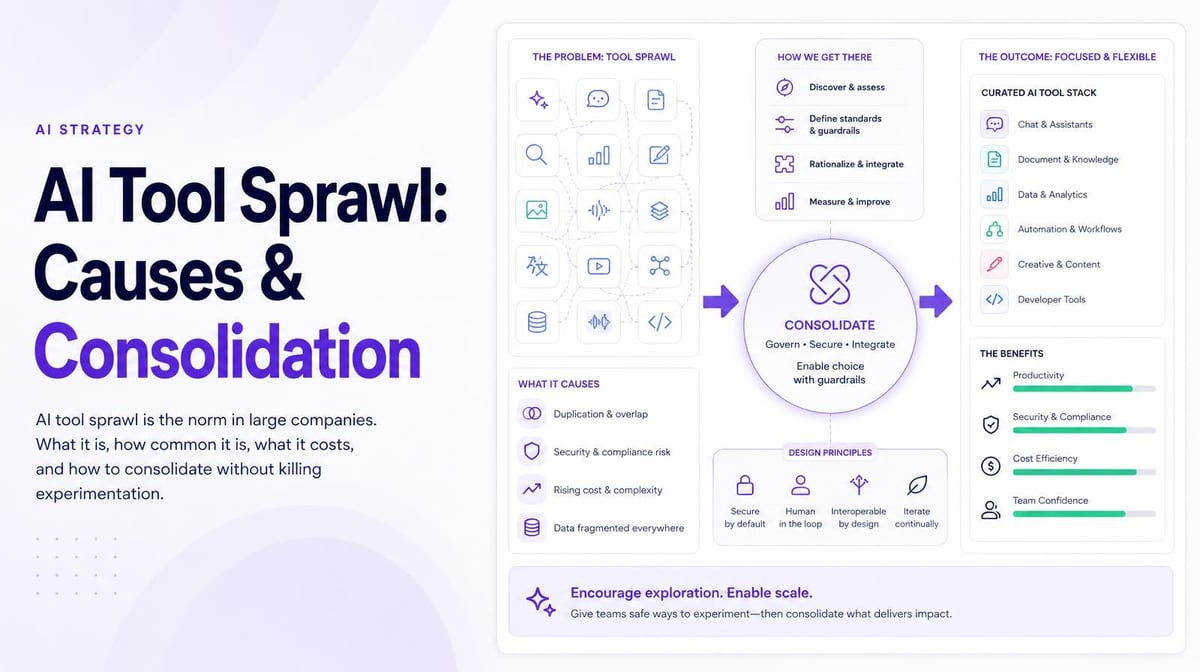

TL;DR
AI tool sprawl is the unchecked growth of overlapping AI tools across a company. It often happens because different teams purchase on different contracts, sometimes without IT's knowledge. MIT NANDA found that employees at more than 90% of surveyed companies regularly used personal AI tools for work, but only 40% of those companies had purchased official LLM subscriptions. Separately, IBM found that 20% of organizations in its 2025 data breach study experienced a breach linked to shadow AI.
Quick Answers
If you’re asking… | Short answer |
|---|---|
What is AI tool sprawl? | Overlapping AI tools spreading across teams faster than anyone can track, pay for deliberately or govern. |
How common is AI tool sprawl? | It is widespread in MIT NANDA’s survey sample, and one in five breached organizations in IBM’s study reported a shadow AI-related breach. |
How do we track spending on multiple AI tools company-wide? | Detect every AI tool in use, consolidate seat and usage costs (including tokens), and attribute spending to teams. Larridin does this across the AI stack. |
Is all AI tool sprawl bad? | No. Some experimentation is healthy. The damage comes from overlap nobody can see or measure. |
What Is AI Tool Sprawl?
AI tool sprawl is the accumulation of overlapping AI tools across an organization without central visibility, ownership, or a plan to consolidate.
It takes several forms at once:
- Two or three general assistants licensed by different departments
- Multiple AI coding tools inside one engineering org
- AI add-ons inside existing SaaS products, raising renewal costs
- Personal AI accounts used for company work
- Agents and scripts calling model APIs through shared keys
Sprawl overlaps with shadow AI, but is different. Shadow AI is unapproved use. Sprawl also includes approved tools that duplicate each other.
For the security side, see how to monitor risky AI use.
How Common Is AI Tool Sprawl?
AI tool sprawl is the norm in large companies, and most leaders underestimate its extent until they run a usage-based inventory.
The evidence points one way. MIT NANDA’s 2025 research described a “shadow AI economy” in which workers at over 90% of surveyed companies used personal AI tools for work tasks. IBM’s 2025 data breach research found one in five organizations reported a breach involving shadow AI, and 63% of breached organizations had no AI governance policy. The Larridin FAQ puts it bluntly: many organizations have no idea how many AI tools are in use.
What Causes AI Tool Sprawl?
AI tool sprawl often grows because AI tools are easy to purchase, evolve quickly, and help teams solve immediate problems without waiting for procurement approval.
- Self-serve signups take minutes on a corporate card
- New tools launch frequently, and teams adopt the best one for their task
- Department budgets fund local fixes without a company-wide view
- Existing SaaS vendors bundle AI features into renewals
- Procurement and security reviews take longer than a free trial
What Does AI Tool Sprawl Cost?
Sprawl costs money through duplicate licenses, raises security exposure, and makes AI ROI impossible to calculate.
Duplicate seats and idle licenses are the visible cost. The larger ones hide elsewhere. IBM found breaches involving high levels of shadow AI cost $670,000 more on average. Fragmented usage data means no one can say which tools produce results. And quality varies when every team works differently with a different tool.
Engineering teams can also track AI coding tool costs across vendors to identify overlapping subscriptions.
How Do You Consolidate AI Tools Without Killing Experimentation?
Consolidate by job to be done using real usage and outcome data, and keep a sanctioned path for trying new tools.
- Build an inventory from usage data, including device-level signals, to cover approved and unapproved tools.
- Group tools by the job they do: writing, analysis, coding, meetings, agents.
- Compare tools in each group on adoption depth, fluency, and cost per outcome.
- Pick a standard per category and publish a sandbox process for evaluating new tools.
- Migrate users with guidance and a clear date, and offer the approved alternative before restricting the old tool.
- Monitor continuously so the next wave of sprawl shows up early.
Larridin supports each step: detection of approved and unapproved AI across the workforce, Token Spend & Insights for side-by-side costs, proficiency scoring by tool and team, and guardrails that steer behavior.
Where AI Tool Sprawl Management Breaks, and How to Fix It
What you’re dealing with | What you need | How Larridin helps |
|---|---|---|
No one knows how many AI tools are in use | Usage-based inventory | Detects approved and unapproved AI tools continuously |
Overlapping tools on separate budgets | One cost view across vendors | Token Spend & Insights across tools and teams |
Can’t decide which tool to keep | Outcome comparison by tool | Usage, proficiency, and cost per outcome by tool |
Bans push usage onto personal devices | Guidance toward approved tools | Policy guardrails designed to steer behavior |
Key Takeaways
- AI tool sprawl is overlapping AI tools spreading without visibility or ownership.
- It is widespread in MIT NANDA’s surveyed organizations, where workers at over 90% of companies reported personal AI use for work.
- Sprawl drives duplicate spend, breach exposure and unmeasurable ROI.
- Consolidate by job to be done, using usage and outcome data, and keep a sandbox.
FAQs
How many AI tools does a typical enterprise use?
There’s no reliable universal figure, and self-reported counts run low. A usage-based inventory of your own workforce is the only number worth planning around.
Is shadow AI the same as AI tool sprawl?
They overlap. Shadow AI is unapproved use. Sprawl also includes approved tools that duplicate each other across departments.
Should we ban personal AI accounts?
Offer a capable approved alternative first, then set a dated policy. Bans without alternatives tend to move usage out of sight.
Who should own AI tool consolidation?
IT or the CIO’s office usually leads, with finance validating costs and security setting guardrails.
Sources
- MIT NANDA, The GenAI Divide 2025
- IBM Cost of a Data Breach 2025 press release
- Larridin FAQ: visibility, detection, guardrails