

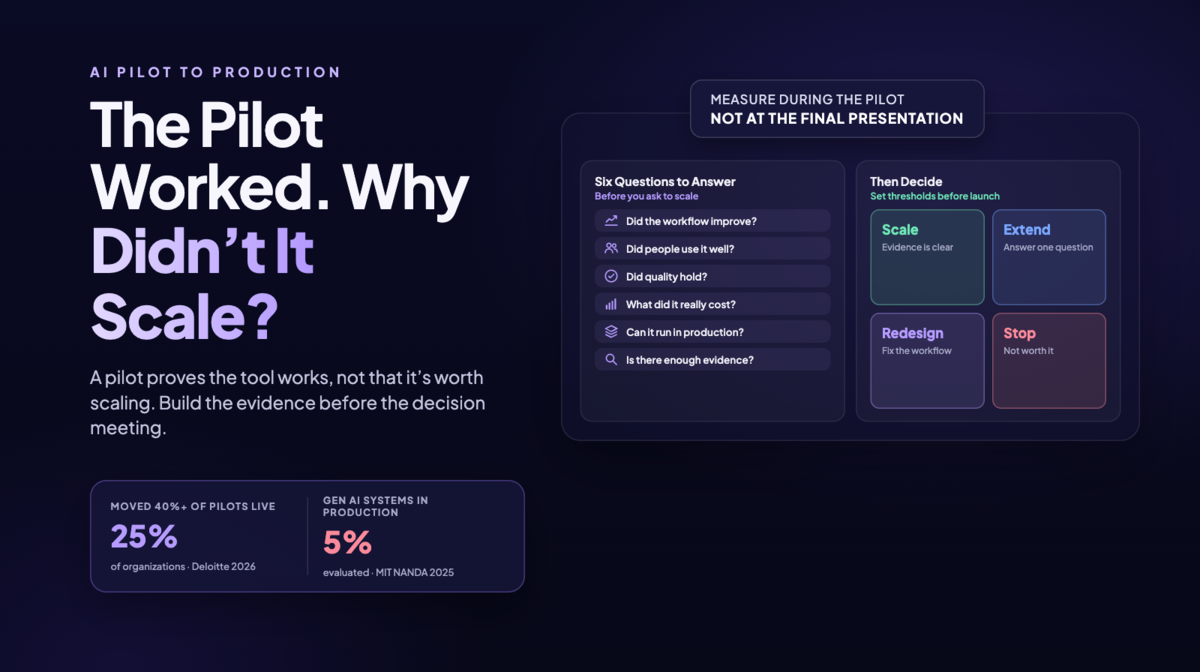

A pilot can show that an AI tool completes a task without showing that the workflow is ready for production. Scaling requires evidence of outcomes, quality, cost, risk, ownership, and the data needed to operate reliably. You can begin collecting that evidence before enterprise-wide data modernization is finished.
Key Takeaways
- Design the pilot around a scale, extend, redesign, or stop decision, not only a successful demonstration.
- Establish workflow and outcome baselines before launch where possible, and track full costs, adoption, proficiency, and quality.
- Run measurement and data-readiness work in parallel. Available usage and spend records support early visibility, while targeted integrations add outcome evidence.
- Production readiness is use-case-specific. Mission-critical workflows still need fit-for-purpose data quality, definitions, access, ownership, and reliable integrations.
- Telemetry alone does not prove ROI or readiness. Disclose gaps and resolve material ones before widening the deployment.
Why Working AI Pilots Still Stall
Many pilots answer a technical question: can the tool do the task? Production decisions ask whether the complete workflow improves enough to justify its operating cost and risk.
A positive demonstration and favorable user feedback can leave finance, security, procurement, and business owners without a defensible answer. If baselines and accepted-outcome measures were omitted, reconstructing the case later can depend on incomplete records and recollection.
Deloitte's 2026 AI reporting and MIT NANDA's 2025 analysis discuss pilot-to-production challenges under different scopes and methods. They are context for the scaling question, not one universal failure rate.
Data readiness adds another distinction. Curated pilot inputs can mask inconsistent live records, missing permissions, slow connections, or unclear definitions. Test the production conditions as well as the demonstration.
Run Measurement and Data Readiness in Parallel
The data-readiness scaling guide explains why waiting for perfect enterprise data can create a second problem: tools, agents, and spending continue to grow without a usable measurement record.
A contained pilot may not require every system to be modernized. That does not make its data needs optional. Define the quality, access, context, and integration requirements for the specific task, while collecting the signals already available.
Start With Three Available Evidence Layers
- Behavioral telemetry: Supported application, browser, or desktop records can reveal tool use, frequency, and workflow patterns. Document coverage and privacy boundaries.
- Tool and spend records: Licenses, provider usage, tokens, API calls, cloud charges, and invoices help establish cost, ownership, and activity.
- Targeted workflow integrations: GitHub, Jira, CRM, service-management, finance, or other relevant systems may provide timestamps, accepted outputs, quality, and business results for the chosen use case.
Surveys and interviews add employee context about friction, trust, and fit. They complement observed results rather than replace them. None of these layers should be assumed complete just because a dashboard is populated.
Usage visibility answers what is running and how it is used. Outcome evidence answers whether the work improved. Data-readiness evidence answers whether the workflow can operate reliably under production conditions. Keep the three questions separate.
Six Questions a Production Business Case Must Answer
1. Did the Target Workflow Improve?
Define the process and its accepted result. Record baseline cycle time, active labor, volume, quality, error, rework, and cost per acceptable output where relevant.
Compare similar AI-assisted and non-AI work, or use reliable historical records. Workflow Intelligence adds evidence on stages, transitions, and friction. A faster AI task can still leave work waiting in review or approval.
Account for staffing, demand, complexity, policy, and other automation changes. A before-and-after difference alone does not establish AI's causal effect.
2. Did Employees Use the Tool Effectively?
Measure adoption separately from proficiency. Access and login activity do not show whether people scope tasks, supply approved context, verify results, and use the tool within appropriate boundaries.
High use with inconsistent output may indicate missing context, weak task fit, integration constraints, or an enablement gap. Investigate those causes rather than assume more training or licenses will solve the problem.
3. Did Quality and Reliability Hold?
Track accepted quality, exceptions, human corrections, failed runs, rework, and escalation. Test representative variation, incomplete inputs, stale data, and permission boundaries rather than only clean examples.
For higher-risk work, exercise review, approval, recovery, and containment controls under realistic conditions. Necessary verification is part of the operating model, not automatically waste to remove.
4. What Did the Pilot Cost?
Include access, tokens, APIs, infrastructure, implementation, integrations, data preparation, training, governance, review, and remediation. Separate one-time setup from the projected recurring cost.
Token Spend & Insights connects available spending with teams, agents, workflows, and use cases. Reconcile observed usage with billed charges and commercial terms, keeping shared and unknown costs explicit.
Use outcome economics with a stated numerator and denominator. Include relevant unsuccessful attempts and recovery rather than assigning all cost only to successful runs.
5. Can the Workflow Operate in Production?
Check the data sources and systems the production workflow actually needs. Fit-for-purpose readiness can include accuracy, freshness, consistent definitions, lineage, permissions, integration reliability, and named stewardship.
A curated pilot dataset does not establish that live systems meet those conditions. Test missing records, conflicting definitions, unavailable sources, changing inputs, and recovery from integration failure.
Assign business ownership and technical support after the pilot team steps away. Define who resolves data-quality issues, approves changes, reviews results, and intervenes when an agent fails or exceeds a boundary.
Scale the assessed workflow and population, not an assumption that the entire enterprise is now ready. Expanding to another region, data source, team, or risk context may require reassessment.
6. Is There Enough Evidence to Make a Decision?
- Scale: Outcome, cost, quality, data, and operational criteria are met for the defined scope.
- Extend: A specific question remains, with an owner, evidence plan, and decision checkpoint.
- Redesign: Task fit, data, integration, workflow, controls, or enablement needs an identified intervention.
- Stop: The economics, quality, risk, or feasibility does not support continued investment.
“Keep exploring” is not a complete decision without an unresolved question and a plan to answer it. A technically successful pilot can still warrant redesign or closure.
Use Pilot Evidence to Prioritize Data Work
Do not clean the entire data estate before learning anything. Do not scale a critical workflow while ignoring data constraints either.
- Establish visibility: Inventory the relevant tools, users, workflows, costs, and coverage gaps.
- Choose the priority use case: Identify a strategically important, costly, or promising workflow.
- Define the intended result: Select acceptance, quality, and business measures before choosing integrations.
- Connect necessary sources: Add the data required to evaluate that result, with consistent identifiers and definitions.
- Identify the material gap: Determine which data problem prevents reliable evidence or production operation.
- Assign targeted remediation: Give the gap an owner, cost, acceptance criterion, and review date.
A weak measurement record does not prove the AI use case failed. It means the conclusion is limited. Conversely, strong adoption and low direct spending cannot justify scaling without the relevant quality and readiness evidence.
The Pilot Measurement Minimum
Before launch, document:
- Workflow boundaries, intended outcome, accountable owner, and production scope.
- The baseline and the quality of the available comparison data.
- Adoption, proficiency, workflow, quality, and cost definitions.
- Required data sources, permissions, identifiers, quality checks, and known gaps.
- Risk thresholds, human oversight, exceptions, and recovery.
- Full pilot costs and recurring-cost scenarios.
- Scale, extend, redesign, and stop criteria with decision authority.
ROI measurement should begin before deployment where possible. If the pilot already exists, establish a reliable current baseline and label missing historical evidence instead of inventing precision.
There is no universal pilot duration. Use enough representative cases and follow-up to observe the intended outcome. Low-volume processes, seasonality, long business cycles, or delayed quality failures may require more observation than a high-volume task.
Build the Evidence Before the Scaling Meeting
Bring finance, technology, security, procurement, and business owners a common record: what changed, what it cost, whether quality held, which data and operational conditions are met, and what remains unresolved.
StackAI's budgeting discussion connects funding with adoption and unit economics. Your actual decision still depends on your use case, constraints, and benefit evidence, not a universal market rule.
Keep released capacity, projected value, and realized financial benefit distinct. Shorter elapsed time is not automatically less labor or lower cost. Record how any additional capacity was used before claiming its return.
Frequently Asked Questions
Why can a working pilot fail to reach production?
Technical completion may not establish workflow fit, reliable data, integration, ownership, quality, full economics, or acceptable risk. The pilot needs to test those conditions and support an explicit decision.
Do we need perfect enterprise data before measuring?
No. Available usage and spend records can establish early visibility, and targeted integrations can support selected workflow outcomes. Production still requires the data quality and governance appropriate to that workflow.
Can behavioral telemetry prove ROI?
Not alone. It shows activity and patterns within its coverage. ROI assessment also needs relevant outcomes, a cost model, and defensible benefit attribution.
How should we prioritize data readiness?
Start with important workflows and the evidence required to evaluate them. Address the data gaps that block reliability or the production decision, with named owners and measurable acceptance criteria.
What if outcome data is missing?
Report what the evidence supports and what remains unknown. Extend or redesign the pilot to answer a specific material question, rather than declare either success or failure from usage alone.
How long should a pilot run?
Long enough to capture representative usage, outcomes, and quality follow-up. Duration depends on volume, complexity, outcome latency, risk, and seasonality, not a fixed calendar standard.
Build Measurement Into the Pilot While Data Work Continues
Larridin connects adoption, proficiency, workflow performance, quality, and AI spending. Targeted outcome integrations add evidence as relevant business data becomes available.
Book a discovery call to discuss measurement that supports a defensible production decision.
Start with the evidence available. Resolve the gaps that matter. Scale the workflow only when its outcomes, economics, and operating conditions support the next investment.