

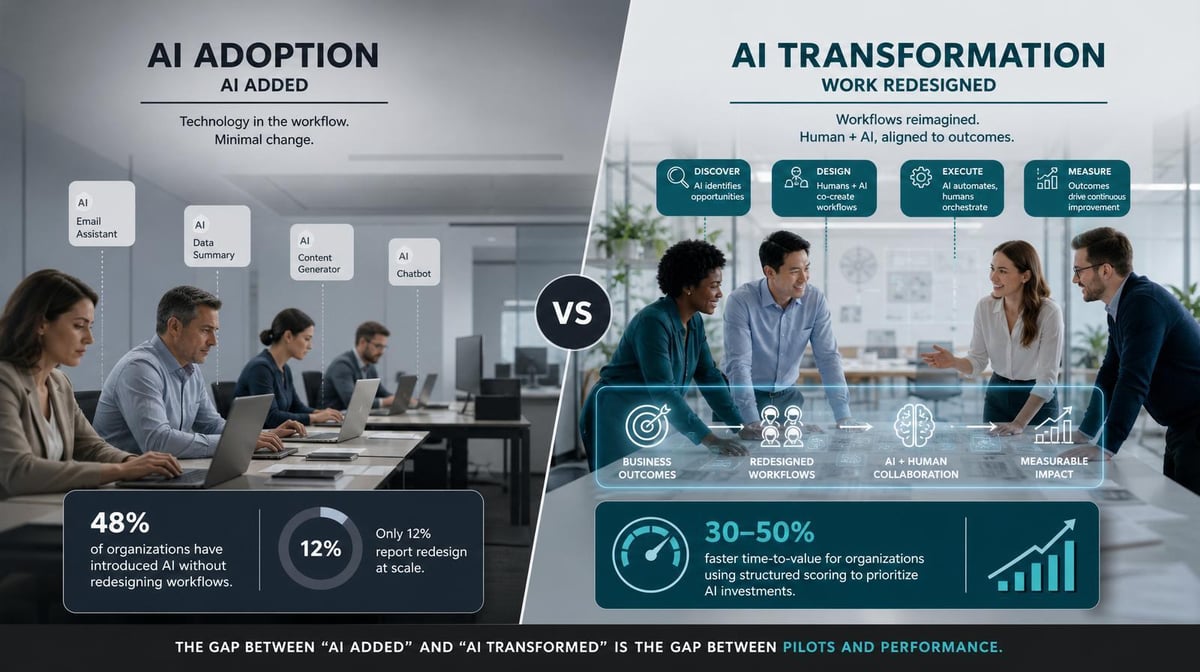

Deploying AI is the easy part. Deloitte found nearly half of organizations have added AI without redesigning the workflows around it. Transformation starts when the work—and the outcomes—change.
Key Takeaways
- Deloitte found that 48% of organizations have introduced AI without redesigning the workflows or roles around it. Only 12% report redesign at scale.
- Adoption metrics show whether people are using AI. Transformation metrics show whether AI changes cycle time, throughput, quality, cost, or revenue at the workflow level.
- The financial risk is scaling licenses, tools, and pilots based on activity while the underlying workflow—and its business results—stays the same.
What Adoption Actually Means
AI adoption starts with access and use. Employees have licenses, log in, and use the tools often enough for AI to become part of their work. Those signals matter because transformation can’t happen if people aren’t using the tools.
But adoption metrics answer a limited question: Is AI being used? They don’t tell leaders whether AI has changed what the organization can produce. Understanding what AI adoption measurement captures is the starting point for seeing why usage alone can’t prove business value.
What Transformation Actually Means
AI transformation means the workflow has changed and the result is measurably different. An employee using AI to draft emails faster is adopting AI. A customer-service workflow redesigned so AI handles triage, routing, and initial responses while people handle exceptions and escalations has been transformed.
The difference is whether roles, decisions, handoffs, and outputs changed around the tool. Deloitte found that 48% of respondents had introduced AI without redesigning the workflows or roles around it. The 12% reporting redesign at scale have paired the technology with a new operating model.
Deloitte expects the gap between “AI added” and “AI transformed” to become more visible in performance data and board-level conversations. That makes the distinction more than semantics. It’s a way to separate deployment activity from operating-model change.
The Measurement Difference Between Adoption and Transformation
AI adoption and AI transformation require different scorecards. Only measuring adoption creates a blind spot; only measuring outcomes makes it harder to diagnose why a workflow isn’t improving.
Adoption Metrics Show AI Is Being Used
The AI Adoption dashboard continuously tracks metrics such as active users, weekly sessions, feature usage, and prompt volume. They show whether employees have access to AI and whether they’re incorporating it into their work. High adoption is necessary for transformation, but doesn’t prove it.
Transformation Metrics Show Whether AI Changed the Outcome
Larridin’s AI measurement and optimization platform connects AI activity with business performance metrics such as cycle time, throughput per employee, output quality, cost per outcome, and revenue per workflow. These metrics answer the harder question: Did AI change what this workflow produces, or did it add another step to an unchanged process?
Proficiency Is the Bridge
Organizations often get stuck between adoption and transformation because employees have access to AI but aren’t using it well enough yet to change workflow output. Larridin measures AI fluency to help identify where proficiency is the bottleneck so development investments can target the teams and skills most likely to improve results.
Why the Confusion Costs Millions
Confusing adoption with transformation creates a false positive at budget review. User counts rise, so leaders keep buying licenses, adding tools, and funding pilots even when the workflow baseline hasn’t moved. The expensive mistake isn’t one weak use case. It’s scaling activity before proving value.
By the time leaders realize that cycle time, quality, throughput, or cost per outcome hasn’t changed, the spend may already be embedded in contracts, processes, and expectations. Teams can also underfund the work transformation actually requires: workflow redesign, data access, governance, change management, and role clarity.
McKinsey found that 40% of surveyed M&A practitioners using gen AI said it enabled 30 to 50% faster deal cycles. The finding is specific to M&A, but it illustrates the measurement difference: faster deal cycles are a workflow outcome. Logins and prompt counts are adoption signals. That outcome gap is where the compounding advantage starts.
How to Prove Transformation
A transformation claim should pass a simple before-and-after test at the workflow level:
- Set a baseline. Document cycle time, cost, quality, throughput, and other relevant business outcomes before changing the workflow.
- Measure adoption and proficiency. Confirm that the right employees are using AI consistently and have the skills to use it effectively.
- Measure the new output. Compare the redesigned workflow with the baseline, not with a general sense that work feels faster.
- Scale only what changed the result. Expand the workflows with sustained, attributable gains rather than the tools with the highest login counts.
Frequently Asked Questions
What is the difference between AI adoption and AI transformation?
AI adoption means employees are using AI tools. AI transformation means those tools have changed how a workflow is structured and what it produces. Adoption is visible in usage metrics. Transformation requires measurable changes in cycle time, throughput, quality, cost, revenue, or another business outcome.
Why do organizations confuse AI adoption with AI transformation?
Adoption metrics are easy to collect and report. Transformation metrics require a baseline, workflow-level measurement, and clear ownership of the outcome. A busy dashboard can look like progress even when the underlying process hasn’t changed.
How do we know if our AI program has reached transformation?
You can point to specific workflows with a measurable before-and-after result and explain how AI contributed to the change. If you can only report access, logins, prompts, or time saved by individuals, you have evidence of adoption, not transformation.
What prevents organizations from moving from adoption to transformation?
The most common barriers are deploying tools without redesigning workflows, proficiency gaps, weak data access, unclear governance, and no measurement infrastructure for workflow outcomes. Moving past them requires treating AI as an operating-model change rather than another technology rollout.
Measure AI Transformation, Not Just Activity
Larridin measures both adoption and transformation, turning the gap between activity and business outcomes into something leaders can see and act on.
Book a discovery call to find out whether your AI program is generating activity or changing performance.