

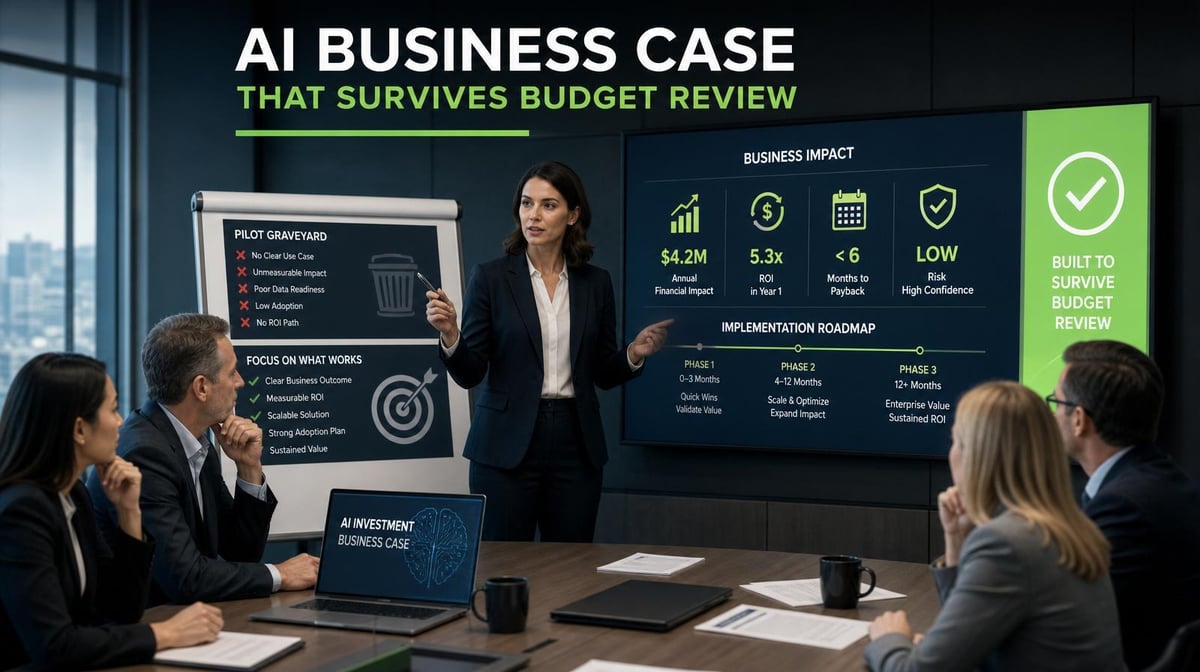

Microsoft’s 2026 Enterprise Trends says the era of AI experimentation is over. CFOs want measurable returns, and procurement teams are cutting tools that never made it past pilots. A business case now needs internal evidence, not another estimate of what AI could deliver.
Key Takeaways
- Teneo found that 53% of investors expect AI ROI within six months, while only 16% of large-cap CEOs believe they can deliver it that quickly.
- A defensible AI business case connects total spend with team-level utilization, proficiency, workflow outcomes, and the cost of implementation and rework.
- The Return on AI Institute found an 85% high-value rate among organizations that formally report AI value to boards or investors, compared with 15% among those that don’t measure or report it.
What Changed in AI Budget Conversations
The AI budget conversation has shifted from whether to invest to which investments deserve continued funding. Potential may win initial approval, but renewals and scaling decisions now depend on evidence that the tool is improving a workflow or business outcome.
The expected payback window is getting tighter too. Teneo found that 53% of investors expect AI ROI within six months or less, while 84% of large-cap CEOs expect new initiatives to take longer than six months to produce positive returns.
Not every AI investment needs full payback in one or two quarters. But leaders need credible early evidence that the investment is moving in the right direction. A multiyear value curve can survive scrutiny when the first phase produces measurable signals across adoption, proficiency, workflow performance, and financial results.
Why AI Business Cases Fail at Budget Review
They Substitute Vendor Benchmarks for Internal Evidence
A vendor case study can show what’s possible. It can’t prove what happened inside your organization.
Applying a published productivity multiplier to an entire function creates a projection, not an ROI case. Budget reviewers need evidence tied to the teams, workflows, and costs they’re being asked to fund.
They Claim Savings Without a Baseline
A savings claim needs a before-and-after comparison. Without a baseline for cycle time, quality, throughput, cost per outcome, or revenue, the business case is built on estimates.
The baseline doesn’t need to be perfect, but it has to be defined before the program changes again. There needs to be a clear measurement window and enough consistency to show direction.
They Count Adoption as Value
License utilization and active users show whether employees are using AI. They don’t show whether the work improved.
A budget reviewer will ask what changed because of that usage. Did the team complete more high-value work? Did quality improve? Did costs fall? Adoption belongs in the business case, but it can’t carry the value claim alone.
They Leave Out the Full Cost
License fees are only one part of AI spend. A complete cost picture may include tokens, implementation, integration, training, security, governance, review time, and rework.
Token Spend & Insights consolidates AI spend and connects it with teams, agents, workflows, and outcomes.
The 4 Evidence Layers a CFO-Ready Case Needs
1. Spend Attribution
Attribute AI spend to the relevant team, tool, use case, agent, or workflow. The case should show who owns the cost, what the investment was expected to produce, and whether the result is strong enough to keep funding.
2. Utilization Evidence
Aggregate adoption can hide major differences across teams. AI adoption measurement should show who’s using the tool, how consistently, and where it has become part of the workflow.
This helps leaders distinguish a weak tool from a weak rollout. Low usage may point to poor fit, limited enablement, workflow friction, or duplicate tools.
3. Proficiency Data
Two teams can use the same tool at the same rate and produce different results. AI fluency measurement helps explain whether employees are using AI effectively enough to improve the work.
The right decision may be to improve training or workflow design rather than cut the tool.
4. Outcome Connection
The business case needs to show what changed in the workflow and what that change was worth. AI Impact connects AI activity with cycle time, throughput, quality, cost per outcome, revenue, and other business measures.
This is the evidence that moves the conversation from “people are using AI” to “this investment changed performance.”
Build the Evidence Before the Review
The evidence layer can’t be reconstructed cleanly at the end of a pilot. Teams need to define the baseline, expected outcome, ownership, and measurement plan while the initiative is running.
The Return on AI Institute found that organizations formally reporting AI value to boards or investors reported high value at an 85% rate. Organizations that didn’t measure or report AI value reached that level at only a 15% rate. The study ties the gap to how rigorously companies track, aggregate, and communicate economic impact.
That doesn’t prove reporting creates value, but it does show that organizations capturing value are much more disciplined about measuring and communicating it.
How to Structure the Business Case
A strong AI business case should make five points clear:
- The business problem: Which workflow, cost, risk, or growth opportunity is the investment meant to address?
- The baseline: What did performance and cost look like before the investment?
- The evidence: What changed in adoption, proficiency, workflow performance, and financial results?
- The confidence level: How directly can the change be attributed to AI, and what else may have contributed?
- The decision: Should the organization scale, improve, pause, replace, or stop the investment?
Separate early indicators from full financial return. Adoption and proficiency show whether the implementation is taking hold. Workflow outcomes show whether performance is changing. Financial results show whether the value exceeds the cost.
Frequently Asked Questions
What evidence does a CFO need in an AI business case?
A CFO needs total spend, cost ownership, team-level utilization, proficiency, workflow outcomes, and a connection to cost reduction, revenue, risk, or another business priority. The case should also explain the baseline, measurement period, and confidence in the attribution.
How do we build a business case for an AI tool that is already deployed?
Establish a current baseline and measure going forward. You may not have a clean pre-deployment comparison, but you can document current performance, define the expected change, and track the next period consistently. Be transparent about the limitation rather than inventing a historical baseline.
How long should an AI payback timeline be?
There’s no universal timeline. Teneo found that 53% of investors expect AI ROI within six months, while most large-cap CEOs expect new initiatives to take longer. A credible case should show early directional evidence and define when workflow and financial results should become measurable.
What is the most common reason AI business cases fail at budget review?
The case answers a value question with activity metrics. License utilization, logins, and self-reported time savings may support the story, but they don’t prove financial impact. The case becomes defensible when those signals are connected with internal workflow outcomes and the full cost.
Build the Evidence Layer Before the Next Review
Larridin connects spend, utilization, proficiency, and business outcomes so leaders can build AI business cases that hold up under CFO and board scrutiny.
Book a discovery call to build the evidence foundation for your next AI budget decision.