

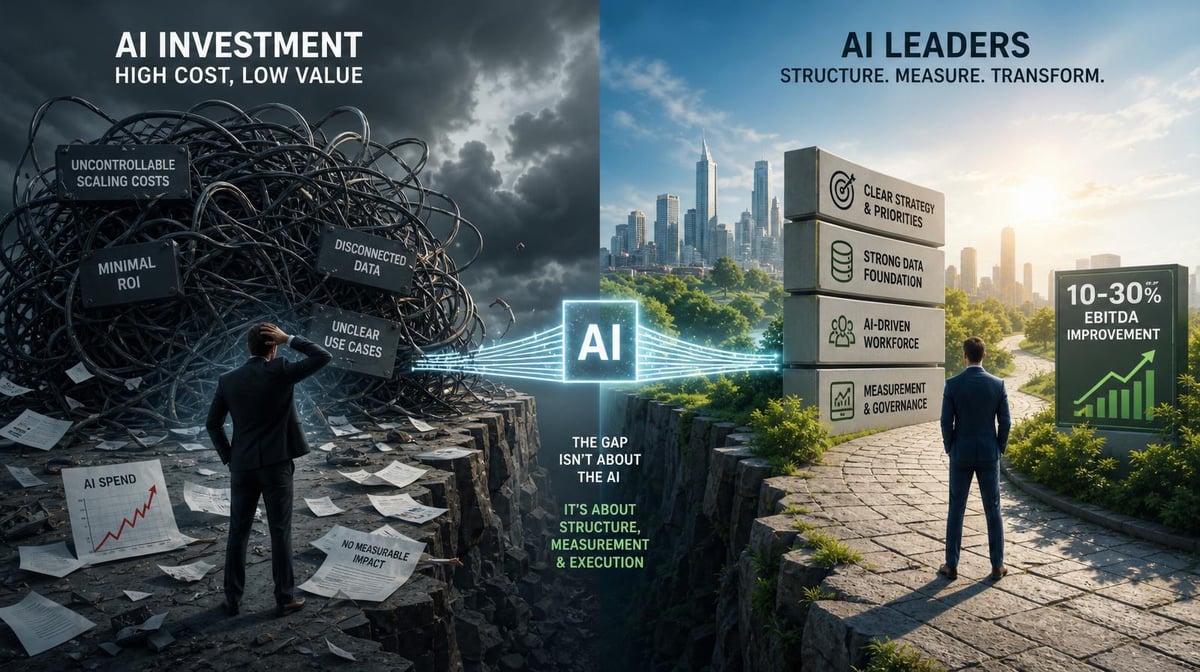

AI can reduce costs, but an estimate of time saved won’t survive serious financial review. A defensible business case connects workflow changes to quality, total AI spend, and net financial impact.
Key Takeaways
- BCG found that 60% of companies report minimal or no AI value despite significant effort, while nearly two-thirds report uncontrollable AI scaling expenses.
- AI leaders deliver three times greater cost reduction, 1.6 times higher EBIT margins, and 2.7 times the return on invested capital than their peers, according to the same BCG analysis.
- A credible AI cost savings business case needs an evidence chain: a workflow baseline, cost-per-output measurement, quality and rework data, full cost attribution, and net savings.
Why the AI Cost Savings Case Keeps Breaking
BCG’s 2026 research describes a widening gap. Most companies still struggle to show meaningful returns, while AI leaders are producing stronger cost and margin results.
BCG doesn’t attribute the gap to tool access. It points to workflow and operating-model redesign, focused use cases, strong data and technology foundations, and rigorous financial tracking. The leaders change how work gets done and verify whether the gains reach the P&L.
That last step is where many business cases break. A team reports that AI saves four hours per employee each week. Finance multiplies those hours by a labor rate and presents the result as cost savings. But unless the company reduced spending, increased output at the same cost, or redirected the capacity to measurable higher-value work, it has documented an efficiency gain—not a financial return.
The same organization may also be absorbing new seat, token, infrastructure, implementation, and governance costs elsewhere. Gross time savings can look impressive while the net financial case stays weak.
The Five-Part AI Cost Savings Evidence Chain
1. Establish the Workflow Baseline
Start with the work AI is supposed to change. Measure the workflow before deployment or compare AI-assisted runs with similar non-AI runs.
The baseline should include:
- Workflow volume
- Cycle time
- Labor hours
- Cost per output
- Error or rework rate
- Completion or success rate
This creates a counterfactual: What would the same work have cost without AI?
Larridin’s Workflow Intelligence compares AI-assisted and non-AI runs of the same workflow. That makes it possible to see whether AI reduces time and friction or adds new overhead.
2. Convert Efficiency Into Financial Value
Time saved is an operational metric. Cost savings require a financial consequence.
The business case should show which of these outcomes occurred:
- The company reduced labor, contractor, or vendor costs.
- The workflow handled more volume without a comparable increase in cost.
- Employees redirected the capacity to work that produced a measurable business result.
Without one of those outcomes, the case should describe the result as productivity or capacity gained. Calling it cost savings overstates the evidence.
Our article on P&L-level AI value covers the structural gap between working faster and changing a financial result.
3. Measure Quality and Rework
A workflow that finishes faster but creates more errors may not cost less.
Measure output quality, success rate, error recovery, and remediation time alongside speed and volume. Compare the full cost of an acceptable output, not the cost of producing a first draft or completing the initial task.
This is how leaders move from gross savings to net savings. The calculation should include the human review, correction, escalation, and rework AI creates.
4. Attribute the Full Cost of AI
The cost side of the equation has to include more than the tool used in one workflow.
Account for:
- Software seats and subscriptions
- Token and API consumption
- Cloud and infrastructure costs
- Implementation and integration
- Training and enablement
- Governance, security, and oversight
- Maintenance and workflow redesign
Larridin’s Token Spend & Insights consolidates AI spend and attributes it to tools, agents, teams, and outcomes. That broader view helps finance identify costs that would otherwise sit outside the workflow-level savings case.
5. Calculate Net Savings
The final calculation should show what the organization gained after accounting for the full cost of producing the outcome.
A simple structure is:
Net AI savings = verified cost reduction or economic value created − total AI costs − remediation costs
The inputs should come from observed performance wherever possible. Vendor benchmarks and projected adoption rates may help with planning, but they shouldn’t be presented as realized savings.
What a Defensible Business Case Shows
A CFO-ready case answers five questions:
- What changed? Identify the specific workflow, team, and use case.
- Compared with what? Show the pre-AI or non-AI baseline.
- Did quality hold? Include errors, rework, and the cost of an acceptable output.
- What did AI cost? Include direct and shared costs across the investment.
- Where did the value land? Connect the result to lower spending, greater throughput, or another measurable financial outcome.
The goal is to distinguish the workflows producing net value from those that need redesign, additional support, tighter cost controls, or retirement— not to make AI investment look successful.
Frequently Asked Questions
Why do AI cost savings claims fail at CFO review?
Many rely on a chain of assumptions: a vendor benchmark, projected time savings, an estimated labor rate, and an assumed financial outcome .CFOs need observed workflow data, full cost attribution, and evidence that the gain affected spending, capacity, or another financial measure.
What is the difference between AI efficiency gains and cost savings?
Efficiency gains mean the work takes less time or effort. Cost savings mean the organization spends less to produce the same or better result. Efficiency can also create economic value through increased capacity, but the business case should show where that capacity went and what it produced.
How do we establish an AI cost savings baseline?
Measure the workflow before deployment or compare AI-assisted and non-AI runs of comparable work. Track cycle time, labor hours, volume, quality, rework, and cost per acceptable output.
How do AI cost overruns affect the business case?
They reduce net savings. A complete case includes seat, token, infrastructure, implementation, training, governance, and remediation costs—not only the cost of the tool used in the measured workflow.
Build AI Cost Savings Evidence That Holds Up
Larridin connects workflow performance with the full AI spend picture. Leaders can compare AI-assisted and non-AI work, identify where AI reduces time and friction, and account for the tools, agents, and teams driving the cost.
Book a discovery call to build an AI cost savings case grounded in observed behavior.