

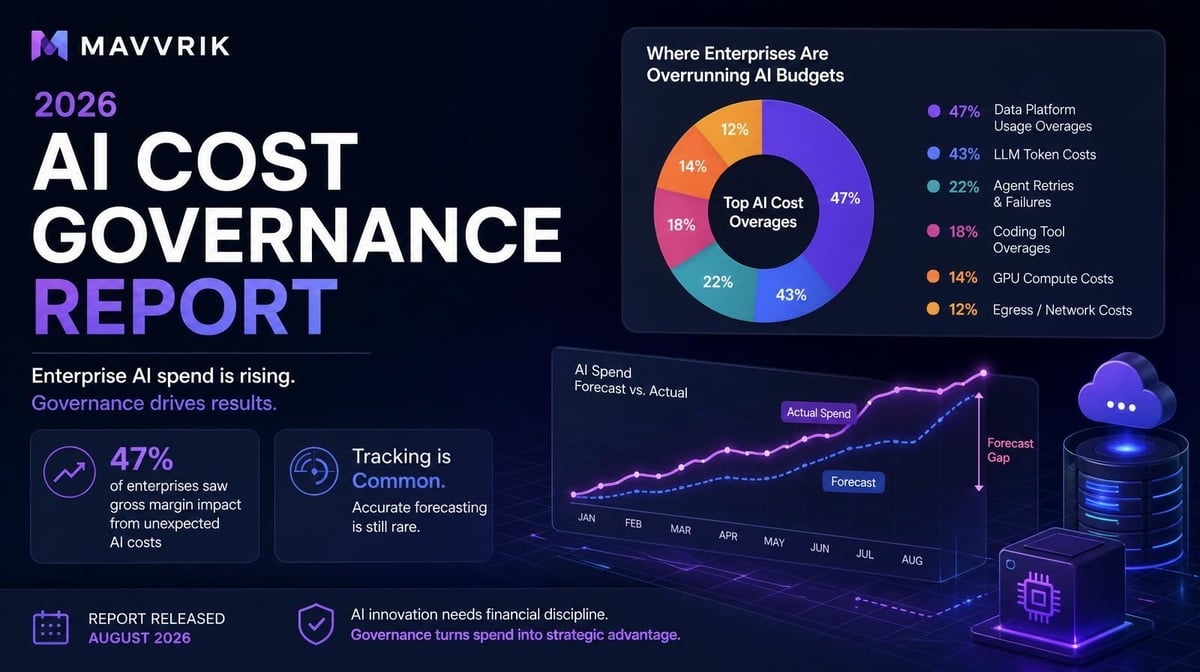

AI cost management has become part of normal technology finance. The 2026 State of FinOps found that 98% of respondents now manage AI spend, up from 31% in 2024.
The next challenge is governance: deciding who owns AI spending, what controls apply, and when teams need to act. To do that, engineering and finance need a shared view of costs, forecasts, and outcomes.
Key Takeaways
- AI cost governance needs a broader view than model or token spend. The cost of an AI use case can also include tools, infrastructure, orchestration, operations, labor, and rework.
- Attribution turns a companywide AI total into something leaders can manage by connecting spend to teams, agents, projects, and use cases.
- Cost controls are more useful when they include business context. Higher AI spend can be justified when it produces proportionately more value.
AI Cost Management Has Outgrown the Model Invoice
The FinOps Foundation’s 2026 data shows how quickly the scope of technology cost management is expanding. Along with the rise in AI spend management, 90% of respondents now manage SaaS or plan to, 64% manage licensing, 48% manage data centers, and 28% are beginning to include labor costs.
That broader view matters for AI because the model invoice captures only part of what it costs to run an AI use case.
The FinOps Foundation’s token economics guidance notes that production AI systems can also generate costs from vector databases, embeddings, orchestration, caching, data transfer, observability, and other supporting infrastructure. These costs may appear outside the model provider’s bill.
For CTOs and CFOs, effective governance needs to answer four questions:
- Who owns each major area of AI spending?
- What budgets, limits, or approval rules apply?
- What triggers a review or escalation?
- Who decides whether spending should continue, expand, or be reduced?
4 Things CTOs and CFOs Need for AI Cost Governance
1. Start With the Full Cost
Before leaders can govern AI spending, they need to know what belongs in the total.
Your AI Invoice Is Not Your AI TCO. Here’s What Else to Count groups enterprise AI costs into four areas:
- Direct AI spend
- Data and infrastructure
- Orchestration and operations
- Internal labor and quality costs
The purpose is to prevent substantial costs from being overlooked because they sit outside the obvious AI invoice.
An AI agent, for example, may create token charges while also using cloud infrastructure, data services, monitoring tools, and employee time for implementation and review.
2. Attribute Spending to an Owner and Use Case
Knowing the total still doesn’t tell leaders what to do with it.
A $500,000 AI total doesn’t tell leaders what’s driving the cost. Attribution shows how much came from a specific team, tool, agent, project, or business use case.
That level of attribution gives leaders somewhere to investigate when spending changes. It also allows them to compare similar investments instead of treating all AI spending as one pool.
Larridin’s AI Token Spend & Insights consolidates AI spending and attributes it to departments, teams, agents, and projects. That attribution supports planning, forecasting, and ROI analysis.
3. Add Forecasting and Alerts
Monthly reporting explains what already happened. Governance also needs forward-looking information so teams can act before the billing period ends.
That means establishing a spending baseline, tracking changes in consumption, projecting where current usage is heading, and alerting the appropriate owner when spending moves outside expected patterns.
A new AI workflow may legitimately increase spending. The important part is making the change visible early enough to understand why it happened and decide whether action is needed.
Larridin’s Token Spend & Insights includes projected overages and alerts before budgets are breached.
4. Connect Cost to Outcomes
Lower spend isn’t automatically better.
A team that spends more on AI may also ship more useful work, reduce cycle time, or improve another outcome enough to justify the added cost. Cutting that spending simply because it is high could reduce the value the organization receives.
The FinOps Foundation recommends moving from raw token and dollar totals toward unit economics that connect AI costs with outcomes, such as cost per workflow completion or cost per business transaction.
For engineering, that could mean comparing AI spend with delivery and quality measures. Larridin’s AI coding cost attribution framework connects spend with measures such as pull request throughput, lead time, incidents, rework, and code turnover.
The question becomes less about whether AI spending rose and more about whether the added spending produced enough value.
Give the CTO and CFO the Same Picture
Engineering and finance naturally see different parts of AI cost.
Engineering understands which tools, agents, infrastructure, and workflows are generating usage. Finance sees invoices, budgets, allocations, and the overall financial impact.
AI cost governance works better when those views are connected.
A shared cost view should let both sides see:
- Total AI cost across the relevant systems
- Spending by team, tool, agent, and use case
- Current trends and projected spending
- The owner responsible for each major cost area
- The delivery or business outcomes associated with the spend
That creates a common starting point for deciding which investments to expand, investigate, or reduce.
Frequently Asked Questions
What’s the difference between AI cost tracking and AI cost governance?
Cost tracking tells you how much was spent. Governance defines who owns the spending, what rules and limits apply, and what happens when costs move outside expectations. Cost and outcome data give leaders the information they need to apply those rules.
Does AI cost governance only belong to finance?
No. Finance can manage budgets and financial reporting, but engineering holds important information about tool usage, architecture, infrastructure, and workflows. Governance requires both sides to work from the same cost and usage data.
What costs are easiest to overlook?
Costs outside the direct AI invoice are easiest to miss. Depending on the use case, those can include data infrastructure, orchestration, monitoring, security, integration work, human review, maintenance, and rework. The exact mix will vary by organization and workload.
Is high AI spending a governance problem?
Not by itself. High spending can be justified when it supports proportionately valuable outcomes. Governance should help leaders distinguish productive investment from spending that is growing without enough value.
Where should we start?
Start with visibility. Identify the AI tools and workloads generating spend, connect those costs to owners and use cases, and establish a baseline. Once the organization can see where the money is going, it can add better forecasting, alerts, and outcome measurement.
Build a Shared AI Cost Governance View
AI cost governance requires clear ownership and controls, supported by a shared view of costs, forecasts, and outcomes.
Larridin’s AI Token Spend & Insights brings AI spending into a shared view and attributes it to the teams, agents, workflows, and projects behind the cost.
Book a discovery call to build a clearer AI cost governance picture.