

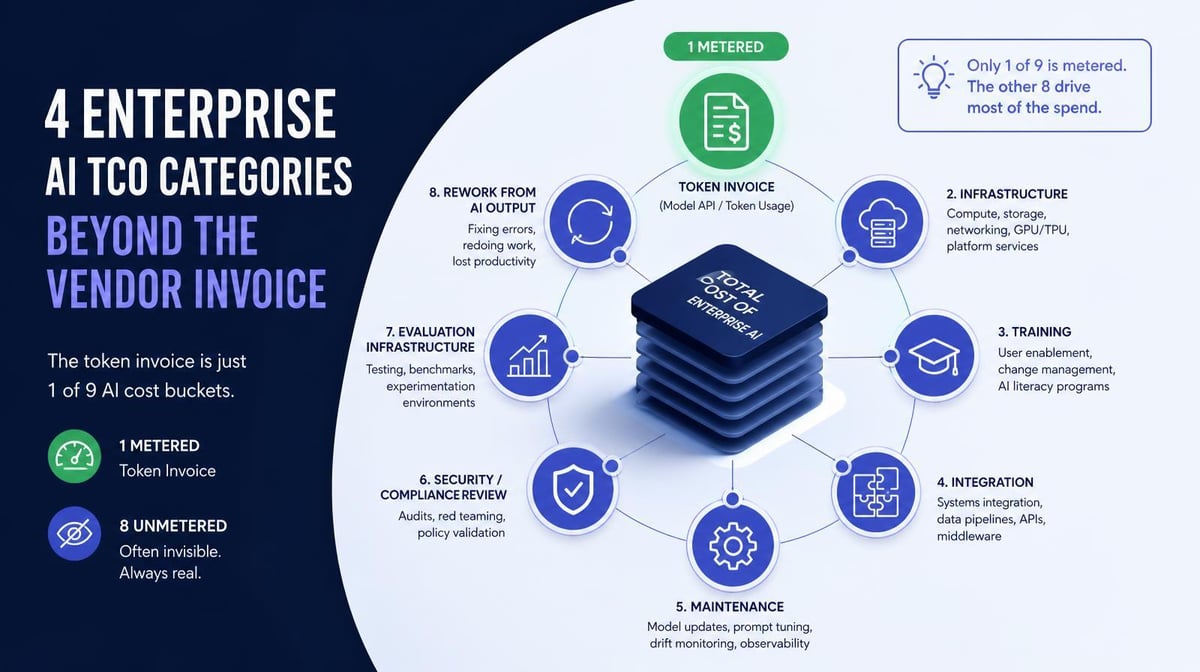

The vendor invoice only shows what you paid the vendor. It doesn’t include everything your organization spent to make AI work. The rest appears in cloud bills, engineering time, governance, review, maintenance, and rework.
Key Takeaways
- The FinOps Foundation says the useful measure for AI is the total cost of achieving a business outcome, not tokens or tool fees alone.
- Enterprise AI total cost of ownership (TCO) should include four main categories: direct AI spend, data and infrastructure, orchestration and operations, and internal labor and quality costs.
- Calculate the total by use case, then divide it by a useful output, such as a code review completed, customer query resolved, or hour saved.
Why the Invoice Is Only a Starting Point
AI spending is now a core FinOps responsibility. The 2026 State of FinOps found that 98% of respondents manage AI spend, up from 31% in 2024. It also found that 28% are beginning to include labor costs.
That shift matters because AI costs are rarely in just one system. Tokens may be on a bill from a model provider. Licenses may be part of a SaaS contract. Infrastructure could be in a cloud invoice. Integration, review, and rework usually show up as employee time.
EY makes the same point about agentic AI. Token charges are visible, but the full cost also includes infrastructure, governance, change management, risk, and other operating expenses. Its example compares a $0.04 chatbot interaction with a $1.20 orchestrated workflow that uses tools, planning, and subagents.
The vendor bill is real. It’s simply incomplete.
4 Enterprise AI TCO Categories
For planning purposes, organizations can group AI costs into four main categories. The categories are less important than making sure nothing substantial disappears between budgets.
1. Direct AI Spend
Start with the costs finance can usually see:
- Tool subscriptions and seat licenses
- Input and output tokens
- API calls
- Premium model charges
- Agent and orchestration platform licenses
- Overage fees and committed-use agreements
Even this category can be fragmented. One team may buy seats through procurement, another may use cloud-model APIs, and individual employees may expense separate tools.
Larridin’s Token Spend & Insights combines AI spending across tools and models, separates human and agent spend, and attributes it to teams, agents, and use cases. That gives finance and engineering a shared view of the direct cost.
2. Data and Infrastructure
AI systems need more than model access. Depending on the use case, this area may include:
- Cloud compute and GPUs
- Storage
- Data pipelines
- Vector databases and retrieval
- Embeddings and caching
- Fine-tuning or model adaptation
- Evaluation data and inference logs
The FinOps Foundation describes an AI lifecycle that can include training, tuning or augmentation, inference, orchestration, and operations. Most companies won’t need every phase, but they should identify which ones they’re paying for.
This is also where build-versus-buy decisions can distort the budget. A self-hosted tool may look cheaper than a managed service until the organization adds the engineering time required to operate, secure, and maintain it.
3. Orchestration and Operations
This area covers what connects a model to real users and business systems:
- Agents and subagents
- APIs and workflow pipelines
- Monitoring and observability
- Security controls
- Governance and audit trails
- Identity and permission management
- Ongoing maintenance
- Integration with existing systems
These costs often grow as AI moves from a pilot into production. A simple tool used by a small group needs less oversight than an agent that can call systems, use company data, and complete multi-step work.
EY notes that agentic systems add costs such as knowledge-base updates, agent evaluation, and human-collaboration design that may not appear on the model vendor’s invoice. These are part of operating the use case, so they belong in its TCO.
4. Internal Labor and Quality Costs
People spend time selecting tools, implementing them, learning new workflows, reviewing output, maintaining systems, and fixing problems. That time is easy to hide under existing payroll even when AI created the work.
Include labor for:
- Implementation and integration
- Training and enablement
- Prompt and workflow design
- Human review
- Security, legal, and compliance work
- Maintenance and support
- Failed runs and retries
- Defect remediation and rework
These costs can materially change the economics of AI coding tools. New Relic’s 2026 State of AI Coding report found that 74% of respondents said at least one-quarter of AI-generated code needed significant post-deployment rework. It also found that 86% reported more senior-engineer firefighting.
Larridin’s Developer Productivity platform tracks delivery and quality measures such as velocity, cycle time, AI code share, code durability, and ROI. That helps leaders see whether AI is improving work or shifting cost into review and remediation.
How to Calculate AI TCO by Use Case
A companywide AI total can show the size of the budget, but it can’t show which investments are working. The FinOps Foundation recommends measuring use case economics: the total cost of producing one unit of a business outcome.
Start with four steps.
1. Define the Outcome
Choose a unit tied to the work. Examples include:
- Cost per code review completed
- Cost per customer query resolved
- Cost per document summarized
- Cost per sales call analyzed
- Cost per hour of work saved
2. Add the Full Cost
Combine the four areas for that use case:
Direct AI spend + data and infrastructure + orchestration and operations + internal labor and quality costs
3. Divide by the Useful Output
If a use case cost $50,000 and produced 10,000 acceptable outcomes, the cost was $5 per outcome.
“Acceptable” matters. Failed runs, rejected output, and work that required substantial correction shouldn’t count as equal value.
4. Track the Trend
Review the same measure over time. Cost per outcome should improve as teams choose better models, reduce retries, streamline workflows, and become more effective with the tools.
A raw token total can’t show that progress. Neither can a seat count.
Frequently Asked Questions
Does every AI use case need all four categories?
Every use case should be checked against all four, but some areas may be small or already included in another contract. A hosted writing assistant may have little separate infrastructure cost. A production agent connected to company systems will usually require more integration, monitoring, security, and review.
Should labor be included if employees are already on payroll?
Yes, when the goal is to understand full TCO. Existing employees still spend time on implementation, oversight, maintenance, and rework. That time has an opportunity cost and may replace work they would have completed instead.
How often should we update AI TCO?
Review it at least quarterly and when the organization adds a major tool, model, agent, or workflow. AI pricing, architecture, usage, and quality can change quickly, so a cost model built during procurement can become stale before renewal.
Who owns the AI TCO calculation?
Finance can consolidate invoices and labor rates, but it can’t calculate the full cost alone. Engineering understands infrastructure, integrations, retries, and rework. Security, legal, procurement, and business owners may hold other pieces.
The FinOps Foundation describes AI cost management as a regular collaboration among finance, engineering, procurement, and operations.
See What AI Actually Costs
Larridin connects AI spending with usage, delivery, quality, and outcomes so leaders can move from a vendor total to the full cost and value of each use case.
Book a discovery call to build a clearer AI TCO picture.
Related Resources
- AI Coding Tool TCO: What a Full Cost Accounting Actually Looks Like
- The Hidden Costs of AI Coding Tools Most Engineering Leaders Miss
- AI Token Spend & Insights
- Developer Productivity Platform