

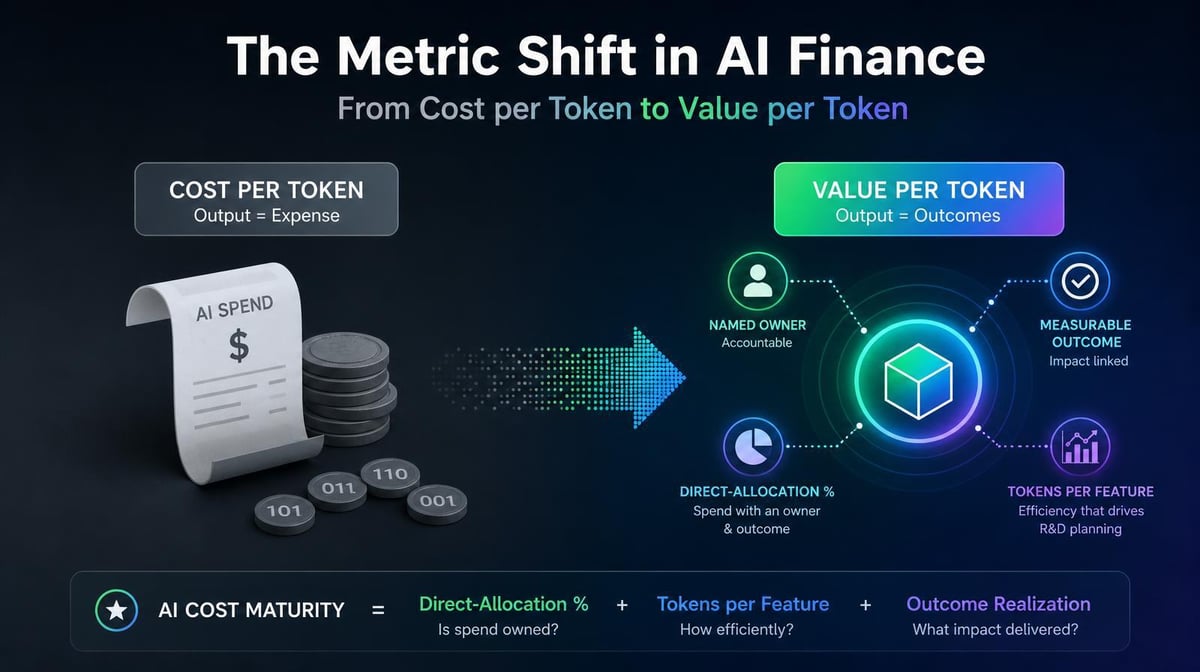

Cost per token tells you what a vendor charges. It doesn’t tell you whether those tokens produced anything useful. To understand AI ROI, teams need to connect consumption to outcomes.
Key Takeaways
- AI cost reporting gets more useful when spending is tied to a defined outcome. That gives engineering and finance a way to compare what AI costs with what it actually produces.
- Vantage identifies tokens per feature as an emerging R&D planning metric. Connecting token consumption to a specific deliverable gives engineering and finance a more useful way to discuss AI spend.
- There’s no universal value-per-token benchmark. Choose an outcome that fits the use case and track it over time.
Why Cost Per Token Is Not Enough
Two teams can consume the same number of tokens and get very different results. One may use them to ship a feature that stays in production. Another may generate code that requires extensive rework.
The token cost is the same. The value isn’t.
That’s why FinOps guidance is moving beyond raw consumption. The FinOps Foundation describes AI unit economics as starting with measures such as cost per token, then expanding to outcome-based measures such as cost per assist, agent action, or case deflected. The goal is to understand what the consumption produced.
The 2026 State of FinOps also shows how quickly AI has become part of the job. It found that 98% of respondents now manage AI spend, up from 31% in 2024. As AI spend becomes routine, leaders need more than a total bill. They need to know whether the spending is producing useful outcomes.
3 Parts of Value Per Token
1. Attribute the AI Spend
First, determine where the consumption came from. That can include the tool, team, engineer, agent, project, or use case.
Without attribution, finance sees the total AI spend but can’t tell where it came from. Engineering may know which teams are using AI heavily but not what those workflows cost across tools.
Larridin’s Token Spend and Insights platform brings AI spending together across tools and attributes it to teams, agents, and use cases. That creates the cost side of the measurement.
2. Measure the Outcome
Next, decide what the AI spending is supposed to produce.
For engineering, useful measures could include features shipped, pull requests merged, cycle time, rework, or code durability. Other AI use cases may need different units, such as customer cases resolved or hours saved.
The outcome should match the work. A lower token count isn’t an improvement if quality falls or employees have to redo the output.
Larridin’s Developer Productivity platform connects AI usage with delivery and quality signals so engineering leaders can see whether higher AI consumption is improving the work.
3. Compare Consumption With the Result
Once cost and outcome data are connected, teams can start building useful unit economics.
Vantage gives a straightforward engineering example: tokens per feature. If a team spends $3,000 in tokens to ship a feature, leaders can compare that cost with what the feature delivered.
Tokens per feature is one way to connect AI spending to what the team produced. Other teams might track cost per accepted pull request, incident resolved, or hour saved.
The goal is simple: show what the organization got for the money it spent.
Start With a Useful Measure, Not a Perfect One
Value per token doesn’t need to be the only companywide ratio.
Different AI use cases create different kinds of value. Engineering may care about delivery and code quality. Customer support may care about cases resolved.
Start at the team or use-case level. Attribute the spend, choose an outcome that matters, and track the relationship over time.
The FinOps Foundation makes a similar recommendation in its token economics guidance: build visibility and attribution first, then use unit economics to connect AI costs to business value.
That approach also makes the metric more useful over time. If a team’s token consumption rises 30% while useful output rises 50% with stable quality, the higher bill may be justified. If consumption doubles while output stays flat, the same increase deserves a closer look.
Frequently Asked Questions
What is a good value per token benchmark?
There isn’t a universal benchmark. The right measure depends on the use case, the value of the output, tool and model costs, and quality requirements. Start with your own baseline and compare the same unit over time.
Larridin’s Developer Productivity Benchmarks 2026 can help teams evaluate overall AI coding ROI. This metric answers a narrower question: what did the organization get for its AI spending?
How do we start if we don’t have detailed attribution?
Start at the team and tool level. Compare that spending with a small number of delivery or business outcomes you already track. More detailed attribution can improve the analysis later, but a useful first measurement is better than an aggregate AI total with no outcome attached.
Is tokens per feature actually calculable?
Yes, if the organization can connect AI consumption to the work that produced a feature. The exact method depends on the tools and data available. The goal isn’t perfect token-level accounting for every line of code. It’s enough attribution to make the cost of the deliverable visible.
How does agentic AI affect value per token?
Agentic workflows can use more compute because they may involve multiple model calls, tool use, retries, and longer context. That makes outcome measurement more important. Higher consumption can be worthwhile if it produces proportionately more value. If output or quality doesn’t improve with the added cost, unit economics will show the problem.
Measure What the Tokens Produce
Larridin connects AI spending with engineering delivery and quality data so leaders can see what higher consumption is producing, not just what it costs.
Book a discovery call to connect your AI spend to outcomes.