
Enterprise AI Measurement Guide
Workflow Intelligence
Potential Savings
How many hours of potential savings does the Workflow Intelligence tab estimate from automating high-friction workflow steps?
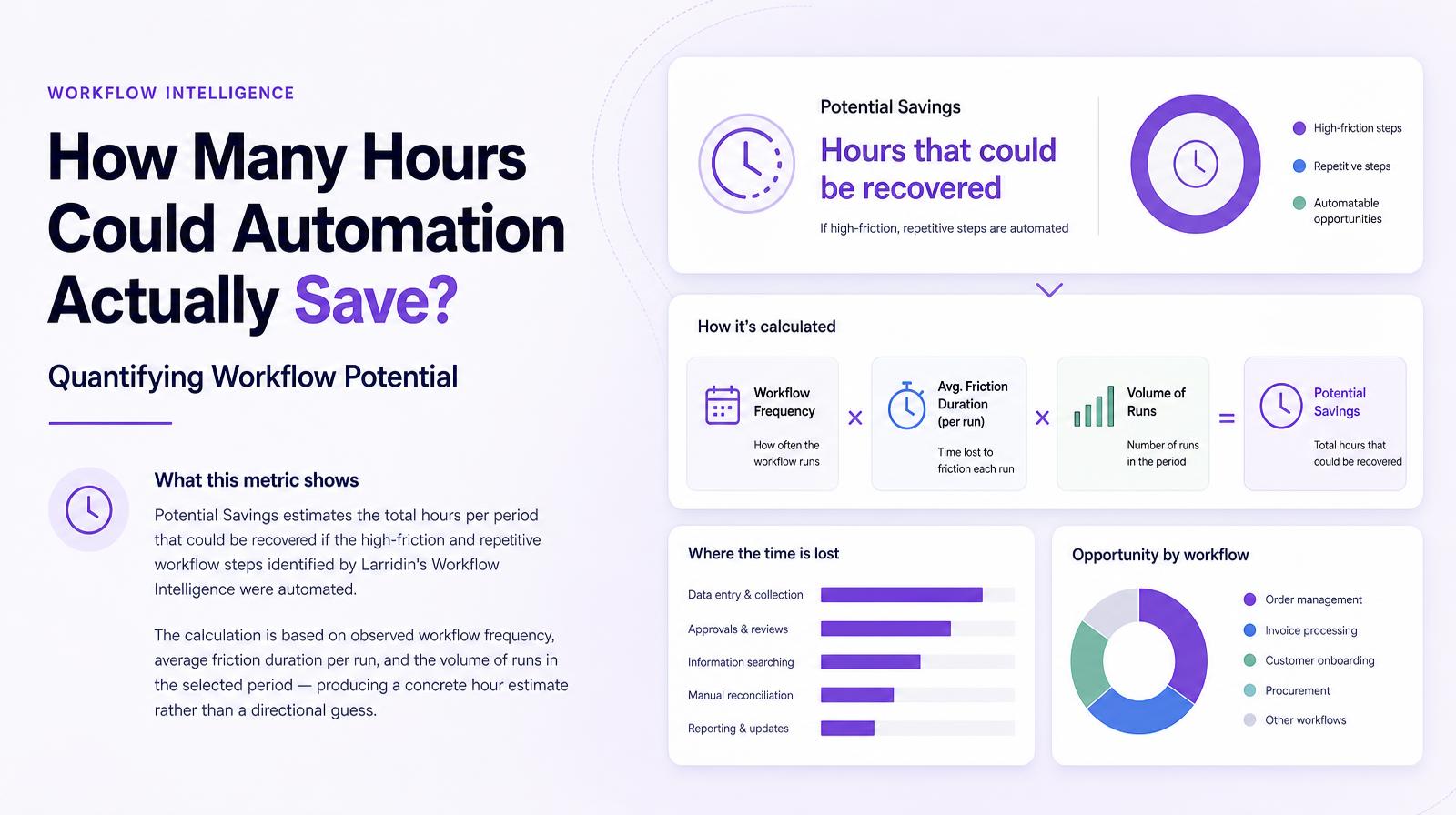
What it shows
Potential Savings estimates the total hours per period that could be recovered if the high-friction and repetitive workflow steps identified by Larridin's Workflow Intelligence were automated. The calculation is based on observed workflow frequency, average friction duration per run, and the volume of runs in the selected period, producing a concrete hour estimate rather than a percentage reduction target. This is the number that converts workflow friction from an operational complaint into a business case.
Why it matters
Potential Savings is the metric that makes the workflow automation conversation financially legible. Larridin customer data shows one organization with 474 tracked workflows, only 2 flagged as high-friction, but 6.7 days of potential savings, more than a separate team with 6 high-friction workflows across fewer runs, because moderate friction repeated across hundreds of workflow runs accumulates faster than severe friction in rare ones. CFOs and COOs need the quantified hour estimate, not the friction label, to make resource allocation decisions about where to invest in automation.
The Larridin angle
Larridin's Potential Savings estimate is workflow-volume-aware, it weights by how often each friction source runs, not just how bad the friction is per run. This is the insight that prevents organizations from investing in fixing the most painful workflow rather than the most costly one. The two are often different, and the hour estimate is what makes that difference visible.
Related Workflow Intelligence Metrics
Common questions
What is the Potential Savings metric in Larridin's Workflow Intelligence?
Potential Savings estimates the total hours that could be recovered by automating high-friction workflow steps, based on workflow frequency, average friction duration, and volume of runs.
Why is the Potential Savings metric important for the C-suite?
It provides a quantified hour estimate that helps CFOs and COOs make informed decisions about resource allocation for automation investments.
How does Larridin's Potential Savings differ from other friction metrics?
Larridin's estimate considers workflow volume, highlighting the most costly friction sources rather than just the most severe ones.
Can moderate friction in workflows be more costly than severe friction?
Yes, moderate friction repeated across many workflow runs can accumulate more potential savings than severe friction occurring infrequently.