
Enterprise AI Measurement Guide
Workflow Intelligence
Friction Index
What does the Friction Index score and trend show about workflow effort in the Workflow Intelligence tab?
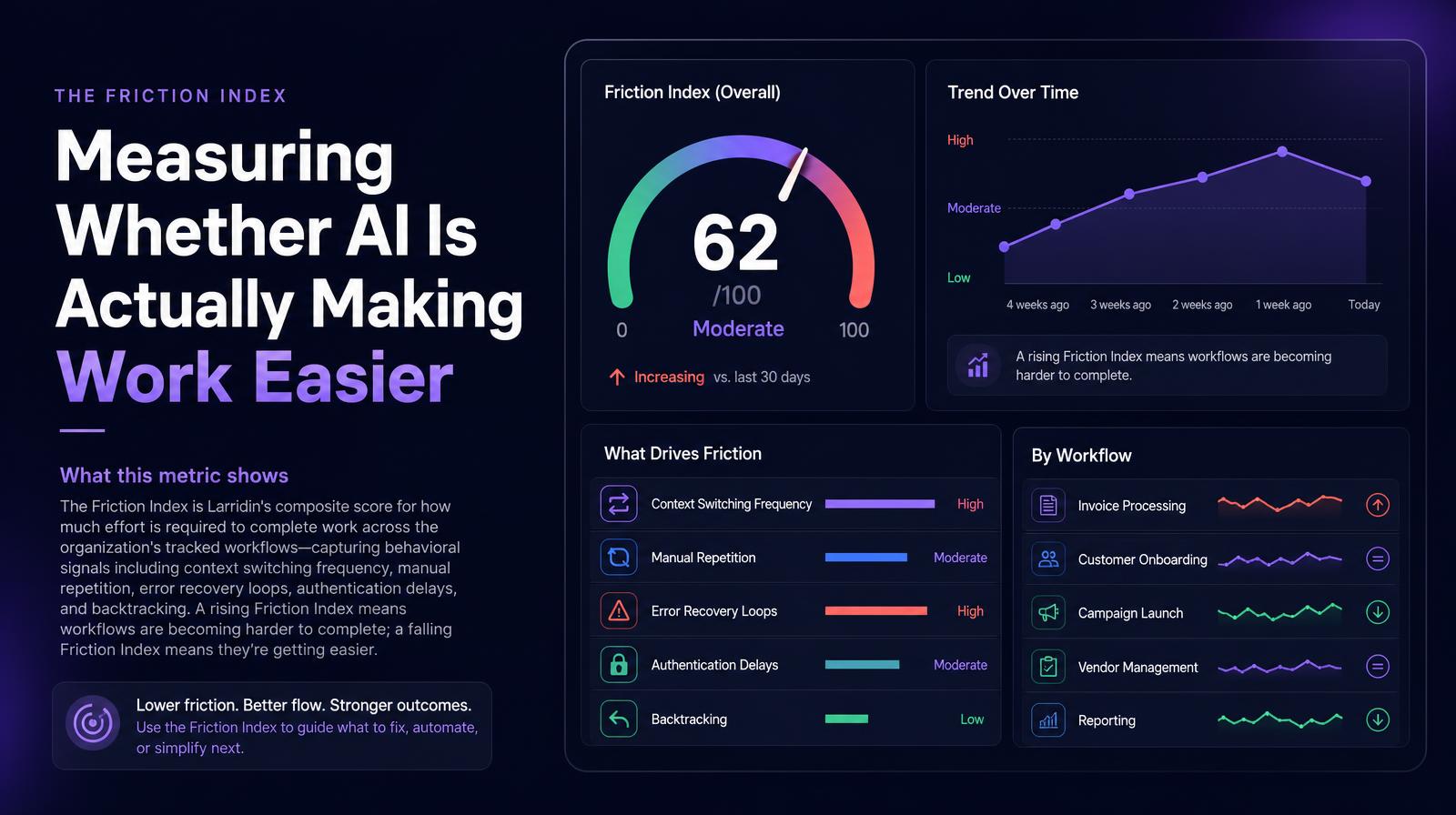
What it shows
The Friction Index is Larridin's composite score for how much effort is required to complete work across the organization's tracked workflows, capturing behavioral signals including context switching frequency, manual repetition, error recovery loops, authentication delays, and backtracking. A rising Friction Index means workflows are becoming harder to complete; a falling index means they're becoming easier. The trend shows whether AI investment is reducing friction or, in some cases, adding a new layer of complexity to manage.
Why it matters
The Friction Index answers the question that AI adoption metrics cannot: is AI actually making the work easier? Larridin customer data shows a documented case where AI in Workflows rose 36% over four weeks while the Friction Index also rose 8%, AI appearing more often in tracked workflows without making them less effortful. WalkMe's 2026 research found employees lose 51 workdays per year to technology friction. Workday's 2026 research found nearly 40% of AI time savings are lost to correcting, verifying, or rewriting low-quality output. The Friction Index is the enterprise measurement that surfaces that paradox before it disappears into a usage dashboard.
The Larridin angle
Larridin's Friction Index is built from behavioral telemetry, observed application sequences, transition patterns, and error recovery behaviors, rather than from employee surveys or self-reported friction. That makes it a system-measured fact rather than a perception metric, which means it can be compared across time and across teams without the bias that survey instruments introduce.
Related Workflow Intelligence Metrics
Common questions
What is the Friction Index?
The Friction Index is Larridin's composite score that measures the effort required to complete work across tracked workflows, indicating whether AI is making work easier or adding complexity.
How does the Friction Index differ from traditional AI adoption metrics?
Unlike traditional AI adoption metrics, the Friction Index reveals whether AI is genuinely reducing workflow friction by tracking behavioral signals rather than relying on self-reported data.
Why is the Friction Index important for the C-suite?
The Friction Index provides insights into whether AI investments are truly easing work processes or inadvertently creating additional challenges, helping executives make informed decisions.
How is the Friction Index calculated?
The Friction Index is calculated using behavioral telemetry, which includes observed application sequences, transition patterns, and error recovery behaviors, ensuring an unbiased measurement.