
Enterprise AI Measurement Guide
CI/CD
Deploy MTTR
How does Deploy MTTR measure recovery time from deployment failures in the CI/CD tab, and how does it relate to Change Failure Rate?
What it shows
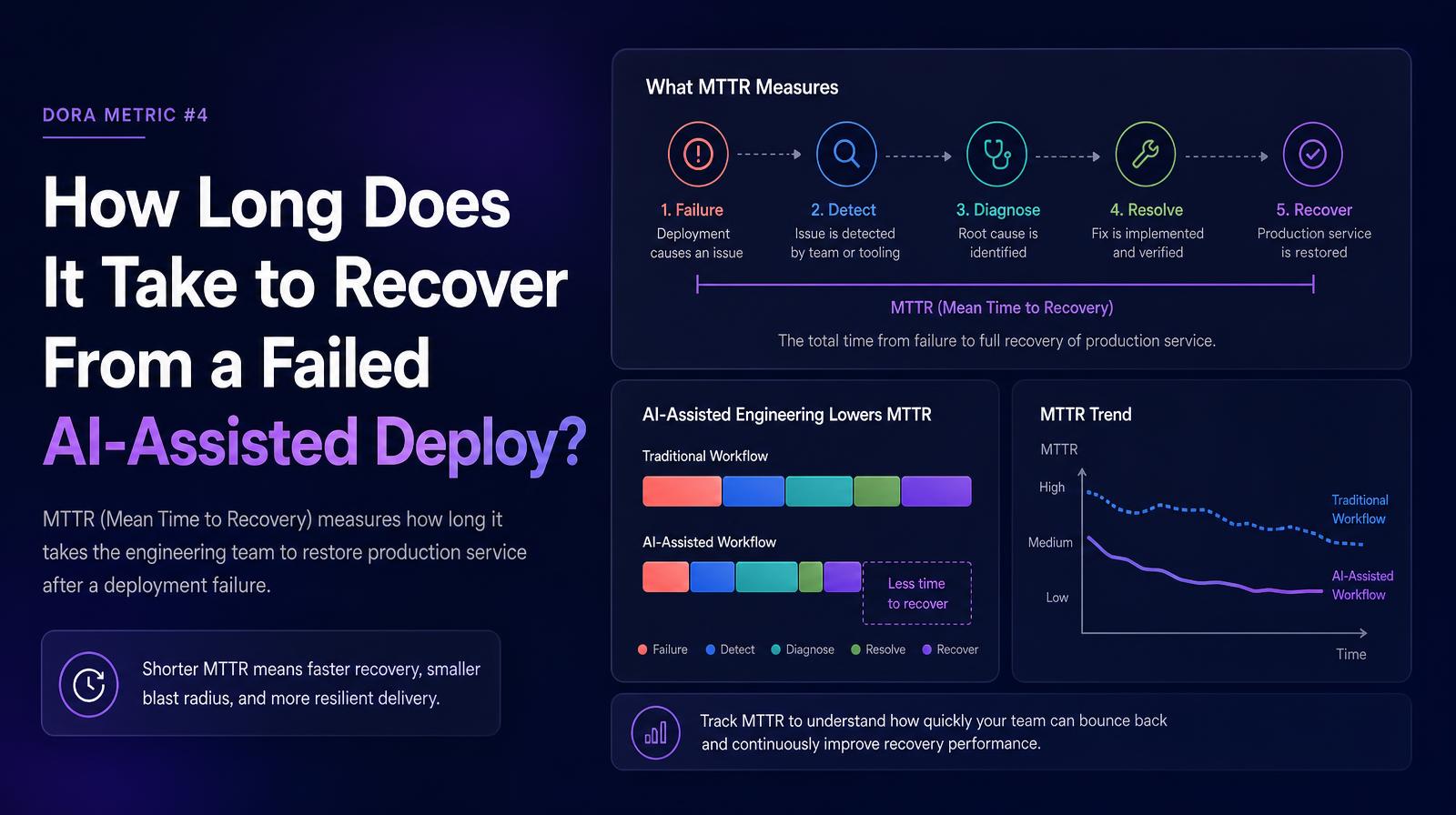
Deploy MTTR (Mean Time to Recovery) measures how long it takes the engineering team to restore production service after a deployment failure, the fourth DORA metric. A shorter MTTR means the team can detect, diagnose, and resolve production issues quickly, limiting the blast radius of any individual failure. In AI-assisted engineering environments, MTTR often improves even as Change Failure Rate rises, because the same AI tools that generate more failures also accelerate the debugging and hotfix cycle.
Why it matters
MTTR improvement is sometimes the one bright spot in a CI/CD picture where other metrics are moving the wrong direction after AI agent adoption. Larridin customer data shows Deploy MTTR improving (down 121%) in the same window where Change Failure Rate rose 83%, faster recovery even as failures increased. That pattern is valuable context: it distinguishes an engineering org that breaks production more often but recovers quickly from one where failures are both more frequent and more damaging. The distinction matters for incident risk assessment, SLA management, and board reporting.
The Larridin angle
Larridin surfaces MTTR alongside Change Failure Rate in the same tab, making the recover-faster-even-as-we-break-more pattern visible as a combined signal. That combination is the one CTOs need to present to boards and CISOs when explaining that rising failure rates are accompanied by shrinking recovery windows, which changes the risk profile materially.
Related CI/CD Metrics
Common questions
What is Deploy MTTR?
Deploy MTTR measures the time it takes for an engineering team to restore production service after a deployment failure.
How does AI affect Deploy MTTR?
AI tools can improve Deploy MTTR by accelerating the debugging and hotfix cycle, even as they may increase the Change Failure Rate.
Why is Deploy MTTR important for the C-suite?
Deploy MTTR is crucial for incident risk assessment, SLA management, and board reporting, as it shows how quickly a team can recover from production failures.
How does Larridin help track Deploy MTTR?
Larridin provides visibility into Deploy MTTR alongside Change Failure Rate, helping CTOs and CISOs understand the impact of AI on deployment recovery times.