
Enterprise AI Measurement Guide
CI/CD
Change Lead Time
Where in the delivery pipeline is time accumulating, and how does Change Lead Time's stage breakdown show the specific constraint?
What it shows
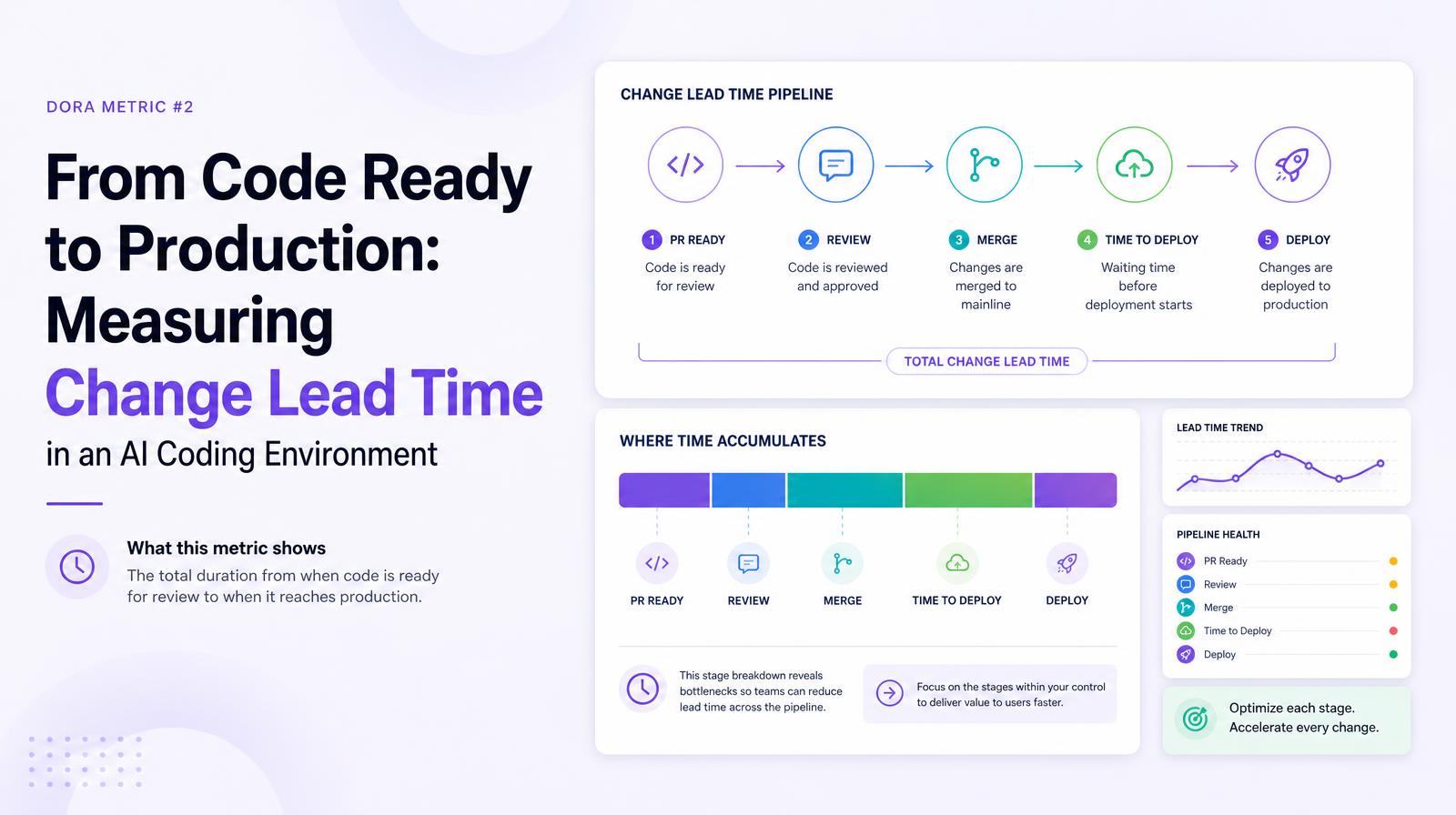
Change Lead Time measures the total duration from when code is ready for review to when it reaches production, the second core DORA metric. Larridin's implementation breaks this into five pipeline stages: PR ready, Review, Merge, Time to deploy, and Deploy, showing where time accumulates across the full delivery pipeline, not just the aggregate duration. This stage breakdown is the diagnostic layer that makes lead time actionable rather than just measurable.
Why it matters
Change Lead Time is the metric that reveals whether AI coding agents are actually accelerating delivery or just accelerating code generation. In multiple Larridin customer instances, Deployment Frequency rose sharply after agent adoption while Change Lead Time also rose, because agents generate code faster than human review capacity can process it. The bottleneck moved from generation to review. The stage breakdown in Larridin's CI/CD tab shows exactly where the time is accumulating: if PR ready is instantaneous but Review sits at 1h 2m and Merge at 57m, the investment needed is in review infrastructure, not in more agent capacity.
The Larridin angle
The five-stage pipeline breakdown is unique to Larridin's Change Lead Time implementation. Most CI/CD tools show aggregate lead time; Larridin shows where that time sits in the pipeline, making the constraint visible and the intervention obvious. Stage-level lead time is the data engineering leaders need to make the "invest in review tooling" case to the CTO and CFO.
Related CI/CD Metrics
Common questions
What is Change Lead Time in the context of AI coding?
Change Lead Time measures the duration from when code is ready for review to when it is deployed to production, broken down into five stages: PR ready, Review, Merge, Time to deploy, and Deploy.
Why is Change Lead Time important for the C-suite?
Change Lead Time helps determine if AI coding agents are truly accelerating delivery or just speeding up code generation, highlighting bottlenecks in the review process.
How does Larridin's Change Lead Time differ from other CI/CD tools?
Unlike most CI/CD tools that show aggregate lead time, Larridin provides a detailed breakdown of where time accumulates in the pipeline, making it easier to identify and address bottlenecks.
What insight can Larridin's Change Lead Time provide to engineering leaders?
Larridin's Change Lead Time helps engineering leaders pinpoint which stages of the pipeline need investment, such as review infrastructure, to effectively reduce end-to-end lead time.