
Enterprise AI Measurement Guide
CI/CD
Change Failure Rate
What percentage of deployments result in a production failure, and how is that rate trending as AI coding agents increase deployment frequency?
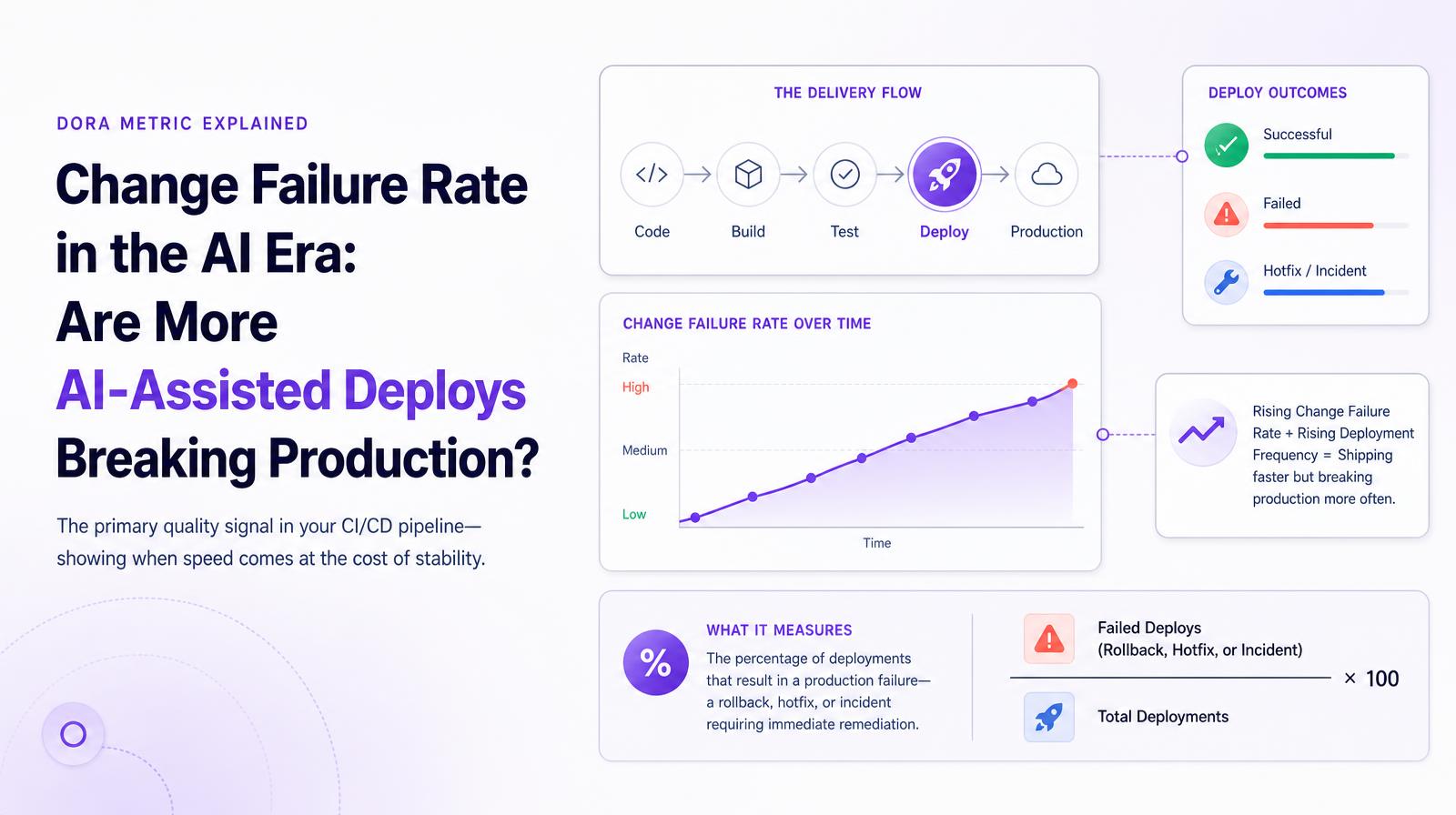
What it shows
Change Failure Rate measures the percentage of deployments that result in a production failure, a rollback, hotfix, or incident requiring immediate remediation. As a DORA metric, it is the primary quality signal in the CI/CD pipeline: a rising Change Failure Rate alongside rising Deployment Frequency means the team is shipping faster but breaking production more often, which is the signature pattern of AI agent adoption without commensurate review investment.
Why it matters
Change Failure Rate is the check on Deployment Frequency. When AI coding agents increase deploy velocity, the Change Failure Rate determines whether that velocity is creating value or creating incidents. Larridin customer data shows Change Failure Rate rising 83% in the same 12-week window where Deployment Frequency rose 10x, a pattern that indicates the review and testing infrastructure didn't scale alongside agent output volume. CISOs and CTOs tracking only deploy counts are systematically unaware of this tradeoff until an incident makes it visible.
The Larridin angle
Larridin's Change Failure Rate trend surfaces the velocity-stability tradeoff as a continuous signal rather than a post-incident finding. The trend line is specifically useful because it shows whether the failure rate is stabilizing as teams adapt to agent output (suggesting the tradeoff is temporary) or continuing to climb (suggesting structural review and testing investment is needed).
Related CI/CD Metrics
Common questions
What is Change Failure Rate in the context of AI-assisted deployments?
Change Failure Rate measures the percentage of AI-assisted deployments that result in production failures, such as rollbacks or incidents needing immediate remediation.
Why is Change Failure Rate important for C-suite executives?
Change Failure Rate helps executives understand if increased deployment velocity from AI coding agents is adding value or causing more production incidents.
How does Larridin's Change Failure Rate trend help teams?
Larridin's trend line provides a continuous signal of the velocity-stability tradeoff, helping teams see if failure rates are stabilizing or if more review and testing investment is needed.
What pattern has Larridin observed with Change Failure Rate and Deployment Frequency?
Larridin observed an 83% rise in Change Failure Rate when Deployment Frequency increased 10x, indicating a lack of scaling in review and testing infrastructure.