
Enterprise AI Measurement Guide
Desktop Analytics
Top 5 AI Tools
Which five desktop AI tools have the most active users, and what does that ranking tell us about our tool portfolio?
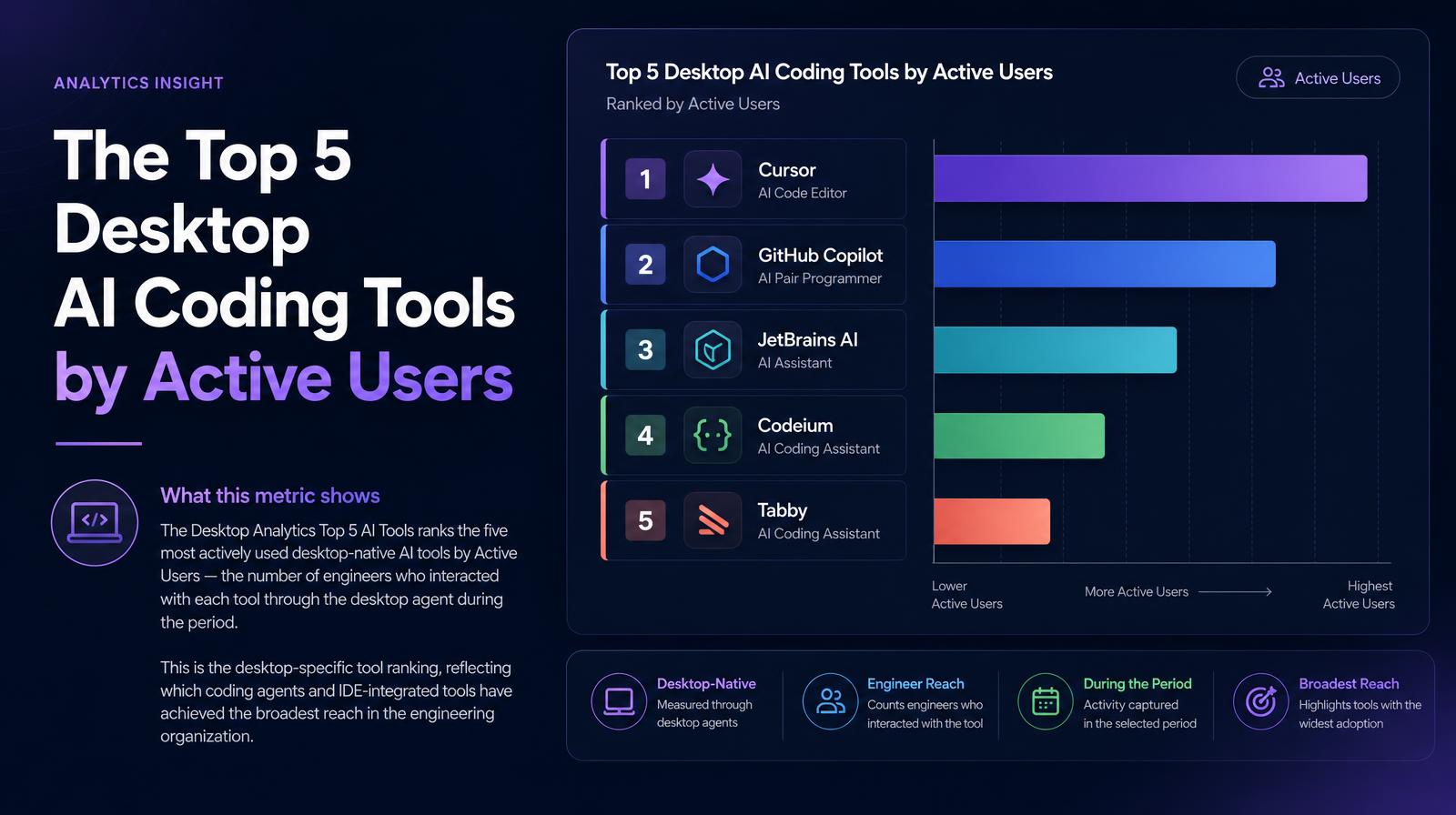
What it shows
The Desktop Analytics Top 5 AI Tools ranks the five most actively used desktop-native AI tools by Active Users, the number of engineers who interacted with each tool through the desktop agent during the period. This is the desktop-specific tool ranking, reflecting which coding agents and IDE-integrated tools have achieved the broadest reach in the engineering organization.
Why it matters
The desktop top-5 list is the engineering AI tool landscape in its most consequential form, these are the tools generating AI-assisted code, the agents running complex tasks, and the applications driving most of the AI token spend in the engineering cost center. For CTOs managing a multi-tool engineering AI stack (Claude Code, Cursor, Codex, Copilot CLI), the desktop top-5 by active users shows which tools are genuinely preferred for daily development work versus which were trialed and abandoned. That preference data should drive procurement, support investment, and training program prioritization.
The Larridin angle
The desktop top-5 ranking is the ground truth for engineering AI tool decisions that browser analytics cannot provide, because the most impactful engineering AI tools (Claude Code, Cursor, Codex) are desktop-native and entirely invisible to browser-only measurement. Organizations making engineering AI tool decisions without desktop analytics data are making portfolio choices based on incomplete or systematically biased usage data.
Related Desktop Analytics Metrics
Common questions
What does the 'Active Users' metric indicate in the context of desktop AI tools?
The 'Active Users' metric measures the number of engineers who interacted with each desktop-native AI tool through the desktop agent during a specific period.
Why is the desktop top-5 AI tools ranking significant for CTOs?
The ranking helps CTOs understand which AI tools are genuinely preferred for daily development work, influencing procurement, support investment, and training program priorities.
How does the desktop top-5 ranking differ from browser analytics?
The desktop ranking provides insights into the most impactful engineering AI tools that are invisible to browser-only measurement, offering a more complete view of tool usage.
What should organizations consider when making AI tool decisions without desktop analytics data?
Organizations risk making portfolio choices based on incomplete or biased data if they rely solely on browser analytics without incorporating desktop analytics insights.