
Enterprise AI Measurement Guide
Desktop Analytics
AI Adoption
What percentage of our workforce is using AI tools through desktop activity, and how is that percentage changing?
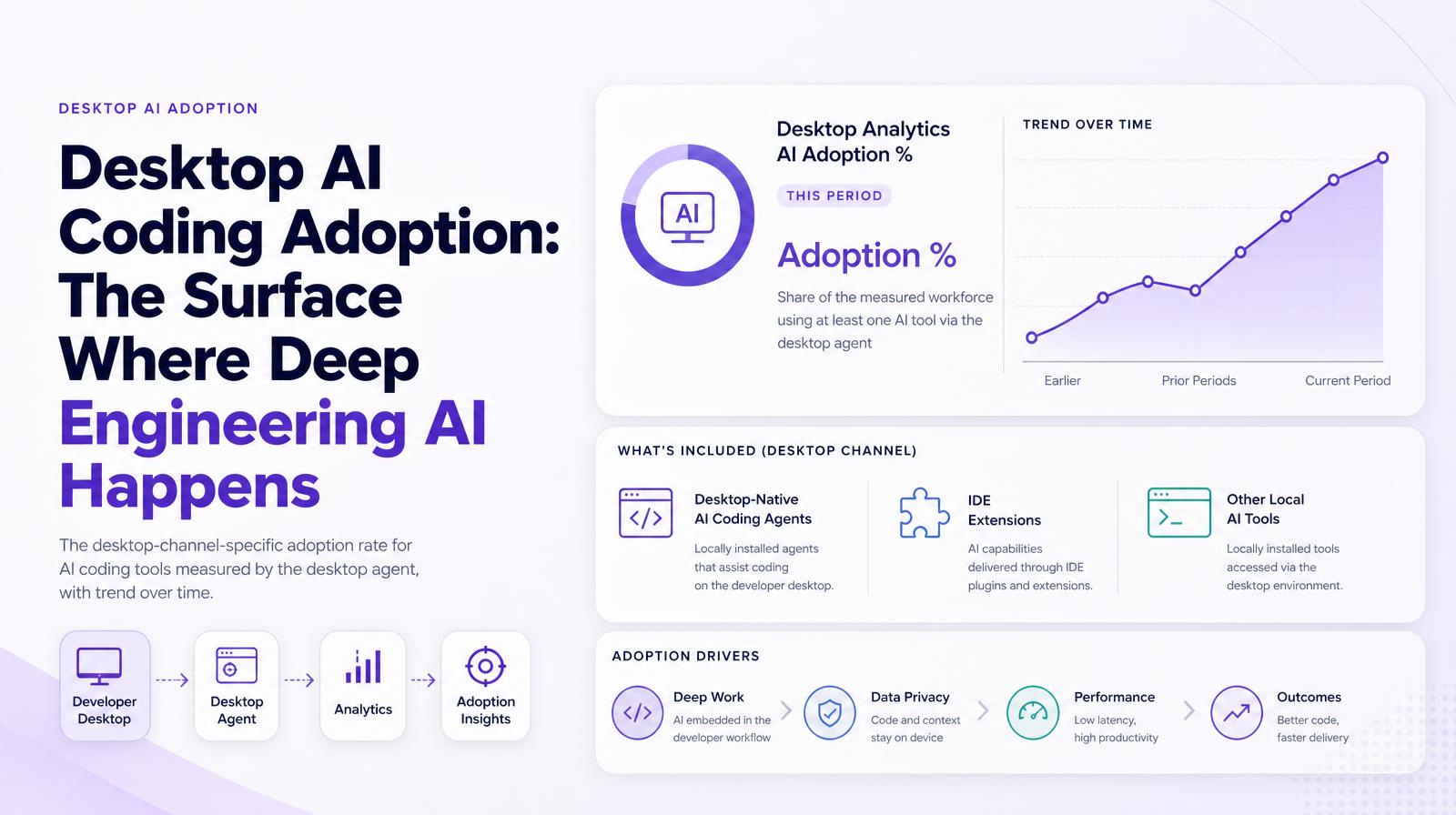
What it shows
The Desktop Analytics AI Adoption % shows the share of the measured workforce using at least one AI tool through the desktop agent in the selected period, with a trend. This is the desktop-channel-specific adoption rate, reflecting usage of desktop-native AI coding agents, IDE extensions, and other locally installed AI tools that the desktop agent captures. Desktop adoption typically lags browser adoption in breadth but significantly exceeds it in per-user engagement depth.
Why it matters
Desktop adoption rate is the proxy for mature AI integration in engineering workflows. Claude Code, Cursor, Copilot IDE, and similar tools are where the highest-intensity AI-assisted coding happens, and they are captured by the desktop agent, not the browser extension. A rising desktop adoption trend in engineering teams signals the transition from casual AI tool use to AI-native development practice. A gap between browser adoption and desktop adoption is the strategic AI maturity gap most engineering leaders should be actively closing.
The Larridin angle
Larridin's desktop agent deployment is what makes coding agent adoption visible, Claude Code, Cursor, and similar terminal-based or IDE-integrated tools generate no browser telemetry. Without the desktop agent, those tools are completely invisible to enterprise AI measurement, which means an organization measuring only browser adoption is missing the highest-value and highest-cost portion of its engineering AI tool usage.
Related Desktop Analytics Metrics
Common questions
What does the Desktop Analytics AI Adoption % measure?
It measures the share of the workforce using at least one AI tool through the desktop agent during a selected period, focusing on desktop-native AI coding agents and tools.
Why is desktop AI adoption important for engineering teams?
Desktop AI adoption is a proxy for mature AI integration in engineering workflows, indicating a shift from casual use to AI-native development practices.
How does desktop AI adoption differ from browser adoption?
Desktop adoption typically lags in breadth but exceeds browser adoption in per-user engagement depth, capturing high-intensity AI-assisted coding activities.
Why might an organization miss key AI tool usage data?
Without a desktop agent, tools like Claude Code and Cursor are invisible to enterprise AI measurement, as they generate no browser telemetry.