


Published August 18, 2026
Enterprise AI spending is accelerating, but measuring what it actually produces hasn’t kept pace. Workday’s January 2026 research found that 85% of employees surveyed save one to seven hours per week with AI. Yet nearly 40% of those time savings are lost to rework, including correcting errors, rewriting content, and verifying outputs. Only 14% consistently get clear, positive net outcomes from AI use. Time saved isn’t the same as value created.
The spend side of the equation is moving just as quickly. Larridin reported that enterprise AI token spending surged 13x in six months as usage increased and billing shifted toward consumption-based models. When spend can move that fast, measuring adoption without cost and outcomes leaves leaders with an incomplete ROI picture.
If you’re a CFO, CIO, or transformation leader trying to answer “what’s the best enterprise tool to measure AI ROI,” the answer depends on which part of ROI you need to see. Here are five tools worth evaluating.
What “Measuring AI ROI” Actually Requires
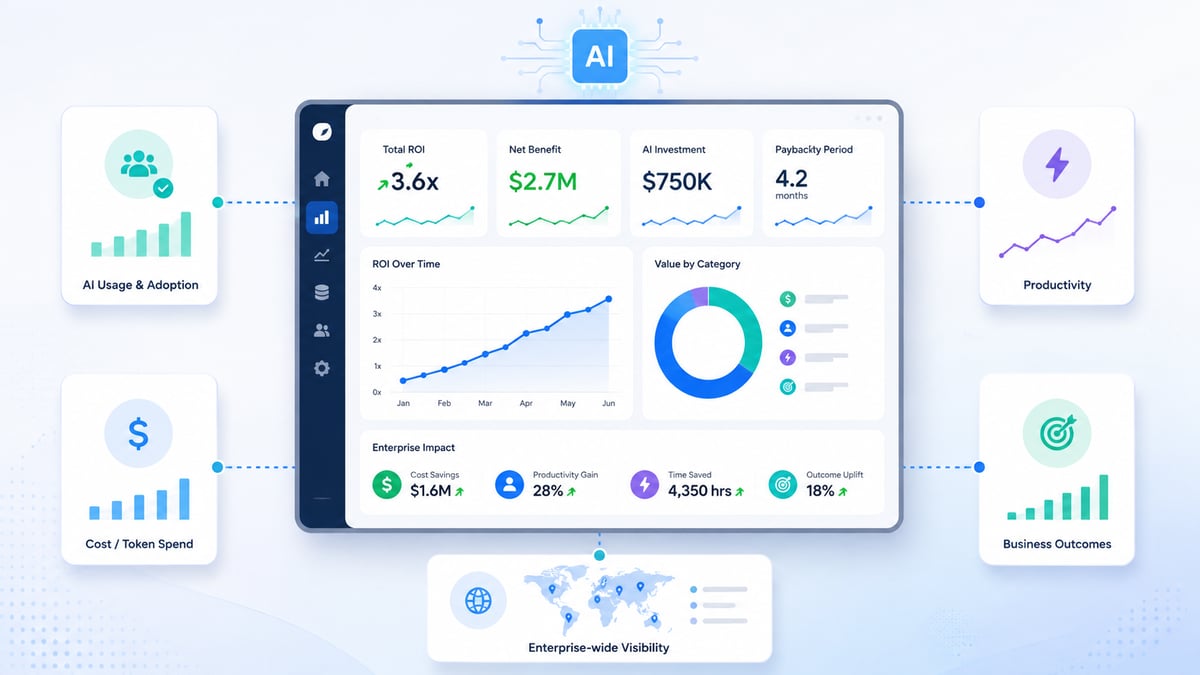
A dashboard showing login counts or token spend alone isn’t ROI. A useful measurement approach connects several layers: which AI tools are actually in use, including shadow AI and embedded features; how deeply and effectively people and agents are using them; what AI costs across licenses, tokens, agents, APIs, and infrastructure; and what changes in workflows and business outcomes alongside that usage.
The tools below cover different parts of that chain. Some focus on engineering, some on workforce adoption, and some on GenAI spend and use-case economics. The right fit depends on what you need to measure.
1. Larridin
Larridin is built for the enterprise-wide version of AI ROI: what AI is being used, how deeply teams are adopting it, what it costs, and where it is changing work and business outcomes. The platform spans adoption measurement, AI Fluency, workflow intelligence, developer intelligence, and spend intelligence across human and agent work.
Best for: CFOs, CIOs, CHROs, and transformation leaders who need one measurement layer across teams, tools, workflows, human and agent activity, spend, and outcomes.
Limitation: If your ROI needs are narrowly focused on specialized engineering delivery metrics or developer benchmarking, an engineering-specific platform may go deeper in that lane.
2. Ascerta
Ascerta focuses on GenAI ROI, cost, and capacity management. Its platform maps AI costs to business KPIs at the use-case level, tracks budgets and ROI by business unit, team, use case, or agent, and helps organizations decide which GenAI initiatives to scale, optimize, or cut.
Best for: Organizations that need detailed financial accountability for GenAI initiatives, agents, model usage, and technical capacity.
Limitation: Ascerta’s measurement model is centered on GenAI initiatives and use cases. It’s less focused on workforce AI adoption depth, fluency, and workflow discovery across the broader employee tool ecosystem.
3. Worklytics
Worklytics approaches AI ROI through workforce analytics. Its AI adoption capabilities aggregate usage across tools such as Copilot, Gemini, and ChatGPT Enterprise and connect that usage to collaboration and productivity signals from calendars, email, project tools, and other workplace systems.
Best for: HR, People Analytics, and operations teams that want to understand who is adopting AI and whether higher adoption correlates with changes in workforce productivity and collaboration.
Limitation: Worklytics’ core lens is employee adoption and workforce analytics, making it a less direct fit when the primary question is autonomous-agent economics or technical GenAI capacity management.
4. Jellyfish
Jellyfish measures AI ROI inside software engineering. Its AI Impact product connects AI-tool adoption and spend to delivery outcomes such as throughput, cycle time, code quality, productivity, and cost efficiency across the software development lifecycle.
Best for: CTOs and engineering leaders who need to understand whether AI coding tools and agents are improving delivery and whether engineering AI spend is producing value.
Limitation: Jellyfish’s ROI lens is centered on engineering and the software development lifecycle rather than AI activity across sales, HR, finance, operations, and other functions.
5. GetDX
GetDX combines engineering productivity measurement with an AI measurement framework focused on utilization, impact, and cost. It brings together system data, developer-reported signals, benchmarking, and engineering productivity frameworks to help leaders evaluate AI-assisted development.
Best for: Engineering organizations that want research-backed measurement of AI adoption, developer impact, and cost alongside broader developer productivity signals.
Limitation: GetDX is designed around software engineering and developer experience, so it doesn’t provide the same enterprise-wide view across non-engineering teams and workflows.
Choosing the Right Fit
The market is more of a set of platforms measuring different layers of the problem than a collection of interchangeable AI ROI tools. Ascerta goes deep on GenAI economics and capacity. Worklytics connects employee AI adoption to workforce signals. Jellyfish and GetDX focus on engineering. Larridin is built around the broader enterprise question, connecting AI adoption, fluency, workflows, spend, and outcomes across human and agent work.
That makes scope the first buying decision. If leadership needs an enterprise-wide view of what AI costs and what the organization gets back, choose a platform designed to follow AI across functions and workflows. If measurement is tightly scoped to engineering, workforce analytics, or GenAI infrastructure, a specialist may be the more direct fit. A broad measurement layer and a specialist tool can also serve complementary roles when they answer different questions.