

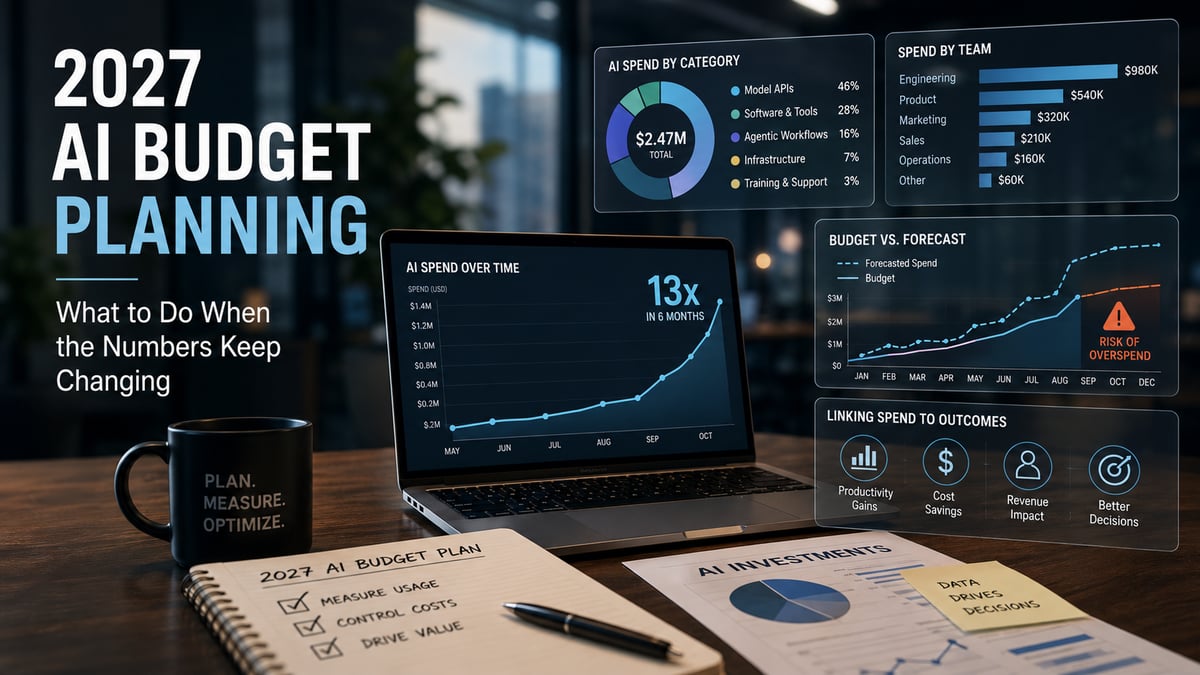

AI token spending surged 13x in just six months. If your 2027 budget still treats AI like a fixed subscription line item, the bill may surprise you.
Enterprise leaders are being asked to plan 2027 AI spend now, but the numbers they’re working from may already be out of date.
That’s not just a pricing problem. It’s a measurement problem.
AI costs have shifted from predictable, seat-based subscriptions to usage-based token billing, agentic workflows, and background API calls. As a result, costs have surged upward. That means AI budget planning has to become part of AI measurement and optimization: knowing what teams are using, how much it costs, and which activity creates business value.
Key Takeaways
- AI token costs are difficult to predict under consumption-based billing because usage patterns are continuing to change, usually upward.
- Accurate budgeting requires visibility into actual spend by team, tool, workflow, and outcome, not just invoice totals.
- AI spend can’t be optimized, nor connected to outcomes, until it’s measured.
Key Terms
- AI budget: The total planned spend on AI tools, subscriptions, API usage, token consumption, training, and internal resources across your organization.
- Token: A unit of data that AI models process. More complex tasks consume more tokens, which typically increases cost.
- Consumption-based pricing: A billing model where costs scale with usage rather than a fixed seat fee.
- Token spend: The dollar cost of AI token usage, often difficult to see without dedicated tracking.
- Return on investment (ROI): The measurable business value returned from a given investment, linking AI costs to real outcomes.
Quick Navigation
- Why This Budget Season Feels Different
- How Big Is the Actual Spend Gap?
- How to Build a 2027 AI Budget That Holds Up
- What Proving AI ROI Actually Requires
- How Larridin Helps You Get Ahead
- Frequently Asked Questions
Why This Budget Season Feels Different
Software budget planning used to start with last year’s licenses, renewals, and headcount as a baseline. AI spend doesn’t work that way anymore.
The subscription costs line item still matters, but it’s no longer the full picture. More AI costs now scale with consumption: prompts, outputs, model calls, agentic workflows, and API usage. Gartner predicts that by 2028, AI coding costs will surpass the average developer salary, due to rising token consumption and the shift to consumption-based licensing models.
Agentic workflows can run around the clock, so token usage compounds. A modest Q1 cost can double by Q3, even with no new tools added, if more teams start using AI, workflows run longer or more often, or tasks become more complex.
That makes 2027 budgets harder to create, defend, and stay within. Last year’s budget line can’t show where usage is accelerating, which teams are creating value, or which workflows are consuming tokens without return.
This is why AI budget planning now requires AI measurement and optimization. Leaders need to understand what’s being used, where spend is going, how spend is tracking against budget limits, and whether AI activity is producing measurable value.
How Big Is the Actual Spend Gap?
The spend gap can be significant. We launched Larridin Token Spend & Insights in response to enterprise token spending surging 13x in just the past six months. This had two sets of drivers: increased usage, and shifts in billing practices.
Increased usage comes from more people using AI; greater use of AI per person; and the shift to agentic AI. Agentic AI uses more tokens, often on a round-the-clock basis rather than when prompted. And agentic AI token use includes software infrastructure for managing agents and resolving conflicts, all of which burns more tokens.
Shifts in billing practices come from a shift to consumption-based pricing for most usage; previously, usage tiers covered most token burn within flat tiers. And the cost of premium tiers, which include access to the most advanced models, has risen.
In our work with clients, organizations usually begin with the belief that they have a clear picture of their current AI costs. But they often discover significant untracked usage once they measure it properly. Agentic workflows, shadow AI tools, and background API calls are usually the culprits.
That hidden spend matters, because leaders can’t manage what they don’t see. When token usage is buried in vendor invoices, team expense reports, or costs for agentic AI software infrastructure, the full cost of AI may not be clear until after costs have already been incurred—and risen.
How to Build a 2027 AI Budget That Holds Up
Audit What You’re Already Spending
Before adding anything to the plan, understand what’s already running. A real AI spend audit goes beyond invoices, and includes:
- AI platform subscriptions, such as Github Copilot, Microsoft Copilot, Google Gemini, and ChatGPT Enterprise
- Direct API and token costs, based on consumption, from model providers
- Agentic workflows running on your computing infrastructure
- Shadow AI tools expensed outside formal IT approval
- Training, enablement, and internal support costs
This audit often surfaces spending that wasn’t accounted for in the original plan. That untracked spend is what creates budget surprises later in the year.
Predict Future Usage
Every part of the AI cost picture is still unsettled. Companies have not fully implemented today’s AI tools, and no one can be sure what AI capabilities and costs will be a few months from now. As workers become more proficient, they’ll do more with AI. And competitive challenges may demand a response that’s impossible to predict in advance.
However, in order to create and manage a budget, you need to do the best you can to estimate usage and costs. Work with department management to predict, and set a ceiling on, next year’s AI costs per department. And connect with vendors to lock in billing tiers and costs for the budget period.
In order to set these projections as accurately as possible, and in order to manage costs within the budget you set, you’ll need to measure AI usage and optimize it as it occurs. Larridin was created for this purpose.
Plan for Three Distinct Cost Buckets
A defensible AI budget should separate costs into three categories.
- Subscriptions and seats: These are the most predictable costs. They’re still worth auditing before renewal, especially if licenses are underused or duplicated across teams.
- Token and API consumption: This is where budgets are most likely to grow unexpectedly. Costs scale with usage and grow as teams build more workflows and increase their use of agentic AI. Track spend by team, project, and workflow so every dollar can be tied to an outcome.
- Enablement and training: This category is often underfunded, even though it directly affects ROI. AI tools only generate value when people know how to use them well. If teams are using AI heavily but inconsistently, training may be one of the highest-value places to invest.
Assign Clear Ownership of the AI Bill
The organizations that manage AI costs well tend to have one thing in common: one person owns the number.
That owner doesn’t need to control every tool or workflow. But they do need visibility into usage, spending, and value. They should be able to track costs monthly, set alerts before usage spikes, and answer the board-level question: what are we getting for our AI investment?
Without clear ownership, AI spend becomes everyone’s responsibility and no one’s number.
What Proving AI ROI Actually Requires
CFOs and boards want to know what value AI spend is creating. Answering that question well requires tracking three things at once:
- Utilization: Who is using which AI tools? How often?
- Proficiency: Are users getting useful, repeatable results?
- Value: What business outcomes can be traced back to AI activity?
Without all three, you either have a cost report with no story, or a narrative with no numbers.
In our work with clients, the organizations that walk into board-level AI reviews with confidence are the ones that can show a direct line between AI spend and business outcomes. That visibility starts with measurement.
How Larridin Helps You Get Ahead
Larridin is built for AI measurement and optimization.
Larridin Token Spend & Insights gives enterprise leaders granular visibility into every token consumed across the organization, attributing spend to teams, workflows, and AI-powered tools, so every dollar can be traced to its source.
Combined with the core AI measurement framework for utilization, proficiency, and value, your team gets the data foundation they need so they can go into 2027 planning with solid numbers for current usage. See which teams generate value from AI, which workflows consume cost without return, and where training investment pays off.
The window for getting ahead of 2027 AI spending is open now. Book a discovery call to see your full AI cost picture in days.
Frequently Asked Questions
What Is an AI Budget?
An AI budget is the planned total spend on AI tools, services, and usage across your organization. It can include subscription fees, API costs, token consumption, training, and internal resources dedicated to AI operations.
Why Are AI Costs So Hard to Predict for 2027?
AI costs are harder to predict because more tools now use consumption-based billing. Instead of scaling seats or headcount, costs can increase dynamically with prompts, outputs, model calls, agentic workflows, and API usage. Vendors have also added more premium tiers, with higher subscription and per-token costs, to gate access to the best and most up-to-date models.
How Should I Budget for AI Spend in 2027?
Start by auditing current AI spend across subscriptions, token usage, APIs, workflows, and shadow tools. Then separate predictable seat costs from variable consumption costs, predict consumption and costs during the budget period, assign ownership of the AI bill, and track spend against business outcomes.
How Do I Measure AI ROI?
AI ROI requires tracking utilization, proficiency, and value. Together, these show who’s using AI, how effectively they’re using it, and what business outcomes can be connected to that activity.
What Is Shadow AI and How Do I Account for It?
Shadow AI refers to AI tools used without formal IT approval, but often expensed through department budgets. A complete AI budget needs a discovery step that surfaces these tools so the organization can decide which ones to formalize, consolidate, or wind down.
Related Resources
- Larridin State of Enterprise AI Report
- AI Measurement Framework
- Larridin AI Impact
- Developer Productivity Hub
Ready to measure your AI spend before budget season closes?
Book a discovery call and see your full AI cost picture in days.