

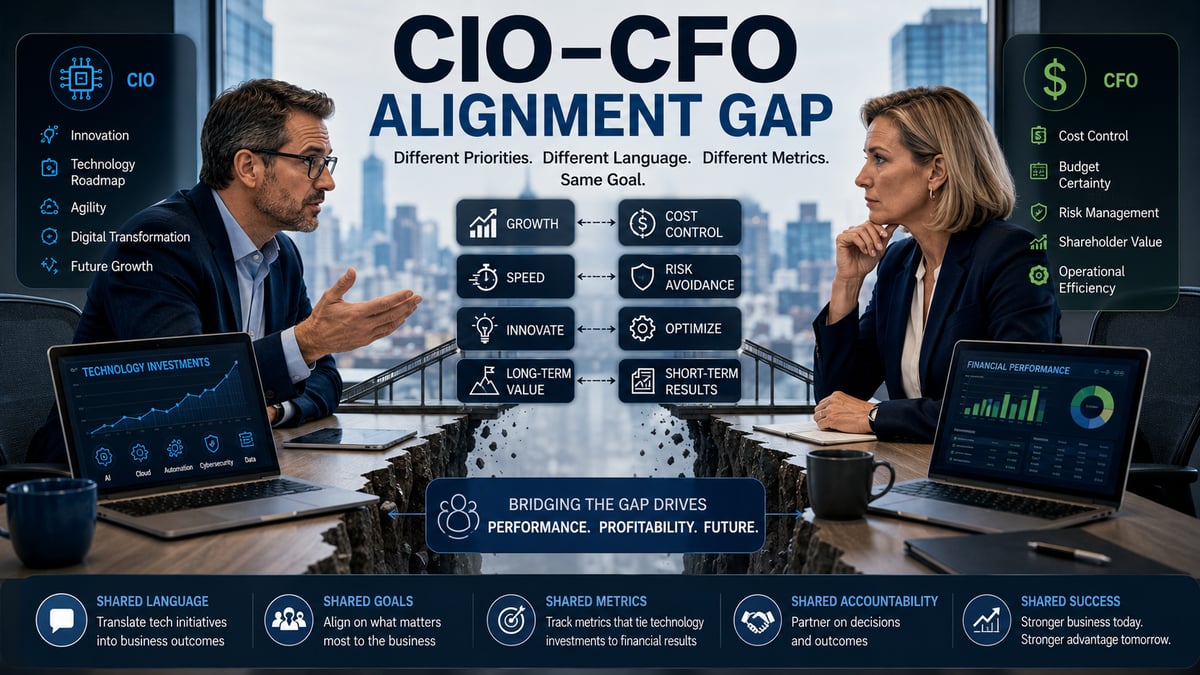

Two leaders, two sets of numbers, and one AI investment decision stuck between them. Sound familiar?
Key Takeaways
- KPMG found that 59% of CFOs and 61% of CIOs each say they hold primary responsibility for AI and technology investment decisions. That overlap can create confusion instead of accountability.
- EY found that only 21% of CFOs say their finance function’s AI preparedness is leading or advanced. Deloitte found that 87% expect AI to be extremely or very important to finance operations in 2026.
- CIO-CFO AI alignment requires shared data that connects spend, utilization, proficiency, and outcomes.
When Two Leaders Both Own the Same Decision
The chief information officer (CIO) sees artificial intelligence (AI) through tools, deployment, governance, and technical risk. The chief financial officer (CFO) sees it through cost, return on investment (ROI), and financial exposure. Both views matter and both are just part of the bigger picture.
The problem is that they’re often working from different data. The CIO has utilization and deployment counts. The CFO has cost centers, license renewals, and budget variance. Neither sees what AI investments are producing in business terms.
The Larridin AI measurement framework guide explains why utilization, proficiency, and value need to be measured together. That shared language gives both leaders a way to talk about AI investment without arguing over whose spreadsheet is right.
The Specific Ways This Plays Out
1. Renewals That Shouldn’t Happen
A tool with high utilization can still have low business value if employees aren’t using it well. If the CIO sees activity and the CFO sees an acceptable renewal cost, the tool may stay in the budget even though it isn’t changing outcomes. The missing connector is proficiency.
2. Good Investments Get Cut
The opposite can happen too. A tool used by a small group with high proficiency may look marginal in an adoption report, even if that group is saving time, reducing risk, or improving an important workflow. Without outcome attribution, a good investment can look like an easy cut.
3. Shadow AI Lands in the Wrong Inbox
When a shadow AI subscription shows up in an expense report, finance sees the cost before IT sees the governance risk. The CFO asks why IT didn’t know about the tool. IT asks how long finance has been paying for it. Neither question needs to be asked if there’s a shared AI inventory.
4. Agent Spend Surprises Everyone
AI agents create expenses based on consumption, which can move faster than either the CIO’s deployment plan or the CFO’s budget model. Without shared visibility, the first real conversation often happens after the bill arrives. Token Spend & Insights gives both leaders the same picture of human-driven and agent-driven AI spend.
What Alignment Actually Requires
Alignment doesn’t require a new org chart. It requires a shared measurement foundation that both leaders trust: one view of AI spend, usage, proficiency, and outcomes, not separate reports to reconcile before every decision.
Both leaders need access to:
- Total AI spend across licenses, tokens, cloud model usage, and agents
- AI Adoption dashboard data that shows which teams and tools are active
- AI Fluency data that shows whether people are using AI well
- AI Impact data that connects AI activity to measurable business outcomes
What a Productive AI Budget Conversation Looks Like
When CIOs and CFOs work from the same data, the conversation changes. Instead of debating which report is accurate, they can ask better questions:
- This team has high AI utilization but low measured value. Is this a proficiency problem, a workflow problem, or a tool-fit problem?
- This agent is running 24 hours a day and accounts for 18% of total AI spend. What outcome is it driving?
- Seven AI subscriptions were found in finance expense reports that never went through procurement. Who owns them, and what are they being used for?
Those questions connect cost, usage, and value in the same conversation. That’s where CIO-CFO AI alignment becomes practical.
Frequently Asked Questions
Who should own AI investment decisions, CIO or CFO?
Both leaders bring essential perspectives. The CIO understands tools, governance, implementation, and technical risk. The CFO understands cost, financial exposure, and ROI. What matters is whether they’re working from the same data.
How do CIO and CFO perspectives on AI typically differ?
CIOs usually focus on deployment, utilization, security, governance, and technical fit. CFOs focus on cost structure, ROI evidence, budget exposure, and measurable business value. Each view needs the other.
What data do CIOs and CFOs need to align on AI investments?
They need one source of truth for total AI spend, utilization by team and tool, proficiency by role and function, and outcome attribution. Without that shared foundation, every investment conversation starts with reconciling reports.
What happens when CIOs and CFOs are misaligned on AI?
Misalignment leads to bad renewals, cut investments, shadow AI conflicts, and agent spend surprises. It also slows decisions because leaders have to reconcile reports before they can act.
Give Both Leaders the Same Starting Point
AI accountability shouldn’t depend on whose report is newer. Larridin gives CIOs and CFOs the same measurement foundation across AI spend, adoption, proficiency, and outcomes, so both leaders can make decisions from the same picture.
Book a discovery call to see how it works.