


TL;DR
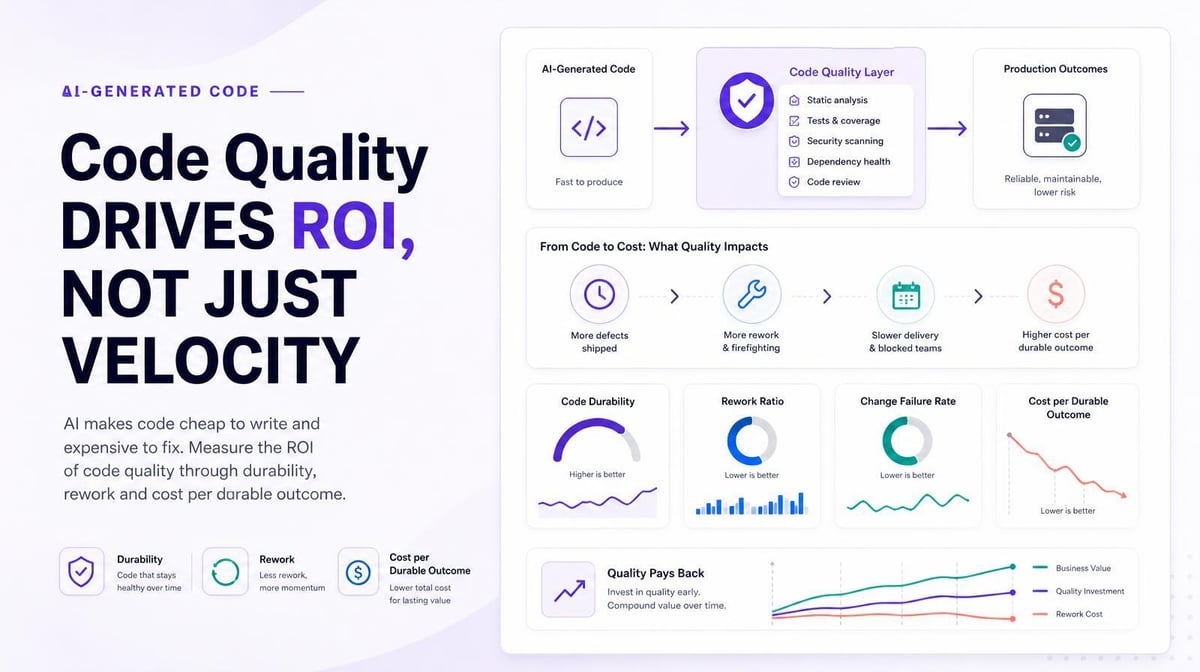
For AI teams, the ROI of code quality is the rework, incidents, and review hours avoided, and it can be measured as cost per durable outcome. AI can raise the volume of code output quickly. When quality doesn’t keep pace, the time saved on generation gets spent on reverts, rewrites, and production fixes. To make the ROI visible, track the durability of AI-assisted code, rework rate, and complexity-adjusted output alongside volume.
Quick Answers
If you’re asking… | Short answer |
|---|---|
What is the ROI of code quality for AI teams? | The value of rework, incidents, and review time avoided measured against what quality practices cost. Cost per durable outcome captures it in one number. |
How do we measure whether AI coding agents are actually improving delivery quality, not just volume? | Compare AI-assisted and human code on durability, rework, reverts, and change fail rate weighted by complexity. Larridin separates AI-generated code from human work to make that comparison. |
Why does code quality matter more with AI? | AI multiplies output, so every weakness in review and testing multiplies with it. |
What counts as durable code? | Merged code that stays in production without a revert or major rewrite over a set window. |
Why Does Code Quality ROI Change When AI Writes the Code?
When AI multiplies code volume, the cost of every quality failure multiplies with it, and verification becomes the main expense.
Generating code is cheap now. Reviewing, testing, and fixing it isn’t. The 2025 DORA research describes AI as an amplifier of existing strengths and weaknesses: teams with strong testing and fast feedback gain, and teams with slow, fragile processes see little benefit. Quality practices decide which group you’re in.
That changes how teams evaluate code quality ROI. The return on code quality used to be fewer bugs. For AI teams it’s whether the speed you paid for survives contact with production.
Where Does Poor AI Code Quality Cost Money?
Poor AI code quality costs money in five places, and only one of them shows up on the AI invoice.
- Rework hours spent rewriting code that merged but didn’t hold
- Reverts and incidents, including recovery time and customer impact
- Review load, as senior engineers spend more of their week checking AI output
- Tokens burned regenerating code that failed review or tests
- Technical debt that slows every future change to the same module
The AI bill captures the fourth item. The other four land in engineering payroll and incident costs, which is why AI quality problems hide so well.
How Do You Measure Code Quality ROI for AI-Assisted Work?
Measure the durability and rework of AI-assisted code against human code, then express results as cost per durable outcome.
The core metrics:
- Durability rate (share of merged changes still in production, unreverted and not heavily rewritten, after your chosen window)
- Rework rate on AI-assisted versus human-authored changes
- Revert rate and change fail rate for AI-assisted changes
- Review time per PR split by AI-assisted and human
- Complexity-adjusted output, so trivial changes don’t inflate the count
These metrics also help teams evaluate AI developer productivity benchmarks without relying on code volume alone.
Then roll it up:
Cost per durable outcome = (AI spend + engineering time cost) ÷ durable, complexity-adjusted changes
If that number falls while durability and rework stay healthy, you have stronger evidence that the speed gains are worthwhile. If volume and cost per durable outcome rise together, investigate whether the extra work is holding up. Larridin attributes code to AI-assisted or human activity, scores each PR for complexity, and tracks cost per durable outcome by tool and team.
What Improves the ROI of AI Code Quality?
Keep AI changes small enough to review well, and plan review capacity as deliberately as you plan generation.
- Ask agents for smaller, scoped changes instead of sprawling PRs
- Test AI-generated code before review starts
- Route complex or risky changes to experienced reviewers
- Compare durability by tool and team, and move work toward what holds up
- Revisit the window on durability as your release cadence changes
Where AI Code Quality Measurement Breaks, and How to Fix It
What you’re dealing with | What you need | How Larridin helps |
|---|---|---|
Can’t tell AI code from human code | Attribution by authorship | Separates AI-generated code from human work |
PR counts rising, value unclear | Output weighted by difficulty | Complexity-adjusted output scoring |
AI code ships, then gets rewritten | Durability tracking | Flags and de-risks AI-written code durability |
Speed gains with rising costs | One cost-and-quality number | Cost per durable outcome by tool and team |
Key Takeaways
- Code quality ROI for AI teams is rework, incidents, and review time avoided.
- Most quality costs hide in payroll and incidents, outside the AI bill.
- Measure durability and rework for AI-assisted versus human code.
- Cost per durable outcome shows whether speed is surviving production.
FAQs
Is AI-generated code lower quality than human code?
It depends on the team, tool and task. In DORA’s 2025 survey, 59% of respondents said AI had improved code quality, but perception and measured durability can differ, so check your own data.
What window should we use to measure durability?
Choose a window that matches your release cadence. Many teams start with 30 to 90 days and adjust once they see how rework clusters.
Should we slow AI adoption to protect quality?
Slow it where durability is low, and expand it where AI-assisted code holds up as well as human code.
Who should own AI code quality metrics?
Engineering leadership owns the targets; team leads own the weekly review. Platform or DevEx teams usually maintain the data.