

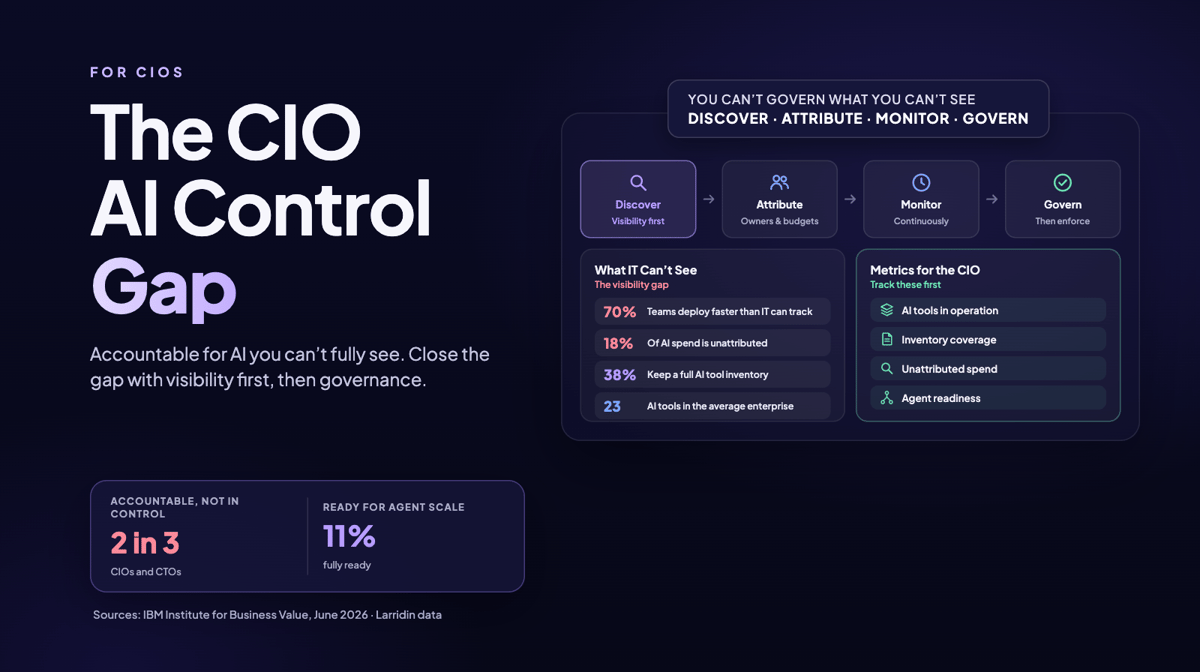

For CIOs, being held accountable for AI systems they can’t see isn’t just a governance problem. It’s a visibility problem. For most CIOs right now, it’s both.
Key Takeaways
According to the IBM Institute for Business Value study published June 8, 2026:
- Two-thirds of surveyed CIOs and CTOs are accountable for AI systems they don’t fully control.
- 70% say teams across the business are deploying technology faster than IT can track.
- Only 11% believe they’re fully ready for the scale of AI agent deployment expected in the next year.
Closing that gap requires independent visibility, clear ownership, financial attribution, and controls that can keep pace with AI activity. Monitoring supplies the evidence. Governance turns it into action.
The Accountability-Visibility Mismatch
When a board or CEO asks whether the organization’s AI is governed, secure, and delivering value, the expected answer is yes. The honest answer for many CIOs is, “I think so, but I can’t prove it.”
That is a consequence of how AI spreads across departments, procurement paths, browser-based tools, SaaS platforms, and workflow automations. Teams find tools that work and deploy them. IT finds out later, if at all.
The June 8, 2026 IBM study makes the scope clear. Conducted with Oxford Economics, it surveyed 2,000 senior technology executives between January and April 2026. Its findings describe a structural mismatch between deployment speed and the systems intended to govern it.
The difference now is that AI increasingly includes agents that can take actions across business systems, not just employees using unapproved apps. Accountability without visibility becomes accountability without a reliable way to intervene.
What “Not Fully Controlling” Actually Means
1. Deployed Tools With No Central Inventory
An approved-tool list is not an inventory of actual usage. It records what IT authorized, not necessarily what employees adopted or what SaaS vendors embedded in existing applications.
A useful inventory connects each tool to its business owner, users, use cases, and relevant data-handling requirements. It also distinguishes sanctioned deployments from personal subscriptions and team-level purchases.
Without that foundation, a CIO cannot reliably answer what is running, who is responsible, or which deployments need review.
2. Agents Operating Without Clear Oversight
Some agents arrive inside approved enterprise applications. Others appear through team-built automations, no-code workflows, and features IT did not evaluate as separate agent deployments.
Their governance requirements differ from human-initiated AI use. An agent can keep acting after its initial trigger. Knowing that an application is approved does not tell you which actions its agents can take, what permissions they hold, or who can stop them.
Inventory and usage visibility must therefore be paired with agent-specific oversight: accountable owners, appropriate permissions, activity records, escalation paths, and intervention mechanisms.
3. Spend With No Attribution
AI costs can be scattered across enterprise licenses, team expense accounts, personal subscriptions, cloud consumption, and SaaS upgrades.
In its June 8, 2026 findings, IBM reports that 85% of surveyed technology executives lack full visibility into real-time AI spend.
A vendor invoice tells you what you bought. It does not establish which teams use it, whether paid seats are active, or whether overlapping tools serve a justified business need. Those questions require usage data connected to license and budget records.
Why Vendor Dashboards Don’t Close the Control Gap
Every vendor dashboard describes a slice of your environment. None, by itself, establishes the full portfolio.
Even accurate reports can be difficult to compare because providers define activity and utilization differently. A login, a prompt, and a completed workflow are not interchangeable measures. Nor does activity alone demonstrate business value.
Independent AI measurement gives CIOs a cross-provider view rather than a collection of disconnected utilization reports. Vendor dashboards remain useful for product-specific administration. They should not be mistaken for enterprise-wide governance evidence.
The purpose is not to replace one dashboard with another. It is to make the questions behind accountability answerable.
The Visibility CIOs Need to Regain Control
A Continuously Updated Inventory
Identify the AI tools in actual use, including approved applications and shadow AI. Associate each deployment with the teams using it and the owner responsible for reviewing it.
Use discovery findings to maintain the inventory, not merely to produce a one-time audit report.
Adoption Depth, Not Just Access
License activation and login counts measure access. They do not tell you whether AI is embedded in meaningful work.
Look at patterns of adoption across teams and roles, then connect those patterns to workflow and outcome evidence. This helps distinguish an enablement problem from an unnecessary purchase without treating activity as proof of impact.
Utilization Connected to Spend
Combine usage signals with license records to identify idle seats, underused tools, and overlapping capabilities across departments.
Review the business context before cutting access. Similar tools may serve different needs. The aim is defensible allocation, not indiscriminate consolidation.
Evidence That Supports Governance Decisions
An inventory provides a starting point for security and compliance review. Ownership, usage records, and documented review decisions make that foundation more useful.
Visibility does not, by itself, establish compliance with the EU AI Act, ISO 42001, NIST AI RMF, or SOC 2. Applicable obligations and controls still require assessment. Measurement helps teams gather evidence; it is not a substitute for governance.
Why Agent Readiness Matters Most
The IBM finding that only 11% of surveyed technology leaders feel fully ready for the next year’s agent deployment scale should stay with leadership teams.
Employees using unapproved AI tools can create data exposure. Agents interacting with business systems and triggering downstream processes add operational risk that can grow with activity volume rather than headcount.
One unmanaged tool can create a blind spot. One unmanaged agent can repeat a bad action until someone notices.
Independent usage visibility helps reveal the environment in which those agents operate. It does not eliminate the need for agent-level permissions, execution records, and controls. CIOs need both discovery and a way to act on what discovery reveals.
Closing the Gap Without Slowing the Business
The instinctive response to a control gap is to restrict access. But blanket restrictions can push legitimate demand into shadow subscriptions and recreate the same visibility problem.
A visibility-first approach starts with attribution before enforcement:
- Discover actual usage. Compare the deployed environment with the approved inventory.
- Assign responsibility. Connect tools and agents to owners, use cases, and budgets.
- Review exposure and value. Bring IT, security, finance, and business owners together around the same evidence.
- Apply proportionate controls. Address risky deployments while preserving useful, governed workflows.
- Keep the evidence current. Revisit ownership, utilization, and control decisions as the portfolio changes.
This is not an argument for visibility instead of control. It is an argument for controls grounded in what is actually happening.
Where Scout Fits
Scout is Larridin’s independent analytics layer for enterprise AI usage. It captures cross-tool usage through browser extensions and desktop agents, helping organizations identify shadow AI, understand adoption, and investigate waste.
For CIOs, that creates a shared evidence base for portfolio decisions:
- Cross-provider visibility: consolidate usage signals rather than relying solely on separate vendor reports.
- License review: connect utilization data with license inventory to investigate idle seats and redundant capabilities.
- Adoption clarity: identify where teams have incorporated AI into work and where enablement needs attention.
- Governance support: give responsible teams usage evidence that informs inventory maintenance and review.
That measurement layer supports accountability. It should sit alongside security controls and agent-specific oversight, not be presented as a replacement for either.
Frequently Asked Questions
Why are CIOs accountable for AI systems they don’t control?
Business teams and application providers can introduce AI faster than central tracking and review processes keep up. Organizational accountability remains with technology leadership even when deployments are not visible in the official inventory.
What is the fastest practical way to improve visibility?
Start with automated discovery of browser and desktop AI usage, then reconcile the findings with approved applications, ownership, and procurement records. For agent deployments, add the relevant execution records and permission reviews. Self-reported inventories alone leave gaps.
How is independent measurement different from vendor dashboards?
Vendor dashboards describe their own applications using provider-defined metrics. Independent measurement brings cross-tool usage into a common view. The two are complementary, but only the latter addresses the fragmented portfolio directly.
How does AI measurement support license optimization?
Connect active usage with paid-seat inventory and departmental requirements. Investigate idle subscriptions and overlapping capabilities, then validate business needs before reallocating or removing licenses.
Does Scout require vendor API integration to capture tool usage?
The original CIO monitoring article, published March 18, 2026, describes browser-extension and desktop-agent telemetry that does not require API integration with each AI vendor. That usage-discovery approach is distinct from collecting the execution records needed for agent-level oversight.
What should a CIO do after discovering an unknown AI tool?
Identify the team, owner, use case, and data involved before deciding on enforcement. The finding may indicate a risky deployment, an unmet business need, or both. Resolve the exposure without ignoring why the tool was adopted.
Take Back Control Without Slowing Down
The CIO AI control gap is not closed by approving more tools or collecting more vendor reports. It closes when responsibility is matched with evidence and the authority to act.
Larridin gives CIOs an independent view of enterprise AI usage, helping turn a fragmented portfolio into something leadership can evaluate and manage.
The choice is between continuing to accept accountability on incomplete information and building the measurement discipline that makes accountability defensible.
The time for AI accountability is now.
Related Resources
- AI Agents Are Operating in Your Business Right Now
- What Is AI Governance?
- The Governance Crisis: 77% of Adoption Outpacing Controls