

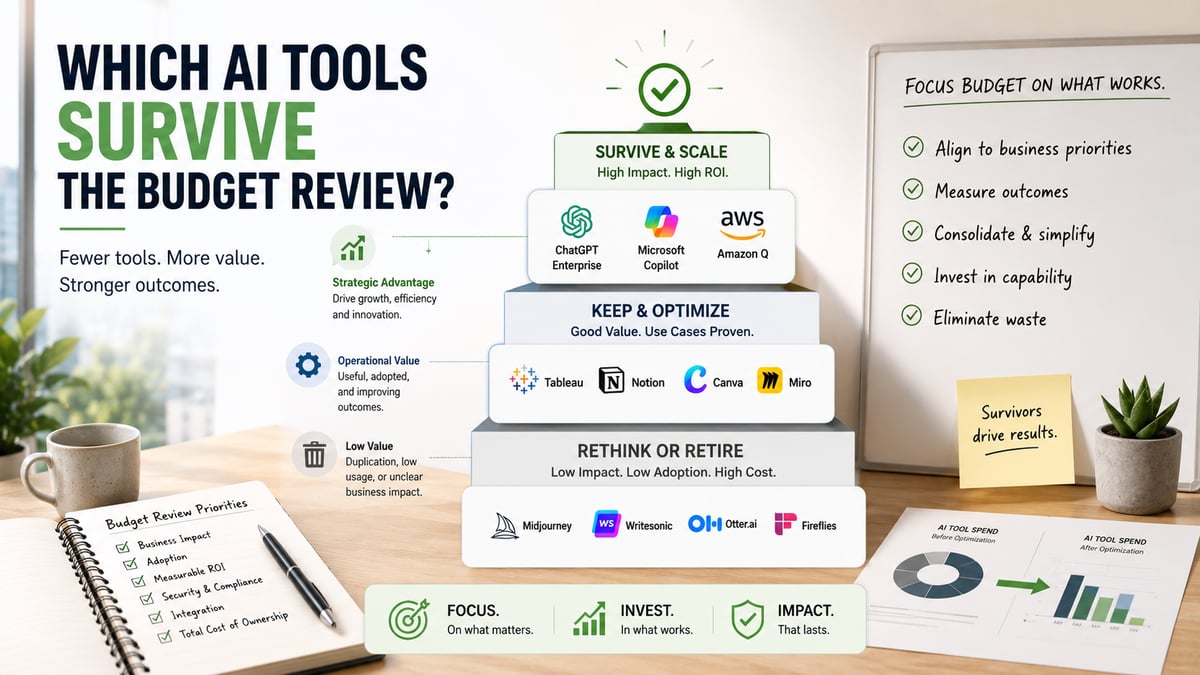

AI budget renewal season is underway, and the conversation has changed. The question isn’t whether to invest in AI. It’s which tools can prove they’re worth keeping.
Key Takeaways
- Futurum found enterprise AI ROI measurement is shifting toward direct financial impact, with top-line revenue growth and bottom-line profitability nearly doubling to 21.7% of primary responses.
- Deloitte found 74% of organizations hope to grow revenue through AI initiatives, but only 20% are already doing so.
- The tools that survive budget review are the ones with evidence: who uses them, how well they use them, and what business outcomes have changed.
Why Budget Reviews Are Different This Cycle
For the first wave of enterprise AI adoption, procurement questions focused on access. The assumption was that access to artificial intelligence (AI) would translate into value almost automatically. That assumption has been tested.
Deloitte found that 74% of organizations hope to grow revenue through AI initiatives, while only 20% are already doing so. Futurum also found that enterprise AI ROI measurement is moving away from broad productivity promises and toward direct financial impact.
That changes the renewal conversation. “People save time with this tool” is no longer enough. Chief financial officers (CFOs), chief information officers (CIOs), and budget owners need to know what changed in the business because a specific tool was deployed. The AI measurement framework guide walks through how to connect usage, proficiency, and business value before the renewal meeting starts.
The Wrong Way to Evaluate AI Tools
1. High Utilization Doesn’t Mean High Value
An employee who opens an AI writing tool every day and uses it to draft emails that don’t save measurable time is a high-utilization user with low outcome contribution. Utilization without proficiency and value data creates an incomplete picture, and incomplete pictures lead to bad renewal decisions.
2. Low Utilization Doesn’t Mean Low Value
A specialist tool used by a small number of high-proficiency employees may have low overall utilization and still produce outsized value. If that tool supports a workflow that reduces risk, increases throughput, or improves output quality, cutting it based on usage rates alone removes value the organization may not notice until later.
3. Vendor-Supplied ROI Data Isn’t Outcome Data
Vendor case studies and productivity estimates can be useful context, but they’re not proof of what the tool is doing in your environment. Budget owners need internal evidence tied to your teams, workflows, baselines, and outcomes, not someone else’s best-case story.
The Right Way to Evaluate AI Tools
1. Actual Utilization at the Team and Role Level
Start with who’s using the tool, how often they use it, and whether usage is consistent enough to suggest it has become part of a real workflow. The AI Adoption dashboard surfaces this data at the team and role level, not just as a license count or login record.
2. Proficiency Data
Next, evaluate whether employees are using the tool well. A tool used poorly by many people may produce less value than a tool used expertly by a few. Low proficiency alongside high utilization is often a training signal, not an automatic cut signal. AI Fluency measurement provides this data at the role and function level.
3. Outcome Attribution
Then ask what changed after the tool entered the workflow. Time-on-task comparisons, throughput, quality indicators, error reduction, revenue influence, and risk reduction can all connect AI usage to business impact. AI Impact connects tool usage to the business metrics leaders need to see.
How to Build the Renewal Case or the Cut Case
Once utilization, proficiency, and outcome data are visible together, renewal decisions become clearer:
- A tool with high utilization, high proficiency, and measurable outcomes is a clear keep candidate and may be worth expanding.
- A tool with high utilization and low outcomes may be a proficiency or workflow-fit problem. Investigate before cutting, because the tool may still have value if people learn to use it better.
- A tool with low utilization across all teams may be the wrong tool, or it may not have received enough enablement. The distinction matters before you replace it.
- A tool used by a small group of high-proficiency employees with strong outcome data should survive even if overall utilization is low, because the value is concentrated rather than distributed.
That’s also where AI tool ROI budget review connects to broader stack rationalization. If multiple tools do similar work, the keep-or-cut decision should come down to value evidence, not whoever has the loudest internal sponsor.
Frequently Asked Questions
What criteria should we use to evaluate AI tool ROI?
The strongest evaluation combines actual utilization at the team and role level, proficiency measurement, and outcome attribution. Utilization alone can show activity, but it can’t show whether the tool is being used well or whether it changed a business result.
How do we compare the ROI of different AI tools?
Compare tools against a consistent set of business outcome metrics and a defined baseline. That requires per-tool attribution, so leaders can see which tools changed time, quality, throughput, revenue, risk, or cost in a measurable way.
Should we cut AI tools with low utilization?
Not automatically. Low utilization might mean low value, but it might also mean the tool is specialized, poorly enabled, or being avoided because employees moved to shadow AI alternatives. Utilization should start the investigation, not end it.
How quickly should we see ROI from an AI tool?
High-volume, repetitive workflows may show measurable ROI within weeks of effective adoption. Complex judgment-heavy work usually takes longer because proficiency development is part of the value creation process. The important thing is to set the measurement timeline before deployment, not scramble for proof at renewal.
Go Into Your Next Budget Review With Evidence
The AI tools that get renewed this cycle will be the ones with evidence behind them. Larridin gives leaders utilization, proficiency, and outcome data at the tool, team, and role level, so renewal decisions reflect what’s actually working instead of what feels like it should be.
Book a discovery call to build your AI tool evidence base.