

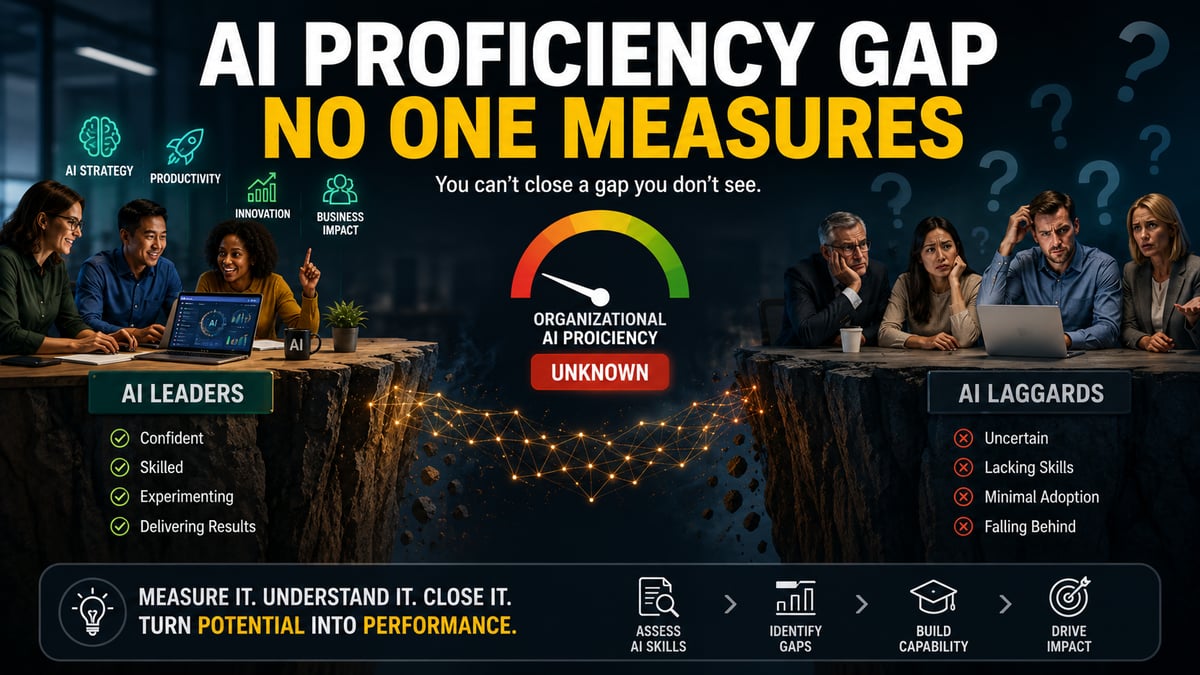

Artificial intelligence (AI) usage is rising, but confidence in using it well is falling at the same time. That gap is where AI investment quietly leaks value.
Key Takeaways
- ManpowerGroup’s 2026 Global Talent Barometer found regular AI usage rose 13% to 45% of workers, while confidence in using technology fell 18%.
- IDC estimates AI-related skills gaps alone put up to $5.5 trillion of economic value at risk through delays, missed revenue, and quality issues.
- AI proficiency measurement shows whether employees are using AI well, not just whether they have access to tools.
Access Isn’t the Same as Proficiency
Most organizations measure AI adoption the same way they measure software adoption: seat counts and login frequency. The problem is that opening a tool isn’t the same as using it well.
A user who types a one-line prompt is counted the same as a user who’s built a repeatable workflow that saves four hours a week. That’s the proficiency gap. If you only measure access, you can miss the difference between activity and impact.
What the Data Shows
ManpowerGroup’s 2026 Global Talent Barometer found regular AI usage rose 13% to 45% of workers, while confidence in using technology fell 18%. IDC estimates that AI-related skills gaps alone put up to $5.5 trillion of economic value at risk through delays, missed revenue, and quality issues.
BCG’s 2026 AI at Work research shows the same pattern from another angle: 42% of regular frontline AI users report saving a full workday each week, but 66% receive limited or no guidance on what to do with that saved time. Usage is increasing faster than organizations’ ability to turn it into measurable value.
What Proficiency Measurement Actually Looks Like
Measuring AI proficiency doesn’t mean reading employee conversations or monitoring their screens. It requires capturing behavioral signals from the tools themselves.
Prompt Sophistication
Prompt length, specificity, context-setting, and iteration patterns can indicate proficiency level while keeping content confidential. You don’t need to know what employees asked. What matters is whether their usage patterns show they understand how to get value from the tool.
Feature Adoption Depth
Most AI tools have basic functions that new users discover quickly and advanced functions that power users leverage to maximize results. Measuring which features are being used and at what depth shows where training or enablement would have the most impact.
Workflow Integration Depth
Employees with high proficiency integrate AI into repeatable workflows. Identifying where those workflows already exist gives leaders a map to replicate them across the organization.
Where Proficiency Data Creates the Most Value
Once you know who’s using AI effectively and who isn’t, three decisions get easier.
- Target development investment. Focus training on the roles and use cases where a proficiency improvement is most likely to change business outcomes.
- Identify power users. Larridin’s AI Fluency measurement surfaces high-proficiency users whose workflows the rest of the organization can learn from and implement.
- Clarify ROI. When utilization is high but value is low, proficiency is often the missing piece. Measurement lets leaders intervene with targeted support instead of writing off the tool investment.
Frequently Asked Questions
What’s the difference between AI utilization and AI proficiency?
Utilization measures whether and how often employees use AI tools. Proficiency measures how well they use them. An organization can have high utilization and low proficiency, which produces high AI spend and low AI value. Proficiency is the dimension most platforms don’t measure.
How do you measure AI proficiency without monitoring employee content?
By capturing behavioral signals rather than content: prompt patterns, feature adoption depth, workflow integration, and output quality indicators. Larridin’s AI Fluency measurement captures proficiency this way across tools, teams, and roles.
Which roles typically have the biggest AI proficiency gap?
The gap is rarely where leaders expect it to be. Some of the most effective AI users are mid-level employees who’ve built repeatable workflows for specific, high-volume tasks. Measurement surfaces those patterns instead of relying on assumptions about seniority or technical background.
What is the ROI of investing in AI proficiency?
The return comes from turning tool access into better workflows, smarter decisions, and measurable value. BCG found that 42% of regular frontline AI users save a full workday each week, but 66% receive limited or no guidance on what to do with that time. Proficiency measurement helps leaders find where AI is already creating leverage and where employees need support to turn usage into outcomes.
Measure What Actually Drives Value
If you’re measuring AI adoption without measuring proficiency, you’re missing the signal that explains whether usage is creating value. Larridin’s AI Fluency measurement gives you proficiency data at the role, team, and function level, without content monitoring, so you can invest in development where it actually changes outcomes.
Book a discovery call to see how proficiency measurement works.