

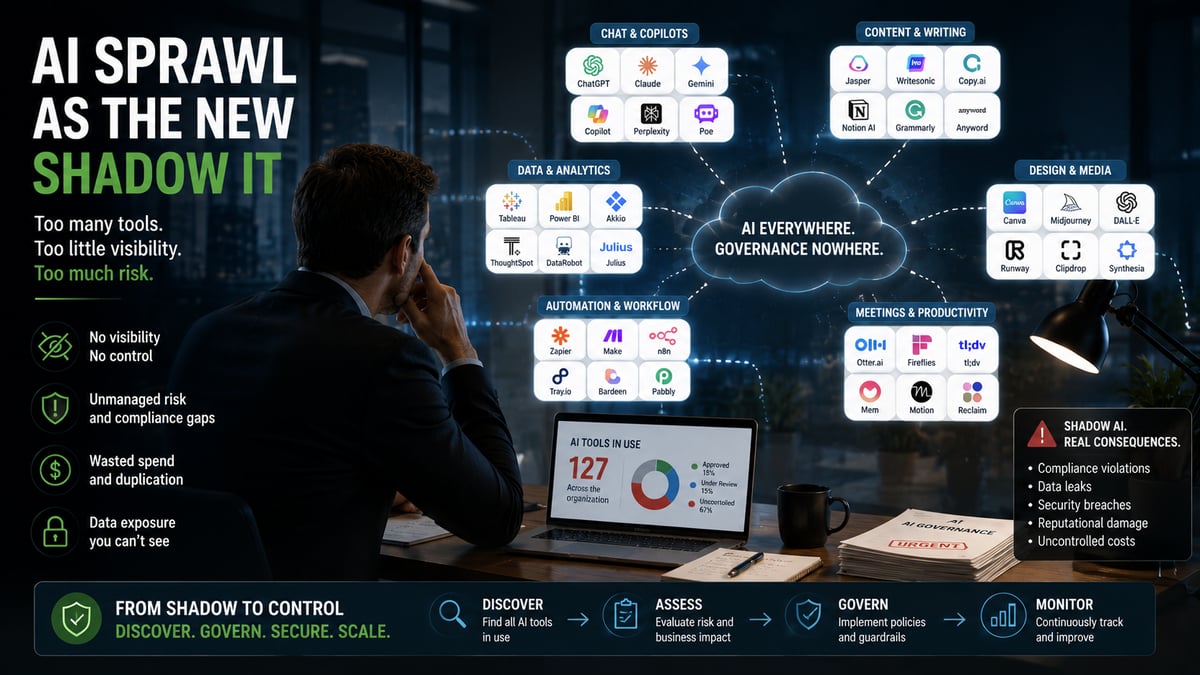

AI sprawl is a portfolio problem. One rogue app was manageable. 23 ungoverned AI tools running simultaneously across departments is a different challenge.
Key Takeaways
- The average enterprise now runs 23 different AI tools, yet only 38% maintain a comprehensive inventory of what is actually running.
- Intuit's 2026 Enterprise Technology Benchmark found 73% of senior leaders agree reducing tool sprawl is the fastest path to a healthier bottom line.
- Ungoverned AI tool growth creates compounding costs: redundant capabilities, underutilized licenses, unattributed spend, and governance gaps no single team is positioned to address.
How AI Sprawl Differs from Shadow IT
Shadow IT, in its classic form, was an individual or team using an unapproved tool to solve a problem IT hadn't addressed. It was largely contained: one tool, one team, one gap. AI sprawl is different. It is the simultaneous, decentralized deployment of copilots, AI-assisted workflows, analytics tools, and agentic systems across the organization. Each tool may solve a real problem. Together, they create infrastructure cost, governance exposure, and measurement noise that grow faster than any central team can track.
InformationWeek’s May 2026 reporting on AI sprawl made the same point: the risk isn’t any one tool in isolation. It’s the lack of a central view across all of them. That is why AI sprawl is less about whether any individual tool is wrong and more about whether anyone can see the whole portfolio clearly enough to govern it.
3 Costs That Compound When AI Sprawl Goes Unmanaged
1. Infrastructure Costs That Grow Faster Than Value
AI tools generate costs differently depending on how they are priced. Seat licenses, token consumption, API calls, and agent activity each compound at different rates. When 23 tools are running simultaneously across an enterprise with no central attribution, the total cost is always higher than what any single budget owner sees. The hidden AI spend problem is a direct consequence of sprawl: you cannot see the full cost of what you are running.
2. Capability Redundancy With No Comparison Data
Three teams paying for three different AI writing assistants isn’t a strategy. It’s sprawl. The problem is that without a comprehensive inventory and utilization data, there’s no basis for comparison. Which tool is actually used? Which one produces better outcomes? Which team's workflow could be shared? Those questions require data that sprawl prevents organizations from having.
3. Governance Gaps That Multiply Across Tools
Every ungoverned AI tool is a potential shadow AI risk and a potential compliance exposure. When governance coverage depends on tools having gone through procurement, tools that bypassed procurement have no coverage by definition. As the number of bypassed tools grows, so does the total exposure.
Why Periodic Audits Can’t Keep Up
The traditional response to sprawl is an annual or quarterly audit. For AI, that cycle is too slow. New tools appear faster than audit cycles run. Agents are deployed by developers and power users in hours. AI features are activated inside existing SaaS platforms without any procurement step. By the time a periodic audit catches a tool, that tool may have been running for months, generating costs and creating policy gaps the organization is only now discovering. The 77% of organizations whose adoption is outpacing governance controls are operating in exactly this kind of continuous gap.
What Getting Control of AI Sprawl Actually Requires
Bringing AI sprawl under control is a four-step process, and it starts with discovery, not restriction. The AI Adoption dashboard surfaces every AI tool in operation continuously, including tools that were never reported to IT. From there:
1. Attribution: connect every tool to an owner, a team, and a use case so spend and outcomes can be evaluated
2. Utilization measurement: find out which tools are actually used and how well, not just which ones are licensed
3. Outcome connection: link each tool to the business metrics it is supposed to move through AI Impact, so rationalization decisions are based on evidence rather than cost alone
4. Continuous monitoring: replace periodic audits with always-on discovery so new tools are surfaced as they appear rather than months later
Frequently Asked Questions
What is AI sprawl and why does it matter?
AI sprawl is the unmanaged proliferation of AI tools, agents, and capabilities across an enterprise. It results from decentralized adoption without central coordination, inventory, or governance. It matters because it creates compounding costs, redundant capabilities, governance gaps, and an inability to evaluate which AI investments are delivering value.
How is AI sprawl different from traditional software sprawl?
Traditional software sprawl involved seat licenses and relatively fixed costs. AI sprawl involves consumption-based pricing that scales with usage, autonomous agents that can generate costs around the clock, and embedded AI features inside existing software that may not appear in procurement records. The cost dynamics are harder to track with traditional license management tools.
How do we know if we have an AI sprawl problem?
If you cannot enumerate every AI tool in operation across the enterprise, if licensed seats substantially exceed active users, or if AI spend surprises you at the end of a billing period, you have an AI sprawl problem. Most enterprises do.
Should we restrict AI tool adoption to address sprawl?
Restriction addresses the symptom, not the cause, and often makes the underlying problem worse by pushing AI adoption into personal accounts and shadow subscriptions. The more effective approach is visibility-first governance: understand what is already running before deciding what to restrict. Teams adopting tools without IT approval are almost always solving real problems. Discovery surfaces those problems so IT can address them rather than just blocking the solution.
Get a Clear View of Every Tool in Your Portfolio
Larridin's discovery layer surfaces every AI tool and agent in operation, providing the inventory required to rationalize a sprawling AI portfolio and connect every tool to actual usage, spend, and outcome data.
Book a discovery call to see your full AI tool inventory.