

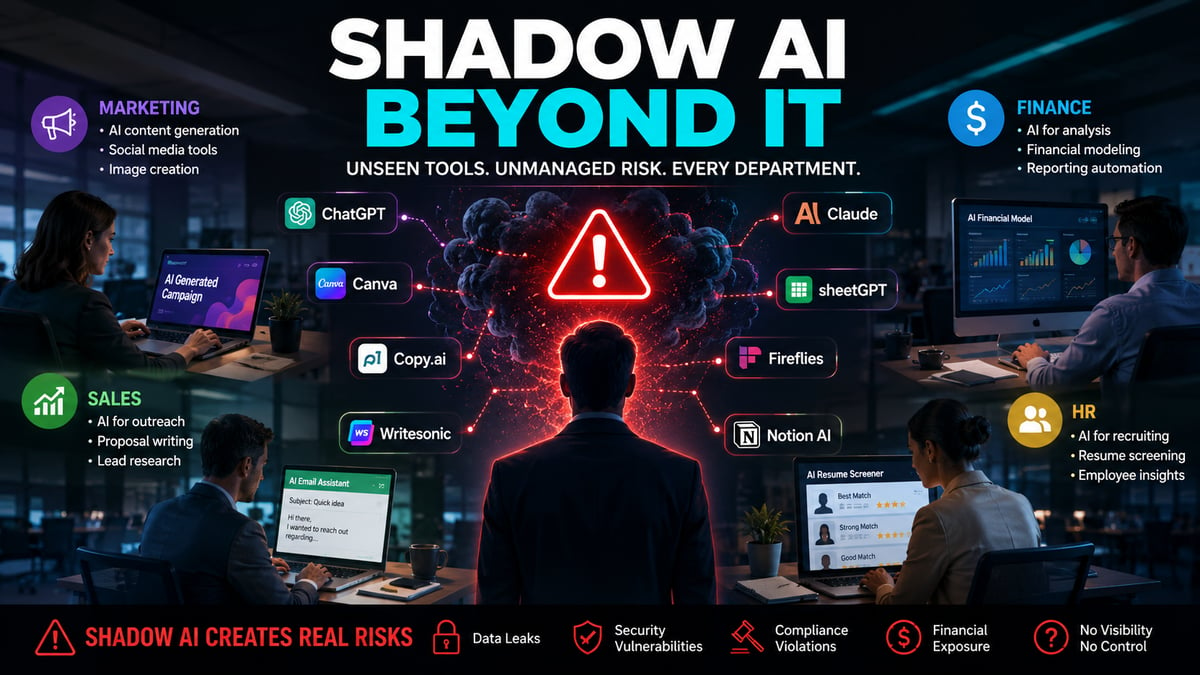

Shadow IT used to mean an employee using Dropbox without approval. Shadow AI can now mean an autonomous agent interacting with business systems without a clear owner or audit trail. The concept is familiar. The consequences are much bigger.
Key Takeaways
- 75% of organizations in Saviynt’s 2026 CISO AI Risk Report have already discovered unsanctioned shadow AI tools running in production.
- IBM found that organizations with high levels of shadow AI saw $670,000 in higher breach costs than those with low or no shadow AI.
- Shadow AI enterprise risk has evolved from data leakage to shadow operations, where agents and AI workflows can now take autonomous actions without clear ownership, oversight, or audit trails.
What Shadow AI Looks Like in 2026
Two years ago, shadow AI was mostly a data privacy concern. Employees pasted sensitive information into free ChatGPT accounts, and information technology (IT) teams worried about what happened to it. That risk hasn’t gone away, but the problem has gotten a lot more complicated. Today, shadow AI includes personal AI subscriptions, embedded AI features, no-code workflow builders, and autonomous agents that can take action without IT oversight.
That last category is where the risk profile changed. An employee accessing company data through a personal AI app is a data governance problem. An agent interacting with internal systems, taking actions, or triggering workflows without an audit trail is an operational and compliance problem with much higher stakes.
Why IT Can’t Find It Through Traditional Methods
Traditional shadow IT discovery relied on network monitoring. That approach doesn’t work well for AI because many tools are accessed through browsers. AI features embedded inside approved Software as a Service (SaaS) platforms may be activated without additional procurement. Agents deployed through no-code builders may call approved application programming interfaces (APIs) but behave in unexpected ways. Personal accounts can remain invisible to corporate monitoring until a breach or unbudgeted charge appears.
Larridin’s State of Enterprise AI 2026 research found that 45% of AI adoption happens entirely outside IT’s view. For security and finance leaders, that means the official AI inventory is often a partial map, not the operating reality.
The Real Costs of Going Undiscovered
IBM’s 2025 Cost of a Data Breach research quantified what many security leaders already suspected: organizations with high levels of shadow AI saw an average of $670,000 in higher breach costs than organizations with low or no shadow AI. That figure reflects incident response, regulatory exposure, and business disruption, not just technical remediation.
Beyond breach costs, shadow AI creates a second category of financial exposure that’s harder to quantify but equally real. When tools run outside of AI governance, their costs aren’t included in budgets, there’s no quality control of the outputs, and their business impact can’t be measured. Organizations pay for capabilities they can’t account for and miss the value signals that would show what’s actually working.
What Effective Shadow AI Governance Requires
Automated, Continuous Discovery
Since shadow AI is constantly changing, point-in-time audits go stale quickly. The AI Adoption dashboard surfaces AI tool usage across teams continuously, including tools that were never reported to IT.
Privacy-First Monitoring
The governance conversation stalls quickly if employees think IT is reading their prompts or monitoring their keystrokes. Effective shadow AI governance captures usage patterns, tool activity, and spend signals without accessing content. That distinction matters for employee trust and legal compliance.
Policy Controls That Scale
A list of approved tools isn’t a policy control. Larridin’s Workflow Intelligence platform provides real-time visibility into which tools are being accessed and flags exceptions before they become problems.
Attribution and Accountability
Every tool, agent, and workflow needs an owner. Unattributed AI activity, especially agent activity, is what causes the biggest governance gaps. Attribution connects shadow AI discovery to budget accountability and risk management.
Frequently Asked Questions
What is shadow AI and how is it different from shadow IT?
Shadow IT is when employees use unapproved software tools. Shadow AI includes that, but also covers autonomous agents, AI-powered features inside approved software, and no-code AI workflows that may interact with business systems without oversight. The autonomous action dimension creates risks that traditional shadow IT did not.
How do organizations typically find shadow AI?
Organizations typically find shadow AI through automated discovery platforms that capture browser and desktop telemetry, application usage, and API activity. Manual approaches such as surveys and interviews significantly undercount shadow AI because employees may not remember every tool they use that has AI, and they likely won’t report tools they’re not sure are approved.
Can shadow AI be governed without monitoring employee content?
Yes. Larridin’s approach captures usage patterns, tool activity, and spend signals without reading conversation content, keystrokes, emails, or private messages. Effective governance is not surveillance. It requires visibility into which tools are active, who owns them, and what they cost.
What should CISOs prioritize when addressing shadow AI?
Chief information security officers (CISOs) should start with discovery to get a complete inventory of what is actually running. Then they should prioritize based on risk profile: agents with autonomous action capabilities deserve more scrutiny than read-only AI assistants.
Find Out What’s Running in Your Organization
Shadow AI is already running somewhere in your organization. Larridin deploys in days and gives you a complete, continuously updated picture of every AI tool and agent active across your enterprise, including the ones that were never reported to IT.
Book a discovery call to start the conversation.