

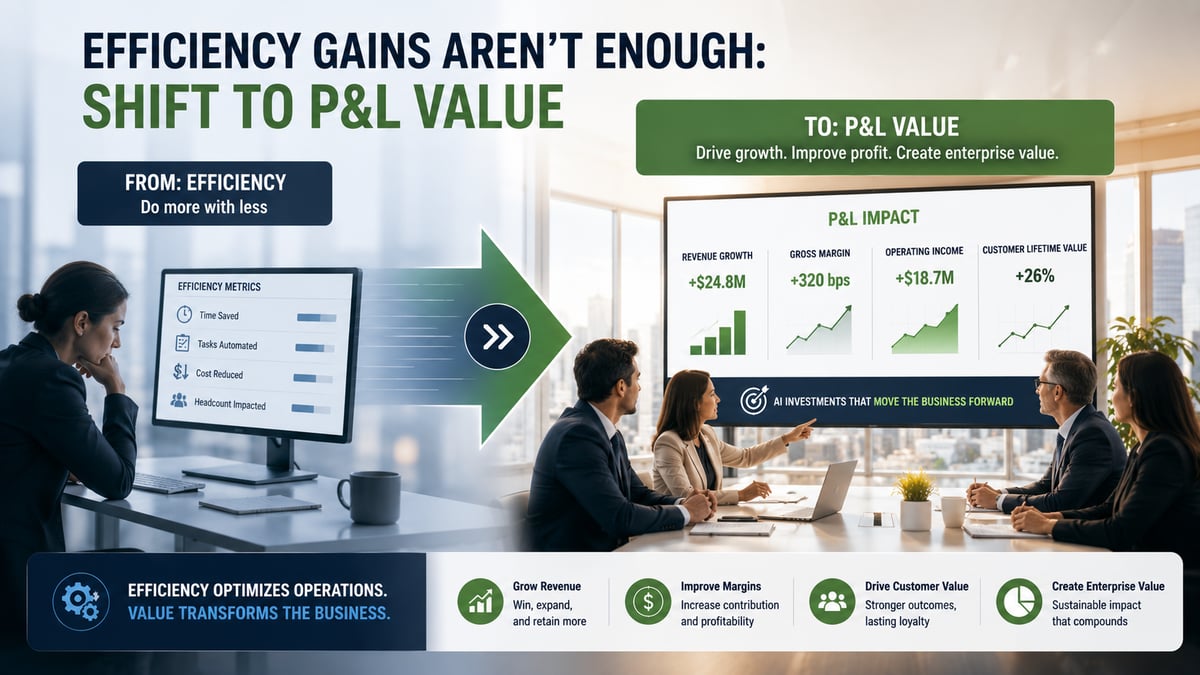

Productivity metrics got AI programs funded. P&L evidence is what will keep them funded. Those are different conversations, and most organizations are still having the wrong one.
Key Takeaways
- The Futurum Group’s 1H 2026 survey of 830 IT decision-makers found “productivity gains” as the top AI ROI metric dropped 5.8 percentage points, while direct financial impact nearly doubled to 21.7%.
- Deloitte’s 2026 State of AI in the Enterprise report found 66% of organizations report efficiency gains from AI, but only 20% have increased revenue. The gap between those two numbers is the measurement problem.
- Boards and CFOs are asking for cost-per-outcome, not license counts. Organizations that can’t make this shift enter every renewal cycle at a disadvantage.
The Measurement Shift That Is Already Happening
For the first wave of enterprise AI investment, productivity metrics were the right currency. AI was new. Getting teams to use it and demonstrating that it made them faster was sufficient proof of value. That phase is over.
The question in 2026 is now how time savings translate into revenue impact, cost reduction, or measurable improvements in business performance. Futurum’s data captures this shift precisely: direct financial impact as a primary AI ROI metric nearly doubled while productivity gains declined. The organizations still leading with hours-saved metrics are presenting a case that their boards have already moved past.
For a deeper view on the measurement infrastructure that makes P&L-level evidence possible, our AI measurement framework guide is the starting point.
Why Efficiency Gains Don’t Automatically Become Revenue
The gap between 66% of organizations reporting efficiency gains and 20% increasing revenue isn’t a coincidence. It reflects a structural measurement problem: efficiency gains are captured at the tool and task level, while revenue impact requires connecting those gains to business outcomes that span multiple teams, workflows, and time horizons.
An employee saving four hours a week on email drafting generates efficiency. Whether those four hours go toward higher-value work that influences revenue depends on what happens next, and most organizations don’t have measurement infrastructure that tracks that chain.
What P&L-Level AI Evidence Actually Looks Like
Moving from productivity metrics to P&L evidence requires three things that the AI Impact platform is designed to provide:
1. Outcome Attribution at the Workflow Level
Which workflows changed, by how much, and what business metrics moved as a result? This requires connecting AI usage data to business outcomes like cycle time, output volume, error rate, and revenue per employee, not just measuring time spent in AI tools.
2. Cost-Per-Outcome Measurement
Cost per seat isn’t an ROI number. Cost per outcome is. Connecting the total AI spend picture to the business outputs that spending produces gives CFOs the unit economics that boards now require.
3. Before-and-After Baselines
P&L impact requires a counterfactual: what would the same output have cost without AI? Building baselines at deployment rather than after the fact is the difference between being able to prove ROI and being able to estimate it. Our CFO guide to AI ROI measurement covers how to structure baseline measurement for financial evidence that holds up at the board level.
The Futurum Insight Every AI Leader Needs to Internalize
Futurum’s 2026 analysis put it bluntly: “Sales teams leading with ‘save 4 hours per week’ are entering a losing conversation.” That framing applies equally to internal AI teams presenting renewal cases to CFOs. The renewal case that wins in 2026 connects AI to a specific P&L line, a specific outcome, and a specific team. The one that loses leads with adoption metrics and time savings.
The organizations that make this transition fastest build measurement infrastructure at the point of AI deployment instead of trying to prove value retroactively. The continuous measurement strategy that makes this possible is covered in detail in this week’s companion article.
Frequently Asked Questions
What’s the difference between AI productivity metrics and P&L metrics?
Productivity metrics measure activity: time saved, tasks completed, and queries processed. P&L metrics measure outcomes: revenue influenced, cost reduced, and margin improved. Productivity metrics tell you AI is being used. P&L metrics tell you whether that usage is generating business value. Boards and CFOs are increasingly asking for the latter.
How do we connect AI time savings to revenue impact?
By tracking what happens to the time that was saved. Efficiency gains only translate to revenue when the freed capacity goes toward higher-value work that influences business outcomes. That chain requires measurement at both the task level and the workflow level, connecting AI usage data to the business metrics the workflow is meant to move.
What AI metrics do CFOs actually care about in 2026?
Based on Futurum’s data and EY’s CFO research, the pattern is clear: finance leaders need direct financial impact, clearer value measurement, and evidence that connects AI spend to specific value drivers. The CIO-CFO alignment challenge is partly a language problem: CIOs speak in utilization and deployment; CFOs speak in cost and return. P&L-level measurement creates the shared language.
Why do efficiency gains from AI not automatically show up in the P&L?
Because efficiency gains at the task level don’t automatically translate to business outcomes at the organizational level. Time saved by one employee may be absorbed into the existing workload without producing measurable incremental output. Converting efficiency gains into P&L impact requires intentional workflow redesign and measurement infrastructure that tracks the entire outcome chain.
Build the AI Evidence That Boards Actually Require
Larridin’s AI Impact platform connects AI usage to business outcomes beyond time savings, including revenue influenced, cost per outcome, workflow velocity, and decision quality, giving leaders the P&L-level evidence boards now require.
Book a discovery call to see how AI Impact measurement works.