

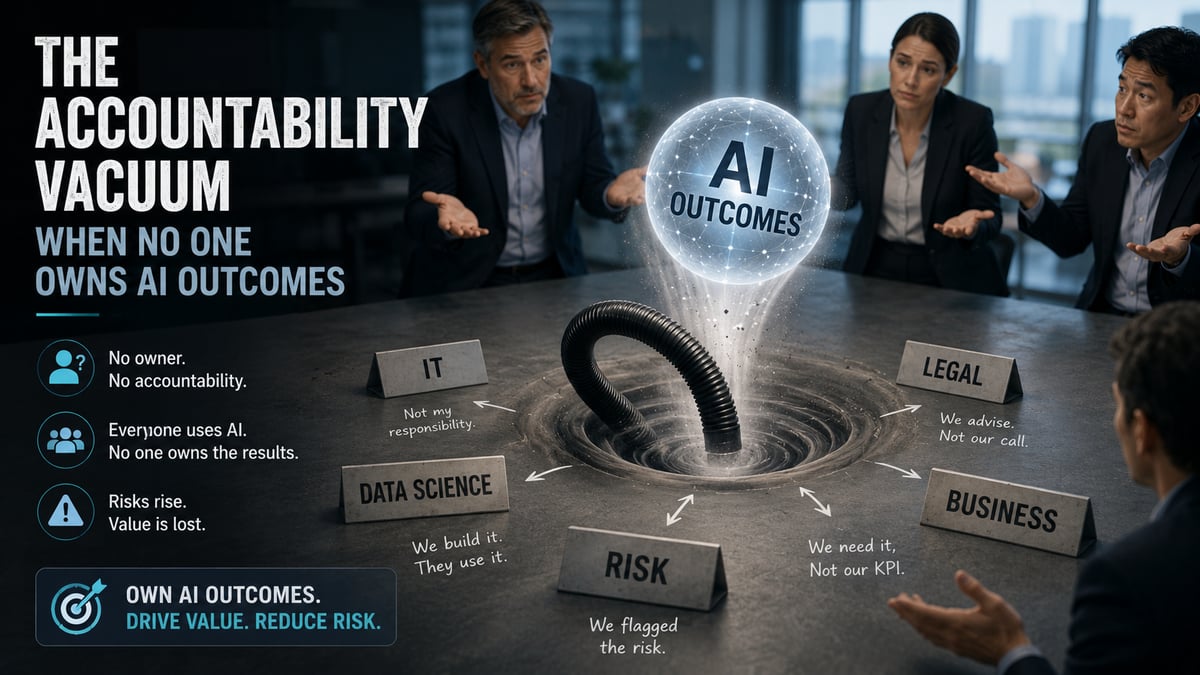

When AI governance questions reach the board without clear answers, the problem is almost never technical. It is that no one is accountable for producing those answers. That gap has a measurable cost.
Key Takeaways
- Grant Thornton’s 2026 AI impact survey found that lack of C-suite alignment is the leading cause of slowed AI progress and escalating risk.
- Cynozure’s 2026 State of the Industry Report found that only 40% of organizations have split AI strategy ownership across multiple executives. 17% report no clear owner at all.
- IBM's June 2026 study found two-thirds of CIOs are accountable for AI systems they do not control, which is the accountability problem made structural.
The Structure of the Accountability Problem
AI ownership in most enterprises is ambiguous because multiple executives have legitimate claims to it, not because one thought about it. The CIO owns deployment and governance. The CFO owns spend and ROI. The CHRO owns workforce readiness and skills. The COO owns operational outcomes. The CEO owns strategic direction.
Every one of those leaders has a stake in AI performance. None of them, in most organizations, is singularly accountable for whether AI is actually working. The CIO-CFO alignment gap is one expression of this problem. The governance adoption gap is another. The accountability vacuum is the root that produces both.
Grant Thornton's data puts the consequence plainly: lack of C-suite alignment is the leading cause of slowed AI progress. When no one is singularly accountable for AI outcomes, every decision that requires cross-functional alignment takes longer. Budget decisions stall. Governance gaps persist because addressing them requires someone to own the resolution. The 77% of organizations whose AI adoption is outpacing their governance controls are almost all organizations where no one person is accountable for the gap.
What the Accountability Vacuum Looks Like in Practice
Governance decisions that require no one's approval
If a team deploys an ungoverned AI tool and no one is accountable for the governance gap that creates, the gap persists indefinitely. There are policies, but nobody’s enforcing them. The most common way organizations discover this is during an audit, not before one.
Budget decisions based on incomplete data
When the CIO and CFO are working from different data on AI performance, budget decisions require resolving the data conflict before addressing the actual question. That resolution takes time and produces lower-confidence decisions than a shared data layer would. The full picture of what the CIO-CFO alignment problem costs in practice illustrates how accountability gaps translate directly into decision-making friction.
Agent activity with no owner
The average Larridin enterprise scan finds 47 orphaned agents with no current owner attached. Each orphaned agent represents an accountability gap made concrete: a system taking autonomous actions with no human responsible for what it does, what it costs or what it produces. The agent cost governance problem is directly connected to the accountability vacuum at the organizational level.
3 for AI Accountability That Work
1. Designated AI outcome owner
The clearest solution is a single executive accountable for AI performance across the enterprise. The Chief AI Officer structure that IBM’s CEO study found has grown from 26% to 76% of enterprises in the last year reflects this. A single accountable leader changes the governance dynamic: instead of shared responsibility that diffuses to no responsibility, someone's performance evaluation depends on whether AI is working.
2. Shared accountability with shared data
When a single owner is not the right structure, shared accountability requires a shared data foundation. The CIO, CFO, CHRO, and COO each owning a piece of AI accountability can work if all four are looking at the same picture. Larridin provides that shared layer, connecting spend data, utilization and adoption data, proficiency data and outcome data in a single view.
3. Attribution as accountability infrastructure
Beyond organizational structure, accountability requires that every AI tool, agent and workflow has a named owner attached to it. Attribution is not just a financial governance requirement. It is the mechanism that makes accountability real at the operational level. If every dollar, every agent and every workflow has an owner, accountability does not require an organizational redesign. It requires the data infrastructure to make attribution visible.
Frequently Asked Questions
Who should own AI accountability in an enterprise?
There’s no single right answer, but the worst answer is "everyone" because that functionally means no one. The most effective structures either designate a single AI outcome owner, such as a Chief AI Officer, or create shared accountability across CIO, CFO, CHRO, and COO grounded in a shared data foundation. The structure matters less than the clarity.
What is the AI accountability vacuum?
The AI accountability vacuum is the organizational state in which no single leader is clearly responsible for whether AI is working, creating governance gaps, slowed decision-making and escalating risk. It typically forms because multiple executives have legitimate partial ownership of AI and no one has been designated to own the whole picture.
How does lack of AI ownership affect governance?
Without a clear owner, there are governance gaps because addressing them requires someone to take responsibility for the resolution. Policies exist but are not enforced. Ungoverned tools continue to operate because calling them out requires someone to own the cleanup. The most common discovery mechanism for these gaps is an external audit, which means organizations find out after the exposure has accumulated.
How does attribution create accountability?
When every AI tool has an owner, every agent has a budget line and every workflow has a team attached to it, accountability becomes an operational reality rather than an organizational aspiration. Attribution makes it impossible for costs, risks or outcomes to exist without a responsible party, which is the functional definition of accountability.
Build the Infrastructure That Makes Accountability Real
Larridin provides the continuous AI portfolio view, spend, usage, proficiency and outcomes, that makes clear ownership and accountability possible. Leadership cannot be accountable for what they cannot see.
Book a discovery call to build your AI accountability foundation.