


Publish date: 12/09/2025
Enterprise AI spending will reach $644 billion in 2025, yet half of organizations can't answer a simple question: what AI tools are your teams actually using? Without strategic policy management, this blind spot turns innovation investments into compliance liabilities and competitive risk.
Key Takeaway
Enterprise AI success demands comprehensive policy management that balances innovation with governance. Organizations that implement strategic AI usage policies and compliance frameworks gain a measurable competitive advantage while maintaining regulatory readiness and operational control across their AI ecosystem.
Key Terms
-
AI Policy Management: The systematic approach to creating, implementing, and maintaining governance frameworks for artificial intelligence use across an organization. This includes defining acceptable AI use cases, establishing approval workflows, setting risk management protocols, and ensuring regulatory compliance while enabling AI adoption.
-
AI Governance Framework: A structured system of principles, policies, and practices that guide responsible AI development and deployment. These frameworks establish accountability, transparency, and ethical AI practices while aligning AI initiatives with business objectives and regulatory requirements.
-
Compliance Frameworks: Structured approaches for ensuring AI systems meet legal, regulatory, and ethical standards throughout their lifecycle. These frameworks help organizations navigate evolving AI regulations including GDPR, the EU AI Act, NIST AI Risk Management Framework, and ISO standards.
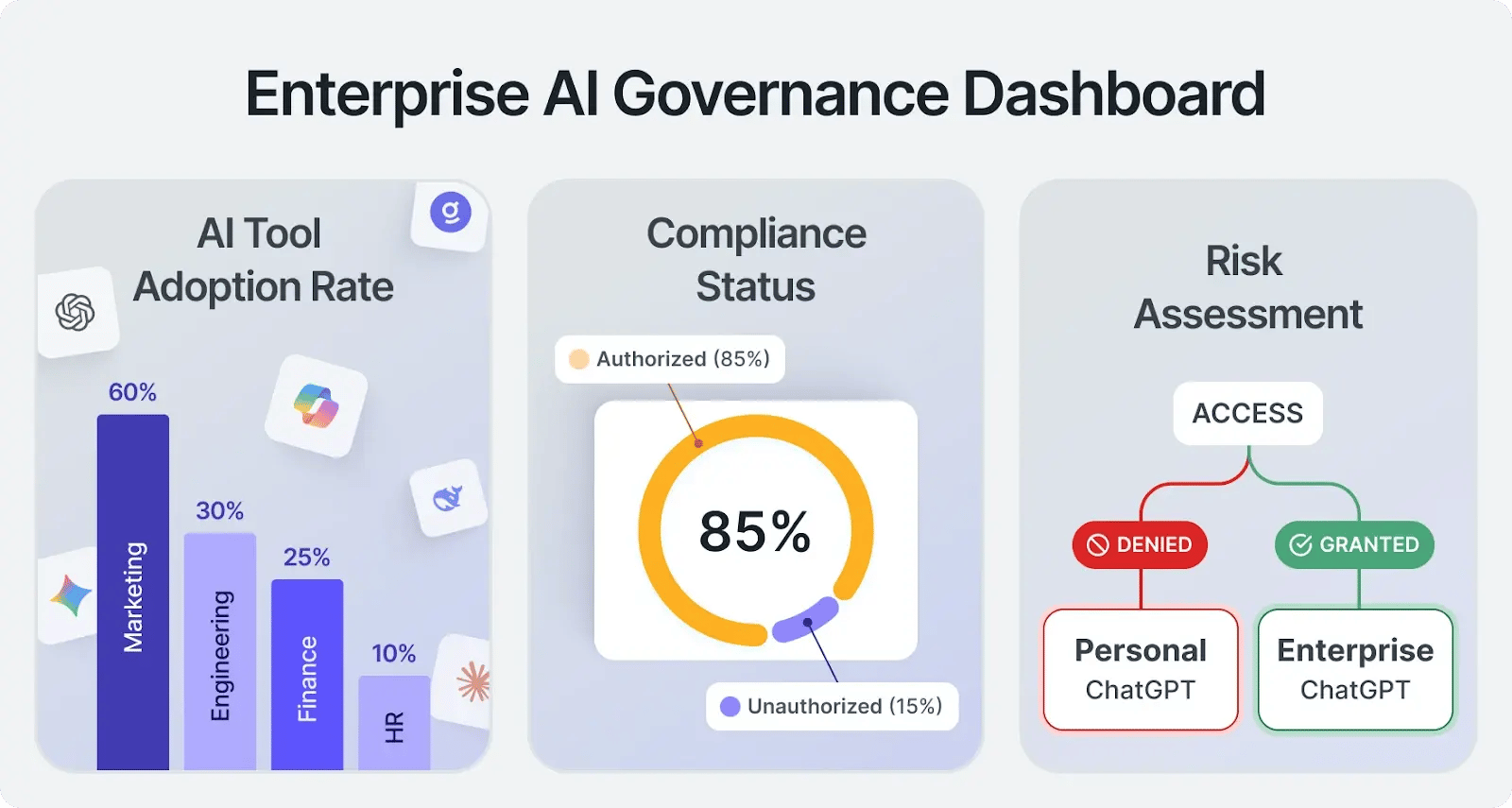
Shadow AI: Unauthorized or unmonitored use of AI tools and technologies within an organization. Shadow AI creates significant governance blind spots and compliance risks, with nearly half of enterprises identifying it as their top AI governance challenge.
The Strategic Imperative for AI Policy Management
As organizations accelerate AI adoption across their operations, the need for comprehensive AI policy management has become a critical business imperative. The challenge facing C-suite executives is stark:
The Larridin State of Enterprise AI 2025 Report found that 49.57% of organizations identify Shadow AI and unauthorized tools as their top governance challenge. Gartner predicts that by 2026, 50% of governments worldwide will enforce responsible AI use through regulations and data privacy requirements.
The financial stakes are equally compelling. By 2027, fragmented AI regulation will cover half the world's economies, driving $5 billion in compliance investment. Organizations without strategic policy management face not just regulatory exposure, but competitive disadvantage as AI-driven decision-making becomes central to business operations.
Navigating the Evolving Compliance Framework Landscape
Enterprise AI policy management must address a complex web of regulatory frameworks, each with distinct requirements and timelines. Understanding this landscape is essential for CAIOs, CFOs, CIOs, and COOs developing comprehensive governance strategies.
Key Regulatory Frameworks
The EU AI Act establishes risk-based requirements, prohibited practices, and transparency obligations for specified uses. Application dates and responsibilities differ by provision and system category. Map the actual use case and the organization’s provider or deployer role, and verify applicable timelines and amendments rather than assuming one enforcement date covers every system.
In the United States, the NIST AI Risk Management Framework provides voluntary but widely adopted guidance for managing AI risks. The framework emphasizes four core functions: govern (establishing organizational policies), map (understanding AI contexts), measure (assessing system reliability and bias), and manage (implementing controls). NIST AI RMF has become the de facto standard for many organizations seeking to establish responsible AI practices.
Data privacy regulations including GDPR have strict requirements for AI systems that process personal data. Organizations must ensure transparency in automated decision-making, maintain lawful data processing practices, and provide individuals with control over their data. These requirements directly impact how AI technologies utilize customer information and generate outputs.
Essential Components of Strategic AI Policy Management
Effective AI governance frameworks integrate multiple components for comprehensive oversight while enabling innovation. Organizations must address technical, operational, and ethical dimensions simultaneously.
Risk Assessment and Classification
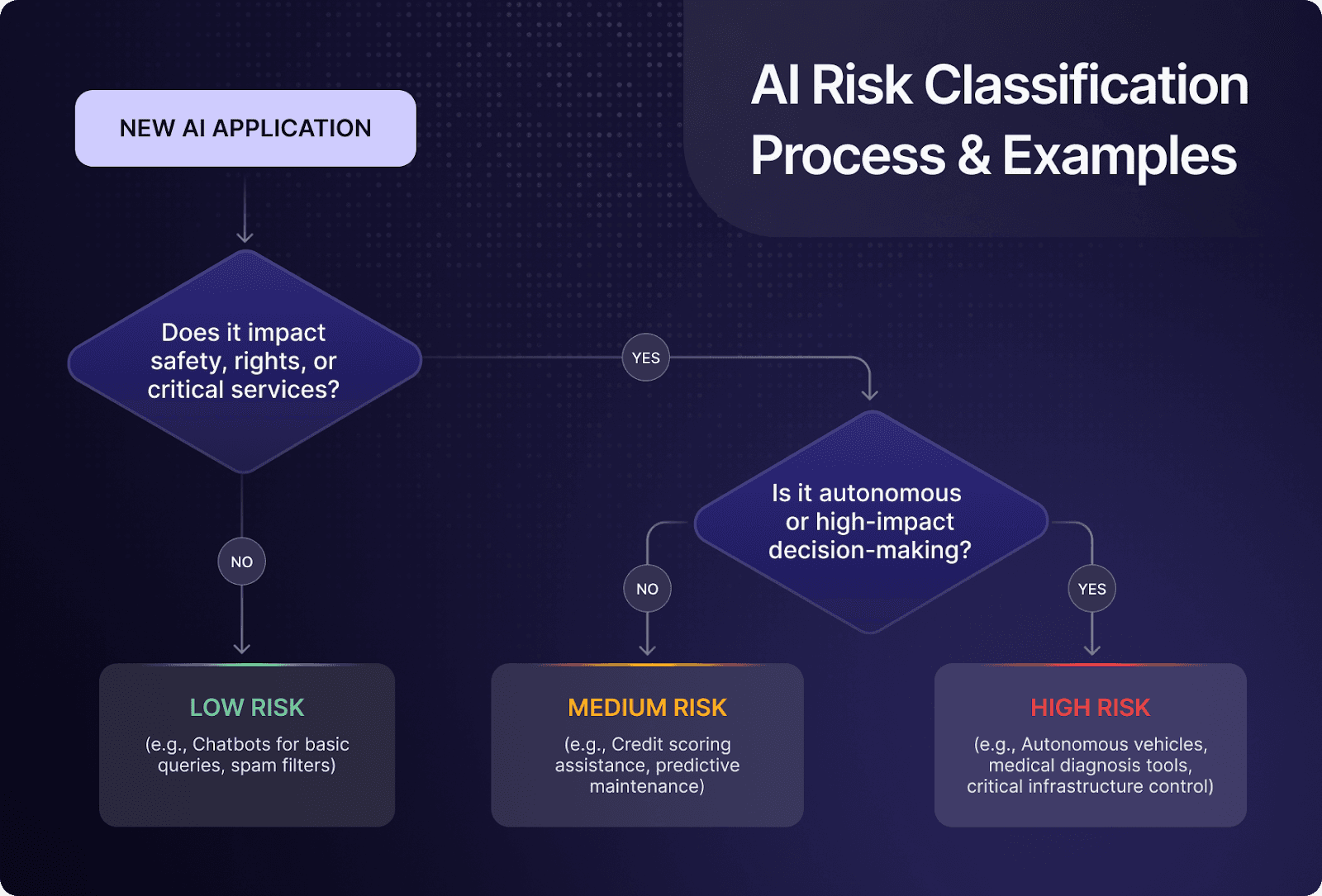
Risk management begins with systematic classification of AI use cases and applications. Organizations should maintain comprehensive inventories of all AI systems, documenting their purposes, data sources, decision-making capabilities, and affected populations. This visibility enables data-driven risk assessments and strategic infrastructure planning while identifying cybersecurity risks and compliance gaps proactively.
High-risk AI applications in sectors like healthcare, employment, and financial services require enhanced oversight. These systems need thorough impact assessments before deployment, regular validation for fairness and bias, and clear procedures for human review of automated decisions.
Data Governance and Privacy
Robust data governance mechanisms safeguard data privacy and enhance transparency across the AI lifecycle. Organizations must establish adaptive policies for data collection, processing, and storage that align with regulatory requirements while maintaining operational efficiency.
Privacy regulations require organizations to collect only data necessary for specific purposes. AI systems must be designed to minimize data collection and use information solely for intended applications to reduce potential risks and build stakeholder trust.
Explainability and Transparency
Transparency requirements extend beyond technical documentation to user-facing explanations. AI governance frameworks emphasize transparency about AI decisions and operations. Organizations must maintain transparent documentation of model inputs and decision logic while ensuring AI outputs remain explainable to relevant stakeholders.
Overcoming AI Governance Implementation Challenges
Despite widespread recognition of AI governance importance, implementation remains challenging. Only 18% of organizations have an artificial intelligence council authorized to make decisions on responsible AI governance, highlighting the urgent need for structured oversight.
Organizational Fragmentation
AI governance suffers when ownership fragments across legal, compliance, technology, and business functions. Effective policy management requires cross-functional collaboration with clear lines of accountability. Organizations should establish governance structures that bridge organizational silos and enable coordinated decision-making on AI initiatives.
Continuous Monitoring and Adaptation
AI systems require ongoing oversight rather than point-in-time assessments. Implementing automated tools and frameworks enables real-time oversight of AI systems through testing and evaluation, compliance dashboards, and cybersecurity monitoring. Continuous education on AI risks and compliance ensures teams can navigate the rapidly evolving landscape effectively.
Turn the Governance Framework Into Operating Controls
The AI governance framework guide connects principles with accountability, risk assessment, access controls, and human oversight. Policy management makes those elements repeatable: who approves a use case, which conditions apply, what evidence is retained, and who responds when the conditions change.
Use a shared register for tools, models, embedded AI features, and agents. Record intended purpose, business owner, affected people, relevant data categories, system access, approval status, vendor terms, and review triggers. Combine available discovery data with procurement, security, and business records. Document coverage gaps rather than assuming one monitoring source finds every system.
Assign cross-functional responsibilities. Business owners define the task and acceptance criteria; technology and security teams assess access and controls; legal and privacy teams evaluate applicable obligations; finance tracks cost accountability. Name the person or body with authority to approve exceptions and suspend a use case.
Close the Adoption–Governance Gap Continuously
The adoption–governance gap analysis identifies recurring weaknesses: inventories based only on self-reporting, reviews that lag deployment, policies that omit agents, and costs without accountable owners. Translate those weaknesses into checks embedded in the policy lifecycle.
- Discovery to review: Route newly identified tools and material usage changes to an owner for assessment rather than waiting for the next periodic audit.
- Approval to control: Specify allowed data, users, actions, and integrations. Test the relevant enforcement mechanism instead of treating a policy document as an enforced restriction.
- Agents to accountability: Define execution permissions, approval checkpoints, retry and spending boundaries, escalation, and stop conditions.
- Cost to ownership: Map available spending evidence to tools, teams, agents, and use cases, with unknown allocations kept visible.
- Incidents to revision: Use exceptions, near-misses, control failures, and changes in intended purpose to trigger reassessment.
A policy states what should happen. A control implements or checks that requirement. Continuous discovery helps identify gaps, but it does not automatically approve a new tool, enforce a rule, or establish compliance.
Connect AI Usage Visibility With Data Loss Prevention
The AI usage data and DLP guide highlights data exposure through prompts, uploads, coding assistants, and unapproved services. Policy management should specify which data can enter which systems, under what contractual and technical safeguards.
Distinguish usage analytics from content inspection and enforcement. Metadata can show which tool is used and where governance review may be needed. It does not, on its own, reveal whether a particular prompt contains confidential data. Detecting or blocking sensitive content requires a suitably configured DLP, endpoint, browser, gateway, or application control with the necessary access and coverage.
Traditional DLP is not universally incapable of covering AI. Test your existing controls against the actual tools and channels in use, including web prompts, file uploads, APIs, and agent actions. Document unsupported paths and residual risk.
- Classify data: Define permitted, restricted, and prohibited categories, including personal data, confidential business information, proprietary code, and sector-specific sensitive information.
- Approve the destination: Evaluate provider retention, training-use terms, subprocessors, access, and relevant contract protections.
- Test controls: Confirm detection, warnings, blocking, and incident routing using safe test data. An alert is not the same as prevention.
- Support users: Provide approved alternatives and clear reporting paths when employees encounter an uncertain data-sharing situation.
- Measure effectiveness: Review control coverage, validated incidents and near-misses, response times, false positives, and resolution of identified gaps.
Do not infer that a breach was prevented simply because a risky pattern was flagged. Record confirmed findings and the response, and keep security investigation evidence separate from routine workforce performance reporting.
Create a Separate Review Path for Employment AI
The employment AI classification guide adds a specific policy-management requirement: assess what the system is intended to do and how its outputs will be used, not just whether it is described as analytics.
Under the EU AI Act’s Annex III employment category, systems intended for recruitment, promotion or termination decisions, certain behavior-based task allocation, or monitoring and evaluation of worker performance or behavior can fall within the high-risk framework. High-risk classification is not itself a ban. Article 6 contains a limited exception for certain systems that do not pose significant risk or materially influence decisions, while Annex III systems that profile natural persons are always considered high-risk. Have qualified reviewers assess the actual use and document the basis. Source: EU AI Act, Article 6 and Annex III.
Workplace emotion inference is a separate prohibited practice, subject to narrow medical or safety exceptions. Do not conflate that prohibition with all performance analytics or employment decision support. Source: EU AI Act, Article 5.
For relevant high-risk systems, distinguish provider responsibilities from employer or deployer responsibilities. Provider documentation and assurance do not remove the organization’s own duties. The Act addresses competent human oversight, monitoring, appropriate input data where controlled by the deployer, retention of controlled automatically generated logs, and notification of affected workers and workers’ representatives. Verify applicable timing, amendments, and transitional provisions with legal counsel before deployment. Source: EU AI Act, Article 26.
Require vendors to explain classification, any claimed exception, available documentation and logs, oversight design, and which obligations remain with the employer. A general “compliant” label is not a substitute for that assessment. Reassess if group-level measurement is later repurposed for individual ranking, performance review, promotion, or termination.
Build Privacy Boundaries Into Workforce Measurement Policy
The differential privacy and workforce measurement guide separates formal differential privacy from broader privacy-preserving controls. Differential privacy uses a mathematical mechanism to limit what an analysis reveals about an individual. Aggregation, access controls, and minimum group thresholds can improve privacy without establishing that formal guarantee.
If a vendor claims differential privacy, ask for the mechanism, privacy parameters, treatment of repeated queries, and accuracy tradeoffs. Do not accept an aggregation threshold alone as proof of differential privacy.
For routine adoption and proficiency measurement, start with the business question and collect only the data needed to answer it. Define purpose, lawful basis where required, access, retention, group thresholds, and restrictions on reuse. Explain those boundaries to employees in concrete terms.
- Does the measurement system read prompts, outputs, or documents, or only usage metadata?
- Who can access individual-level data, and who receives only aggregated trends?
- How are small groups and combinations of reports handled to limit individual inference?
- Which decisions may the data support, and which employment uses require a separate review?
- How long are records retained, and how are access, deletion, and other applicable rights handled?
Larridin’s workforce measurement guide describes no prompt or output visibility, aggregated reporting, and configurable minimum group thresholds. Those boundaries should not be confused with content-inspecting DLP capabilities or a claim of mathematically certified differential privacy.
Where GDPR applies, identifiable usage metadata can still be personal data. Address lawful, fair, and transparent processing, purpose limitation, data minimization, and information provided to employees. Significant solely automated individual decisions can raise additional Article 22 questions. Privacy-preserving architecture can support compliance but does not establish it by itself. Source: GDPR, Articles 5, 6, 13, and 22.
Building Strategic AI Governance Capability
Organizations that treat AI governance as a strategic capability rather than a compliance burden gain competitive advantage through faster, more confident AI deployment. The foundation begins with comprehensive usage analytics that reveal actual AI adoption patterns across the enterprise.
Understanding what AI tools teams use, how effectively they leverage AI technologies, and where shadow AI creates governance blind spots enables data-driven policy development. This intelligence allows organizations to balance AI innovation acceleration with appropriate governance and cybersecurity requirements.
Strategic AI policy management connects usage analytics with adoption acceleration. Organizations can systematically scale successful AI practices enterprise-wide through secure, governed access to approved models and tools. Centralized AI infrastructure that enables rather than restricts innovation becomes possible when built on comprehensive usage intelligence.
Future-Proofing Your AI Governance Strategy
The regulatory environment will continue accelerating, demanding traceability, resilience, and transparency at levels few organizations have achieved. By 2027, Gartner expects three out of four AI platforms to include built-in tools for responsible AI and oversight, making governance capabilities a competitive differentiator.
Organizations should develop AI governance frameworks that map their AI portfolio to evolving regulatory requirements across different jurisdictions. This includes implementing AI trust, risk, and security management controls that reduce inaccurate or illegitimate information leading to faulty decision-making.
Vendor accountability forms another critical element. Organizations must enforce contractual obligations for responsible AI governance with third-party providers, mitigating risks from unethical or noncompliant outcomes. Many compliance failures occur through external AI tools rather than internal systems, making vendor evaluation processes essential.
Moving from Compliance to Competitive Advantage
AI usage policies and compliance frameworks are far more than regulatory obligations. They establish the foundation for confident, accelerated AI adoption that delivers measurable business value. Organizations that embed governance into AI workflows from the start avoid the costly retrofitting required when compliance becomes an afterthought.
The organizations thriving in the AI era are those turning compliance into operational capability: connected, explainable, and verifiable at any time. This transformation requires comprehensive usage intelligence, systematic governance structures, and continuous adaptation as AI technologies and regulations evolve.
Strategic AI policy management positions enterprises to harness artificial intelligence responsibly and effectively, transforming AI from scattered experiments into coordinated competitive advantage.
Frequently Asked Questions
What is the difference between AI governance and AI policy management?
AI governance is the overarching framework of principles and practices that guide responsible AI use across your organization. AI policy management is the operational execution of that governance: the systematic process of creating, implementing, and maintaining specific policies, approval workflows, and compliance procedures. Think of governance as your strategy and policy management as the tactical implementation that makes that strategy actionable.
How do we start building an AI policy framework when we don't know what AI tools our teams are using?
Begin with comprehensive AI usage analytics to discover your complete AI landscape, including shadow AI. Deploy monitoring tools that reveal what AI technologies teams use, how frequently, and for what purposes. This visibility provides the foundation for evidence-based policy development. Without understanding current adoption patterns, policies risk being either too restrictive (hindering innovation) or too permissive (creating compliance gaps).
What are the most critical compliance frameworks we need to address for enterprise AI?
Assess the EU AI Act for applicable risk-based duties and prohibitions, GDPR where personal data processing falls within its scope, and sector-specific or national requirements relevant to the use case. NIST AI RMF provides voluntary guidance organized around govern, map, measure, and manage; it is not itself an EU-style regulatory obligation. Verify current applicability and timelines with qualified reviewers.
How can we balance AI innovation speed with compliance requirements?
Strategic AI policy management treats compliance as an enabler rather than a barrier. Establish pre-approved AI tools, model libraries, and use case frameworks that teams can access immediately within defined guardrails. This approach accelerates adoption of vetted solutions while maintaining control. Organizations with centralized governance and clear approval pathways deploy AI-powered solutions faster than those treating compliance as an afterthought requiring extensive retrofitting.
What's the biggest risk of not having formal AI usage policies?
Shadow AI—unauthorized or unmonitored AI tool adoption. Nearly 50% of organizations identify this as their top governance challenge. Shadow AI creates multiple risks: compliance violations you can't detect, data exposure through unapproved systems, inconsistent AI practices across departments, and inability to measure ROI on AI investments. By 2027, fragmented AI regulation will drive $5 billion in compliance investment, with unmonitored AI usage exposing organizations to substantial fines.
How often should AI policies be updated?
AI policies require continuous monitoring and quarterly reviews at minimum, with immediate updates when regulations change or new artificial intelligence advancements emerge. The regulatory landscape is evolving rapidly—generative AI capabilities, agentic AI systems, and new compliance frameworks demand adaptive policy management. Implement automated tools that enable real-time oversight and establish clear processes for policy amendments as your AI adoption matures.
Do we need different policies for different types of AI systems?
Yes. Risk-based policy frameworks should classify AI systems by their potential impact. High-risk applications in healthcare diagnostics, employment decisions, or financial services require enhanced oversight including impact assessments, bias validation, and human review procedures. Lower-risk applications like internal automation or content generation may operate under streamlined approval processes. This tiered approach optimizes resources while ensuring appropriate governance where it matters most.
Does AI usage analytics automatically prevent data loss?
No. Usage visibility can guide assessment and investigation, but sensitive-content detection and blocking depend on the capabilities, configuration, and coverage of enforcement controls. Metadata-only measurement cannot establish what confidential information was entered in a prompt.
Does aggregation mean a product uses differential privacy?
No. Aggregation and minimum group sizes can reduce exposure, but formal differential privacy requires a mathematical mechanism and defined privacy guarantees. Ask vendors to explain the mechanism and parameters behind any such claim.
Is AI used in performance reviews prohibited?
Not categorically. Some employment systems fall within the EU AI Act’s high-risk framework and require a specific assessment. Workplace emotion inference is a separate prohibited practice with narrow exceptions. Classification depends on intended purpose and actual use, including whether analytics are used to evaluate individuals.
How do we know policies are keeping pace with adoption?
Compare discovered tools, agents, and changed use cases with the approval register and tested controls. Track ownership gaps, time to assessment, open exceptions, and incident follow-up. Review policies on a regular schedule and when material changes occur.