


An organization-wide AI spending total tells finance how much was spent. It can’t show which team, agent, project, use case, vendor, or model drove the cost or whether it produced value . That’s the gap AI token spend attribution closes.
Key Takeaways
- The FinOps Foundation’s 2026 survey found that 98% of respondents now manage AI spend, up from 31% in 2024. Practitioners still reported challenges with visibility, cost allocation, and value measurement.
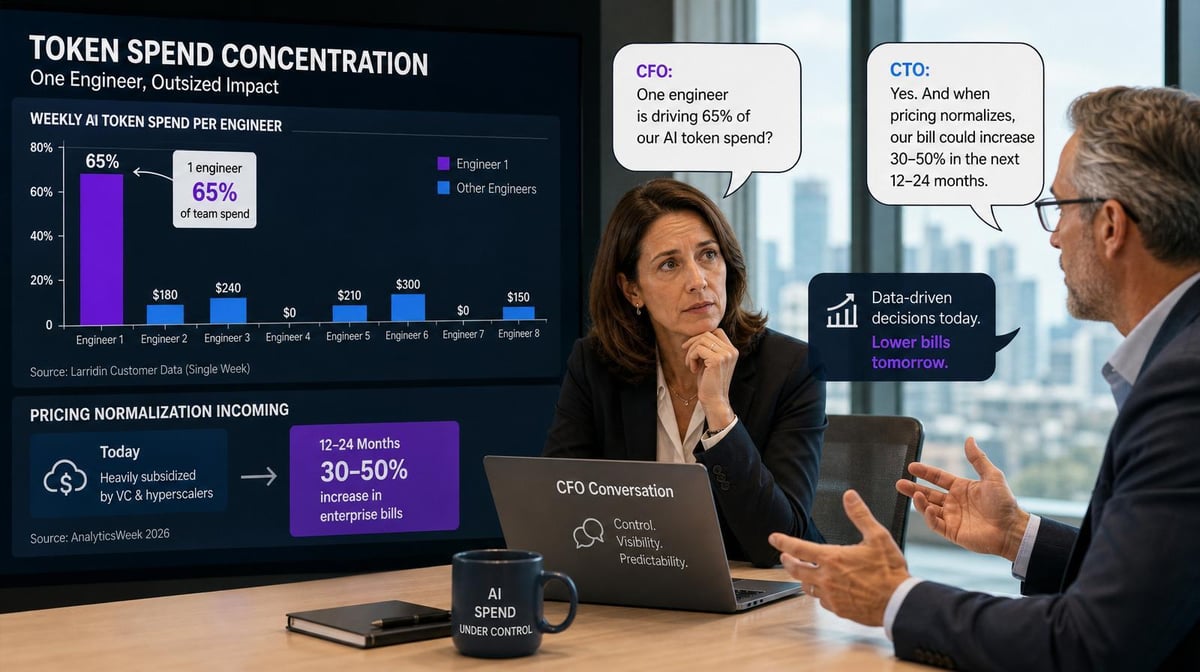
- In one Larridin customer environment, one engineer accounted for 65% of the team’s AI spending during one week, while several teammates spent between $0 and $300. The team total couldn’t explain the concentration.
- Useful AI cost reporting connects billed spending and observed usage to the teams, agents, projects, use cases, vendors, and models that generated it.
What an Aggregate AI Spend Total Can Tell You
Spending totals are a necessary starting point. They tell finance how much the organization spent and how that compares with the budget. Viewed over time, they also show whether costs are rising or falling. They don’t explain the variance.
AI expenses can come from seat licenses, API usage, cloud model calls, coding tools, desktop applications, agents built by employees, and invoices submitted through different departments. When those sources are consolidated into one budget line, leaders can’t tell whether an increase was due to broader adoption, one high-volume workflow, a model change, an agent loop, or a temporary project.
The FinOps Foundation’s 2026 survey included 1,192 practitioners responsible for more than $83 billion in annual cloud spending. Granular monitoring of tokens, LLM requests, and GPU use was the most requested missing tooling capability. The report also identified AI cost visibility, allocation to business units, and value measurement as persistent challenges.
AI FinOps needs more than a total. It needs an attribution layer.
What Spend Concentration Reveals
In one Larridin customer environment, one engineer accounted for 65% of the team’s AI spending during a single week. Several teammates spent between $0 and $300 during the same period.
That concentration isn’t automatically good or bad. The engineer may have been doing valuable, high-volume work, testing a new workflow, using a more expensive model, or generating unnecessary cost. The team total can’t distinguish among those explanations.
Attribution changes the conversation from “Why is the AI bill so high?” to more useful questions:
- Which tool or model generated the cost?
- Was the activity tied to a defined project or use case?
- Was the spending expected?
- Did the work produce enough value to justify it?
- Is the pattern temporary, recurring, or accelerating?
A concentrated cost pattern is a signal to investigate, not proof of waste.
The Attribution Levels Finance Needs
Each type of AI spending needs clear ownership and an appropriate way to allocate the cost. When identity data is available, employee tool use can be attributed to a person or team. Agent costs can be tied to an owner, project, and workflow. Shared infrastructure costs may need to be divided across departments or use cases.
A CFO-ready view should connect AI spending across five dimensions:
- Spend source: Which provider, application, cloud service, invoice, or gateway generated the charge?
- Owner: Which department, team, or accountable leader is responsible for it?
- Workload: Which agent, project, workflow, or use case consumed the resources?
- Model and cost type: Which model was used, and was the expense a license, token charge, cloud cost, or agent activity?
- Outcome: What operational or business result did the spending support?
Not every source will support every level of attribution. Reporting should show what is known, shared, or unattributed rather than creating false precision.
Observed Usage and Billed Spend Are Different Views
Finance needs the invoice amount, but long-term planning may also require the underlying consumption data.
Provider credits, discounts, bundled allowances, and subsidies can cause billed spending to differ from observed token usage. A low invoice doesn’t necessarily mean low consumption, and token volume doesn’t reveal the final cost without the provider’s pricing and billing terms.
Larridin’s Token Spend & Insights consolidates AI spending across providers and formats while tracking both observed token usage and billed spending. Its public product information describes attribution by department, team, agent, project, vendor, model, workflow, and use case.
Seeing both views helps finance understand current costs while building forecasts for different pricing, credit, and usage scenarios.
How Attribution Creates an Optimization Surface
Once leaders know what drove the cost, they can choose an action that fits the cause.
- High spending tied to a valuable project may warrant a larger budget rather than a cut.
- A costly workload using a frontier model may be a candidate for lower-cost routing, but only after testing quality, reliability, latency, and risk.
- Dormant licenses or approved tools with little use may signal a renewal or enablement problem.
- Agent spending that rises unexpectedly may require an owner, budget, activity limits, or projected-overage alerts.
- Unattributed costs may require better integrations, tagging, identity mapping, or allocation rules.
The goal is to identify which spending should be expanded, redesigned, routed differently, governed more closely, or stopped.
What CFO-Ready AI Spend Reporting Should Show
A useful AI FinOps view should include:
- Consolidated billed spending across providers and purchasing channels
- Observed token and model usage where available
- Allocation by department, team, agent, project, workflow, and use case
- Vendor- and model-level cost distribution
- Budget forecasts and projected overage alerts
- Separation between human and agent spending
- Unattributed costs that still need an owner
- Business outcomes tied to major investments
This gives finance, engineering, and business leaders a shared basis for deciding what to do next.
Frequently Asked Questions
What is AI FinOps?
AI FinOps applies financial accountability and technology value management to AI spending. It brings finance, engineering, IT, and business teams together to understand usage, allocate costs, forecast spending, optimize workloads, and connect investment to outcomes.
Why isn’t total AI spend enough for cost optimization?
Spending totals show how much you spent and whether costs are rising or falling over time, but not what caused the change. Optimization requires enough attribution to identify the owner, tool, model, workload, and value behind the cost.
How do we build per-person AI spend visibility?
Start with sources that provide usage data and reliable user identity. Map provider or gateway records to employee accounts, document shared accounts, and leave costs unattributed when they can’t be assigned accurately.
Can task-level attribution reduce model costs?
It can identify workloads that may be candidates for a different model or routing policy. The organization still needs to test whether a lower-cost option meets its requirements for quality, reliability, speed, privacy, and risk.
Will AI inference prices increase over the next two years?
There’s no reliable universal forecast. Provider prices, credits, model efficiency, competition, and usage volume can move in different directions. Finance teams should model several scenarios using both billed spending and observed consumption rather than assuming one fixed price path.
Build the Attribution Layer Behind AI FinOps
Larridin’s Token Spend & Insights consolidates AI spending and connects it to the teams, agents, projects, workflows, vendors, models, and use cases that drive it.
Book a discovery call to see what is driving your AI costs and where better attribution can support forecasting, governance, and optimization.