

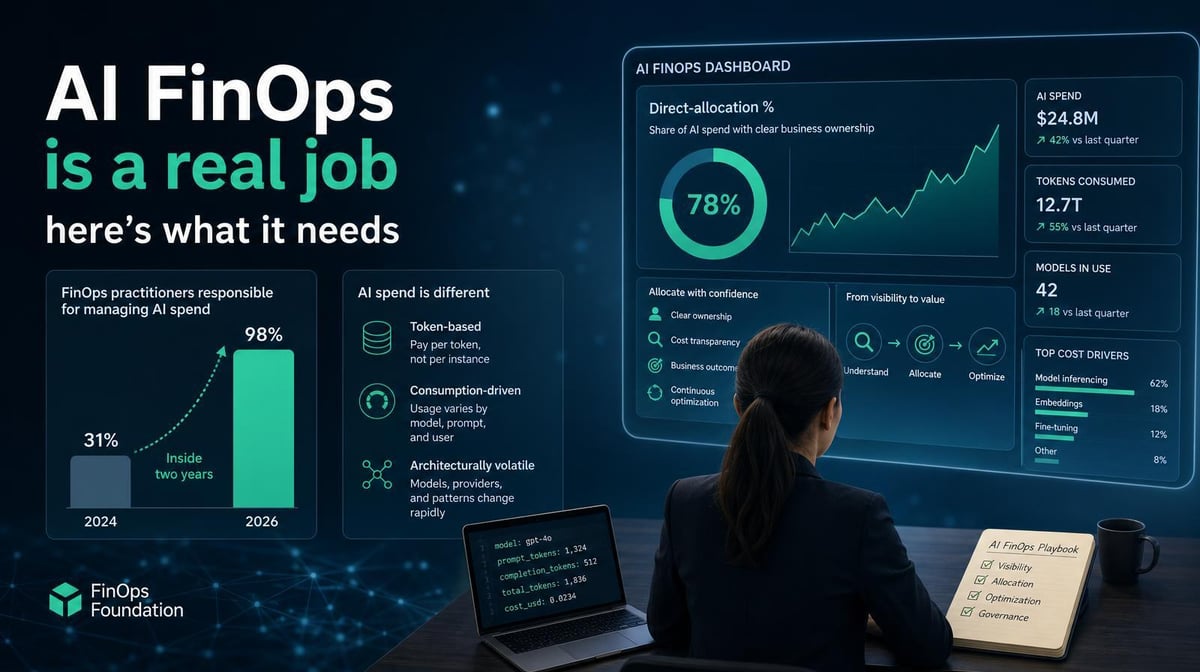

In 2024, 31% of FinOps practitioners managed AI spend. In 2026, 98% do. The responsibility moved faster than the standards, tools, and operating practices needed to manage it. The result is a function that’s expected to manage AI spend without a complete operating model.
Key Takeaways
- Visibility, allocation, and value measurement are the biggest AI FinOps challenges. Teams also need more granular data on token use, model requests, and GPU consumption.
- Existing FinOps principles still apply, but they have to work with new usage data, pricing models, and attribution challenges.
- The goal is to connect AI spend to owners, budgets, and outcomes so leaders know what to expand, change, or stop.
Why AI FinOps Needs Different Data
The FinOps Foundation describes AI as another technology category that needs the same core discipline as cloud: understand the cost, assign ownership, forecast demand, optimize use, and connect spending to value.
The challenge is that AI cost data is scattered. Spend can appear in model-provider invoices, cloud services, SaaS subscriptions, GPU infrastructure, coding tools, gateways, and employee-built agents. Credits and subsidies can also make billed spend look different from actual token consumption.
The State of FinOps 2026 identifies visibility, allocation, and value measurement as the main challenges practitioners face when applying FinOps to AI. Granular monitoring of tokens, large language model requests, and GPU utilization is also the most requested missing tool capability.
4 Capabilities AI FinOps Actually Requires
1. Consolidated Cost and Usage Visibility
Start by bringing billed spend and observed usage into one view.
Track the provider, model, tool, project, request volume, input and output tokens, cached usage, GPU consumption, credits, and effective cost. The exact fields will vary by deployment, but finance should be able to reconcile what the organization consumed with what it paid.
Larridin’s Token Spend & Insights platform consolidates AI spend from model providers, cloud platforms, coding tools, gateways, agents, desktop applications, and invoice files. It shows both observed token usage and billed spend after credits and subsidies.
2. Allocation to an Owner and Use Case
A total AI bill doesn’t show who’s responsible for the spend or whether it supports a priority.
Allocate costs to the department, team, project, agent, and use case that generated them. Then track allocation coverage: the percentage of total AI spend connected to an owner and purpose. Unallocated spend should be visible as a gap to investigate, not buried inside a shared total.
Larridin attributes tokens and dollars to departments, teams, agents, and projects. That gives budget owners and team leaders data they can act on.
3. Forecasting and Anomaly Detection
Monthly reporting shows what already happened. AI FinOps also has to forecast what’s likely to happen before the billing period closes.
Compare actual and projected spend with the budget. Set alerts for unusual token growth, retries, agent loops, model changes, unused seats, and rollouts that are scaling faster than expected. The goal is to catch waste and misconfiguration without blocking productive work.
Larridin’s token spend view surfaces projected overages and unused seats before spending goes over budget.
4. Value Measurement and Optimization
Seeing what you spend is only the first step. AI FinOps becomes more useful when it shows what that spending produced.
The State of FinOps 2026 says mature practices are focusing on unit economics and AI value quantification. For engineering teams, that means reading spend alongside delivery speed, code durability, quality, rework, and other useful outcomes.
Larridin’s Developer Productivity platform connects AI use with delivery, quality, code durability, cost, and ROI. Once the organization can see both sides of the equation, it can apply optimization levers such as model routing, prompt caching, agent-loop changes, and spending controls based on evidence rather than across-the-board cuts.
Larridin’s guide to AI cost optimization covers those levers in more detail.
What AI FinOps Should Report to Finance
A useful finance view should show:
- Total billed AI spend and observed usage over time
- Spend allocated by business unit, team, project, and use case
- Allocation coverage and the largest unattributed cost pools
- Actual and projected spend compared with budget
- Material anomalies and the action taken
- Cost per useful outcome or another relevant unit economics measure
- Which investments should expand, change, or stop
That report shows finance who owns the spend, what’s driving it, what the organization receives in return, and what leaders will do next.
Frequently Asked Questions
How is AI FinOps different from cloud FinOps?
The core discipline is the same. AI FinOps still uses visibility, allocation, forecasting, optimization, and value measurement. The difference is the data: AI spend can span tokens, requests, GPUs, SaaS licenses, tools, agents, credits, and multiple providers, with less consistent ownership and pricing.
What’s allocation coverage?
Allocation coverage is the percentage of AI spend connected to an owner and use case. It’s a practical way to measure whether the organization can explain and govern its costs. Track the percentage over time and investigate the largest unattributed pools first.
Does AI FinOps require dedicated headcount?
Not always. A member of the FinOps team, an engineering finance partner, or a cloud cost lead can run the early program with support from engineering, finance, procurement, and data teams. Dedicated headcount is useful when allocation, forecasting, optimization, and stakeholder reviews require continuous attention. The State of FinOps 2026 says the most common setup is a small central team that sets standards and provides support, while people in individual departments or teams manage their own AI spending.
What should we implement first?
Start with consolidated cost and usage data, then assign owners and use cases. Forecasts, anomaly alerts, and optimization decisions become more reliable after those foundations are in place.
Don’t wait for a perfect historical baseline. Establish the clearest current view available and improve it as more sources are connected.
Build the Attribution Layer AI FinOps Needs
Larridin Token Spend & Insights consolidates observed usage and billed spend, attributes costs to departments, teams, agents, and projects, and alerts leaders before spending goes over budget. Pair it with Developer Productivity to connect engineering spend with delivery and quality outcomes.
Book a discovery call to build an AI FinOps view that goes beyond reporting the bill.