

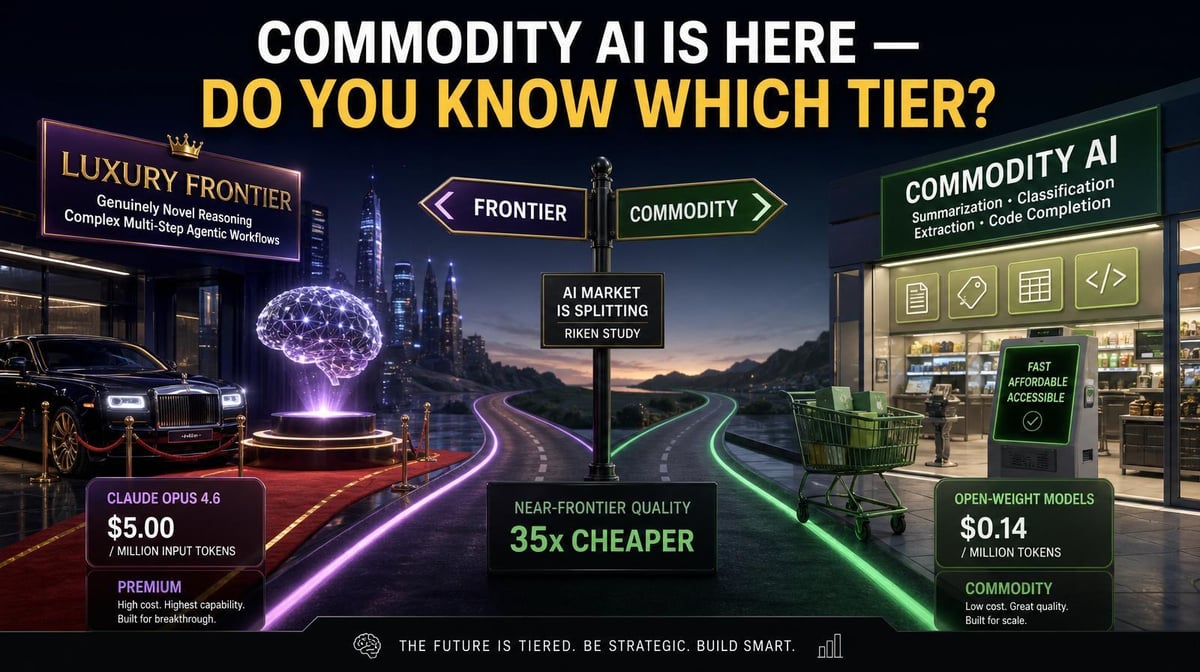

The question is no longer which AI model is best. It’s which model is good enough for each task, what the quality difference is, and whether the added capability justifies the added cost.
Key Takeaways
- Matsuoka’s July 2026 scenario analysis describes a possible split between increasingly expensive frontier development and a lower-cost mass tier built through open-weight models, distillation, and more efficient inference. It’s a market scenario, not proof of a permanent two-tier structure.
- Gartner says routine, high-frequency work should be routed to efficient small or domain-specific models, while frontier inference should be reserved for complex reasoning. It also estimates that agentic tasks may use five to 30 times more tokens than a standard chatbot.
- Intelligent routing isn’t a price-table exercise. Enterprises need task-level quality, usage, and cost data to choose the lowest-cost model that consistently meets the requirement.
The Market Is Separating Into Different Cost and Capability Tiers
Satoshi Matsuoka’s July 2026 scenario analysis examines how memory prices, open-weight models, inference efficiency, and infrastructure economics could reshape the AI market through 2030. Its central argument is that frontier development may get dramatically more expensive, while a lower-cost mass tier becomes more capable.
That’s a useful enterprise lens, but it isn’t a universal routing rule. The paper models several possible market outcomes. It doesn’t prove that open-weight models deliver equivalent quality for every routine task or that the split will be permanent.
Gartner makes the practical implication clearer. It predicts that organizations will use small, task-specific models at least three times more than general-purpose LLMs by 2027. Gartner also recommends routing routine, high-frequency tasks to efficient small or domain-specific models and reserving frontier inference for complex reasoning.
“Commodity” should mean a task can be handled reliably by a lower-cost tier in your environment, not that the task sounds easy in the abstract.
Which Tasks Are Candidates for Each Tier?
Lower-Cost Tier Candidates
Routine tasks are good candidates when the inputs are predictable, the output can be evaluated consistently, and errors have limited consequences. Examples may include:
- Summarizing standardized documents
- Classifying or tagging content
- Extracting defined fields from familiar formats
- Applying repeatable transformations
- Generating first-pass boilerplate or routine code completion
Those tasks still need to be tested against your actual quality requirements. A classification workflow with specialized terminology or strict compliance requirements may need a domain-specific model, retrieval, or a more capable tier.
Frontier Tier Candidates
Frontier models are more likely to justify their cost when the task requires:
- Complex multi-step reasoning
- Novel synthesis across multiple domains
- Long-running agentic workflows with tool use
- High-stakes decisions where errors have material consequences
- Work where internal evaluations show a meaningful quality gap between tiers
The dividing line is the measured difference in quality, reliability, latency, and total cost for the specific workflow.
Why Cheaper Tokens Don’t Guarantee a Lower Bill
Gartner predicts that inference on a one-trillion-parameter model will cost providers more than 90% less by 2030 than it did in 2025. But it also warns that frontier intelligence will consume significantly more tokens. Agentic tasks may use five to 30 times more tokens than a standard chatbot.
Lower unit prices don’t automatically reduce total spend. Reasoning depth, output length, retries, tool calls, caching, and repeated agent actions all affect the final bill.
A model that costs less per input token may produce more output tokens, require more retries, or fail quality checks that create downstream work. A premium model may cost more per token but finish the task in fewer steps. The useful comparison is total cost per acceptable result.
Coinbase Shows What Routing Actually Requires
Coinbase has described a multi-cloud, multi-model architecture that routes different use cases to appropriate models. Its system also includes an internal evaluation framework, usage and billing dashboards, semantic caching, load and latency benchmarks, and a decision framework for selecting cost-effective models.
That’s the real model-routing pattern. The organization doesn’t pick one cheap model and declare victory. It evaluates models by use case, tracks cost and performance, and combines routing with other controls.
As AI agents operate across more of the business, that discipline becomes more important. A single agent may call several models, use tools, retry steps, and generate far more tokens than an employee using a chatbot.
What Task-Level Visibility Enables
AI model tier routing requires visibility into five things:
- Which task or workflow generated the usage
- Which model handled it
- What the full run cost, including input, output, retries, and tool calls
- Whether the output met the quality requirement
- Which team, agent, or business outcome the spend supported
Larridin’s Token Spend & Insights consolidates spend across tools and models, then attributes tokens and dollars to teams, agents, projects, and use cases. That gives leaders the data to find where premium models are being used and decide which workflows are candidates for controlled routing tests.
The next step isn’t an automatic downgrade. Run the same task on candidate models, define the acceptance criteria, and compare quality, latency, and total cost. Route production work to the lowest-cost tier that consistently passes.
Frequently Asked Questions
What is the difference between frontier and commodity AI models?
Frontier models are built for the strongest available reasoning, coding, tool use, and complex professional work. Commodity or lower-cost models trade some capability for lower cost and faster execution. The relevant distinction is whether a lower-cost model meets the quality requirement for a specific task.
Which AI tasks should use lower-cost models?
Start with high-volume, repeatable tasks that have clear inputs and measurable outputs. Summarization, classification, extraction, and standardized drafting may be candidates, but each workflow should be evaluated before production routing.
How much can model tier routing save?
Savings depend on the current model mix, input and output tokens, caching, retries, latency, and the share of tasks that can move without reducing quality. Measure total cost per acceptable result rather than comparing input-token prices alone.
How do we know which models our teams are using?
You need usage and spend attribution by model, team, agent, project, and use case. Aggregate token totals can’t show whether frontier models are being used for routine work or whether the added cost is producing better outcomes.
See Which Model Tier Your Work Is Using
Larridin’s Token Spend & Insights shows which models are driving spend across teams, agents, projects, and use cases, giving leaders the visibility to test smarter routing without guessing.
Book a discovery call to see where premium model spend is justified and where a lower-cost tier may perform just as well.