

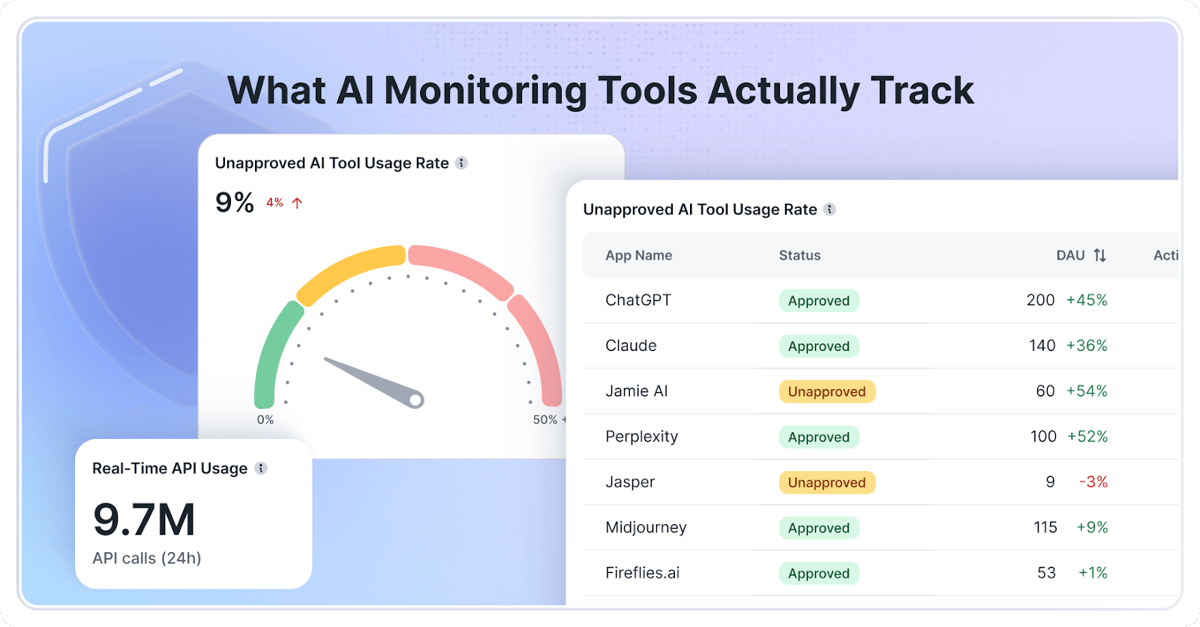

Your approved AI list may describe only part of the business. Employees can adopt browser tools, activate embedded features, and build agents without creating a new procurement record. AI monitoring helps discover that activity so the organization can assess its owners, costs, access, and risks.
Key Takeaway
Shadow AI discovery is the starting point for governance, security, and compliance assessment. Find the tools and agents in use, connect them to accountable owners and workflows, and determine which controls and obligations apply. Continuous visibility improves the inventory, but does not by itself establish content exposure, prevent a breach, enforce a policy, or prove compliance.
Quick Navigation
- The Shadow AI Problem
- What AI Monitoring Tools Actually Track
- From Shadow Tools to Shadow Operations
- Connect Discovery to Compliance Assessment
- Why This Matters for Decision-Making
- Building Your AI Monitoring Strategy
- Moving From Visibility to Action
- Frequently Asked Questions
- A Fast Path to Monitoring Excellence
Key Terms
- AI Monitoring: Ongoing observation of available tool, usage, workflow, and operational signals to support investigation and decisions.
- Shadow AI: AI tools, features, services, or agents used outside the organization's approval or oversight processes.
- AI Discovery: Identifying AI activity across supported applications, devices, APIs, and workflows, with coverage limits documented.
- Data-Handling Context: The intended data categories, access, permissions, provider terms, and workflow purpose needed to assess risk.
- Shadow Operations: Unreviewed agents or automations taking actions in business systems without adequate ownership or oversight.
- Policy Enforcement: A control that restricts or changes behavior, distinct from a dashboard or notification that reports it.
The Shadow AI Problem
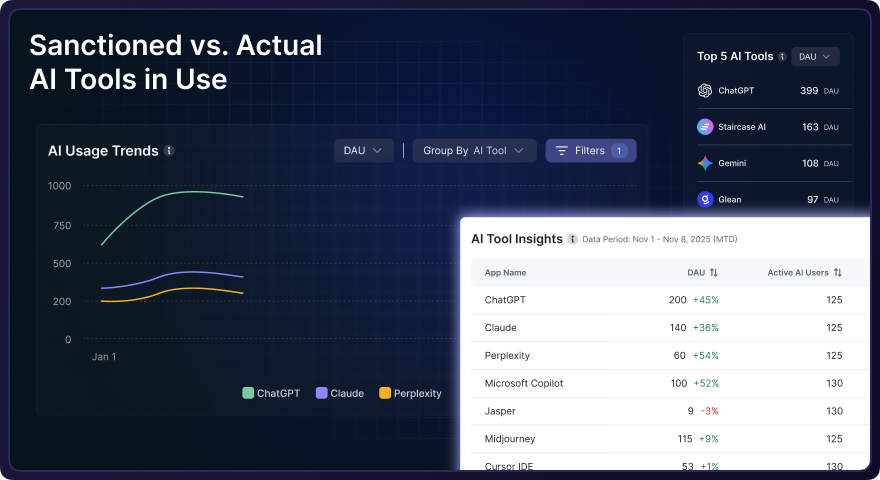
An employee may use a personal account to summarize a document, a team may buy an assistant on a corporate card, or an approved SaaS product may add AI without a separate procurement review. The official tool list can therefore differ from operating reality.
Larridin's State of Enterprise AI research examines this visibility problem. For your own organization, compare discovered activity with procurement, identity, billing, and approval records rather than assuming the approved inventory is comprehensive.
Personal or unapproved services may lack the organization's expected retention, training-use, contractual, and access protections. Whether data is exposed depends on what was shared, the account and provider terms, and the controls in place. Tool presence alone does not prove a leak or that corporate data was used for training.
What AI Monitoring Tools Actually Track
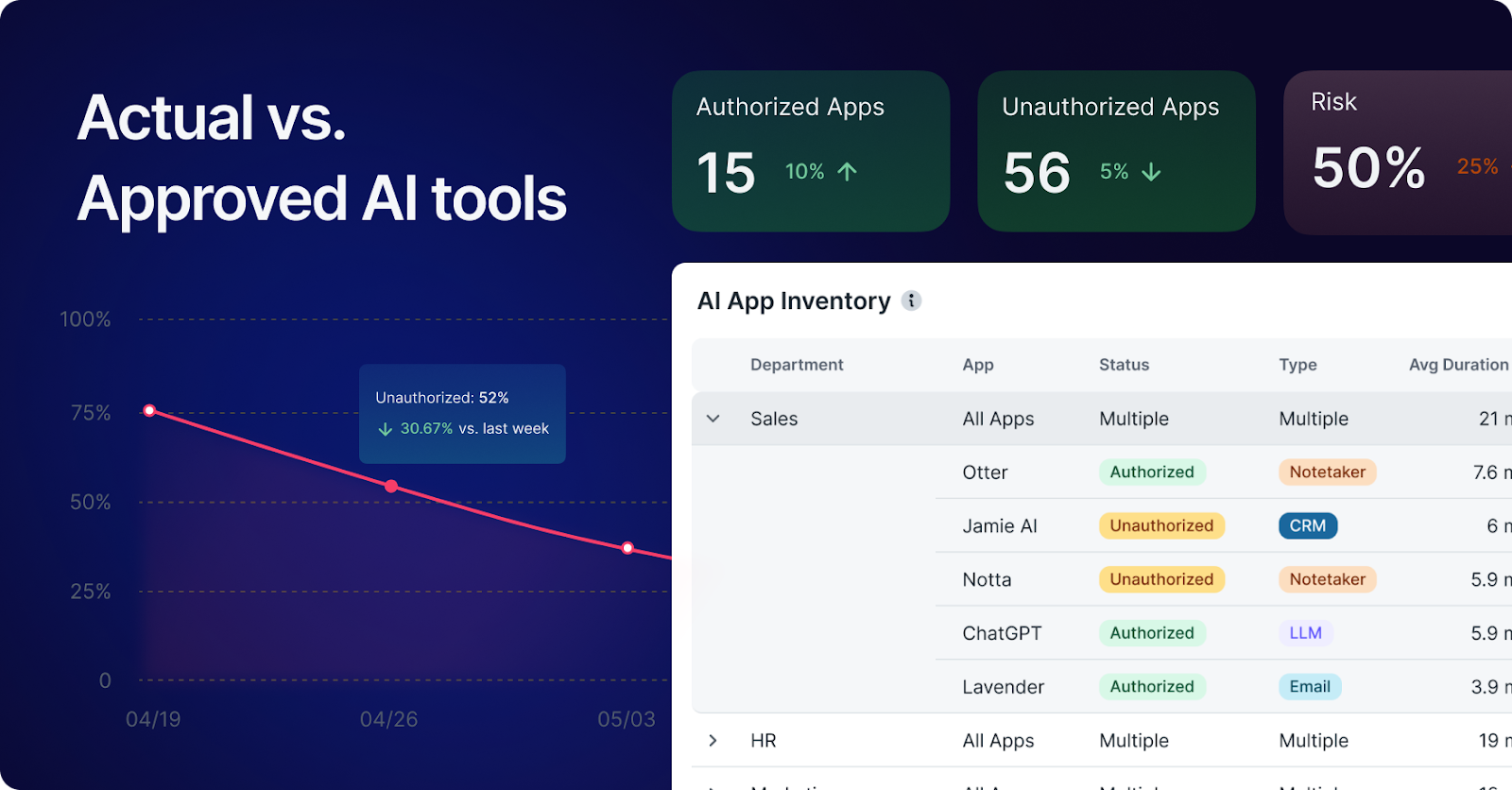
Discovery methods provide different evidence. Combine the methods relevant to your environment and document unsupported devices, accounts, applications, and execution paths.
Browser, Desktop, Identity, and Application Activity
Available telemetry can identify AI applications and patterns of access. Identity records, SaaS integrations, and application settings can add context about users, approvals, accounts, and embedded features. Surveys and team interviews can help explain purpose or reveal gaps, but should not be treated as a complete inventory.
API and Workflow Connections
Provider, gateway, cloud, and orchestration records can reveal model requests, connected systems, service accounts, usage, and costs where exposed. OAuth and permission records help assess granted access. Request metadata does not automatically show the sensitive content involved, and a third-party endpoint may hide its internal steps.
Performance and Agent Observability
Latency, errors, resource use, retries, and workflow traces support operational diagnosis. Agent records may show actions, tools, handoffs, and approvals depending on instrumentation. These measures answer different questions from application adoption and should not be assumed available from every monitoring product.
Data Flow and Privacy Boundaries
ISACA's shadow AI auditing discussion highlights leakage and intellectual-property concerns. Evaluating those concerns requires the appropriate data-handling evidence, not simply a count of active tools.
Usage metadata can support discovery without reading prompts, documents, or outputs. It cannot independently determine whether a prompt contained confidential information. Content inspection and blocking require suitably configured DLP, browser, endpoint, gateway, or application controls. Test their coverage and legal basis separately.
Define purpose, access, retention, employee transparency, and group-level reporting safeguards for measurement. Metadata can still be personal data when it identifies an employee. Privacy-preserving design supports responsible monitoring but does not automatically establish compliance.
From Shadow Tools to Shadow Operations
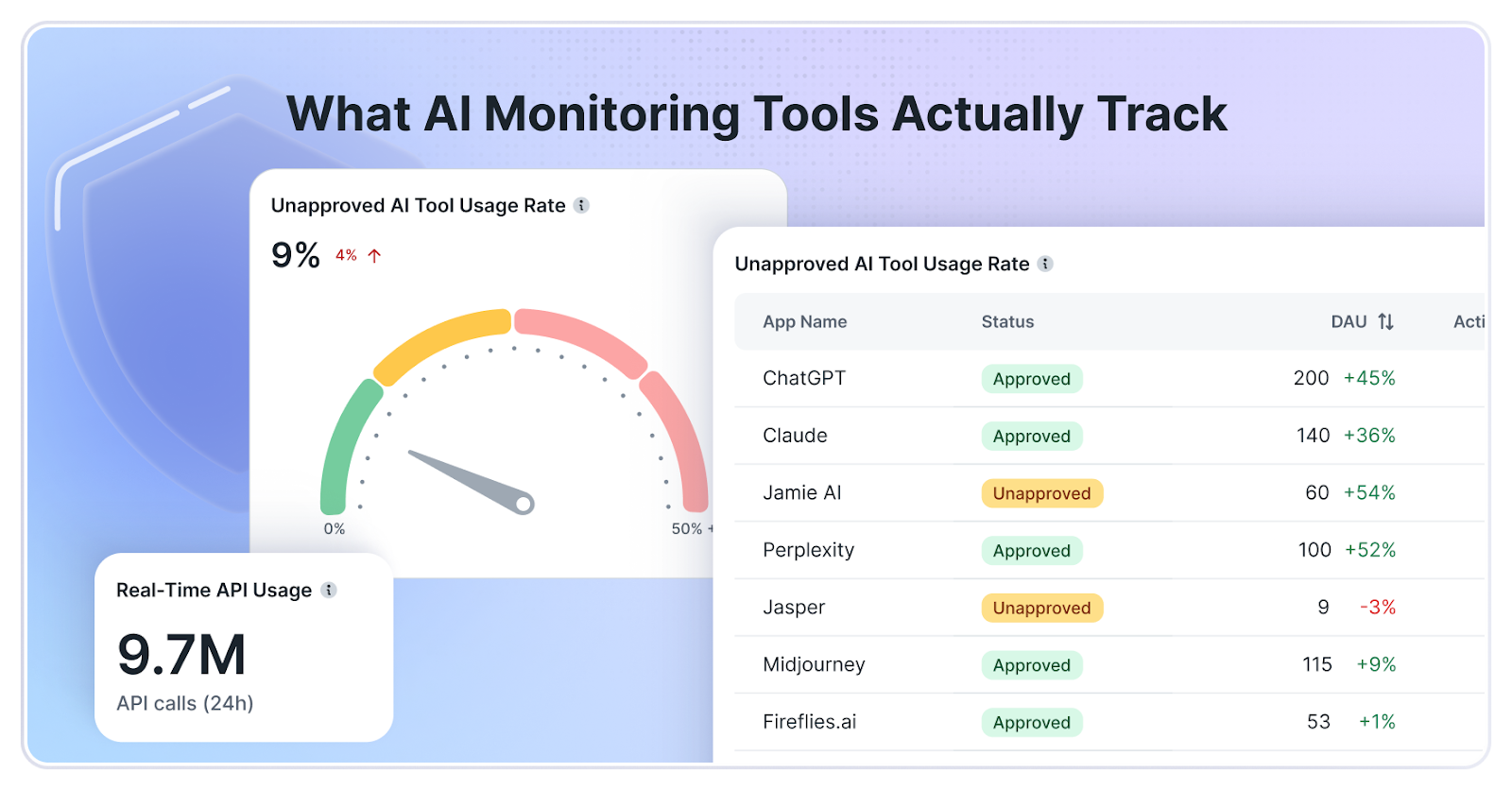
The enterprise-risk guide extends discovery to autonomous agents, no-code workflows, and AI features that can interact with internal systems. The concern is not only an employee sharing information; an agent may read records, change data, trigger another workflow, or keep executing after its original owner has moved on.
Prioritize by the actual capability and exposure. A read-only assistant and a workflow authorized to change customer records require different controls. Human-initiated use can also be high-risk; autonomy is one dimension, not the whole assessment.
For each material agent, record:
- The accountable business and technical owners.
- The purpose, trigger, connected systems, and data access.
- Credentials, permissions, and permitted actions.
- Human approval, exception handling, and stop procedures.
- Billing source, budget, and outcome evidence.
- Review date, ownership-transfer process, and retirement conditions.
An unknown owner or unexplained action is a finding to investigate, not proof of compromise. Retain enough evidence to assess dependencies and decide whether the workflow should be approved, restricted, redesigned, or retired.
Connect Discovery to Compliance Assessment
The shadow AI compliance guide explains why inventories must connect with legal, privacy, and security processes. Some obligations arise from the way AI or personal data is used, without a breach occurring first. An unapproved tool is not automatically a legal violation; applicability depends on the system, data, purpose, organization, and jurisdiction.
Article 50 Is Not a Blanket Inventory Mandate
The source guide distinguishes the EU AI Act's specific transparency obligations from a universal requirement to keep an enterprise AI usage log. Article 50 assigns different responsibilities to providers and deployers for relevant AI interactions and synthetic-content uses, including specified deepfake and public-interest-content disclosures.
An inventory helps determine which provisions apply, but it does not itself satisfy every duty. Have qualified legal reviewers check current requirements, exceptions, application dates, and the organization's role. Avoid treating all AI tools as subject to the same disclosure rule.
Existing Privacy and Sector Requirements Still Matter
Where GDPR applies, review the basis, purpose, transparency, minimization, security, and accountability of personal-data processing. Sector supervision and cybersecurity expectations may add other duties. The SEC examination priorities discussed in the source article concern the registered firms and activities within their scope, not every enterprise using AI.
Build a discovery-to-assessment record covering approval status, owner, intended use, accessible data categories, provider terms, relevant jurisdiction, applicable controls, and review findings. Usage telemetry can initiate that record, but business owners and specialist reviewers must supply context it cannot infer.
Why This Matters for Decision-Making
Discovery connects security and governance with the financial and operational picture. Unknown subscriptions can create unbudgeted costs. Embedded features can add consumption. Unowned agents can continue spending or acting without useful outcomes.
Use the evidence to evaluate business need, adoption, proficiency, workflow performance, costs, and risk together. A widely used tool may still create rework. A selectively used tool may support an important process. Neither usage volume nor a low invoice establishes the right decision.
Research on shadow AI and breach costs can provide risk context, but should not be converted into an assumed loss for each unapproved tool. Measure confirmed incidents, findings, and remediation in your environment rather than reporting theoretical avoided losses as realized savings.
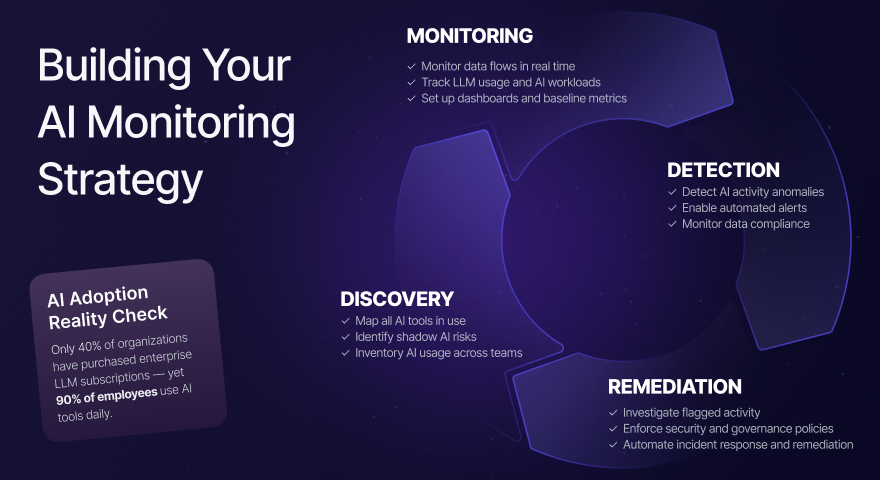
Building Your AI Monitoring Strategy
- Define scope and privacy boundaries. Specify systems, populations, data collected, purpose, access, retention, and known exclusions.
- Combine discovery sources. Join supported browser, desktop, application, identity, API, workflow, procurement, expense, and billing records.
- Classify the footprint. Distinguish approved, pending review, unapproved, embedded, and unknown activity. Preserve uncertainty.
- Assign owners and purposes. Connect material tools and agents to a team, use case, budget, and accountable decision-maker.
- Assess risk and obligations. Review data categories, account terms, system permissions, autonomous actions, and applicable legal or sector requirements.
- Test the relevant controls. Verify the difference between alerts, approval gates, restrictions, and actual blocking or termination.
- Maintain the record. Reassess when new activity, permission changes, incidents, model changes, or ownership changes affect the use case.
Continuous discovery reduces the delay between adoption and review where coverage supports it. It should complement a documented assessment and incident process rather than replace one.
Moving From Visibility to Action
Route each material finding to an owner with a deadline and a decision. Options include approval under defined guardrails, safer account configuration, targeted enablement, an approved replacement, permission reduction, suspension, or retirement.
Start with immediate containment when evidence indicates material risk; do not postpone it simply to complete attribution. For lower-risk discoveries, understand the business need before imposing a blanket ban that leaves the underlying workflow problem unresolved.
Track inventory coverage, time from discovery to assessment, unresolved ownership, reviewed permissions, tested controls, incidents and near-misses, and verified closure. A shrinking unapproved-tool count can mean better governance or incomplete detection, so interpret it alongside coverage.
Give security, privacy, legal, IT, finance, and business leaders the same evidence record. The useful endpoint is an accountable decision, not a longer list of applications.
Frequently Asked Questions
How is shadow AI different from shadow IT?
It includes unapproved software use, but also AI features, model APIs, and agents that may process data or take actions inside business workflows. Assess the actual access, behavior, and oversight rather than assuming all shadow tools have the same risk.
Can we discover shadow AI without reading employee prompts?
Tool activity, identity, application, API, and spend metadata can support discovery without prompt content. That approach has boundaries: it does not prove what information was shared. Content-specific security investigations or enforcement require separate appropriate controls and review.
Does Article 50 require a complete enterprise AI inventory?
It is not a blanket inventory mandate. It sets specific transparency obligations by system type and provider or deployer role. An inventory helps assess applicability; qualified reviewers must determine the duties for the actual use.
Does shadow AI automatically create a compliance violation?
No. Unapproved use creates a review gap. Whether it violates a rule depends on the data, purpose, permissions, jurisdiction, and applicable duties. Some obligations arise before any incident occurs.
Should every discovered unapproved tool be blocked?
Not automatically. Evaluate the business need and risk, then approve, restrict, replace, or block as appropriate. Immediate material risk may require containment while the assessment proceeds.
What should security teams prioritize?
Prioritize consequential access, sensitive data, unowned workflows, autonomous actions, and missing controls. Review agent permissions and intervention paths alongside approved tools and personal accounts.
Make Discovery the Foundation of Governed AI Use
Larridin helps organizations examine AI adoption, workflows, spending, and outcomes across tools and teams. That visibility supports investigation of approved and unapproved activity with clearer ownership and decision context.
Confirm the integrations and coverage required for your environment. Measurement visibility is not equivalent to content inspection, security prevention, or automatic regulatory compliance.
Schedule a Demo to discuss your shadow AI discovery and governance priorities.
Find the activity. Establish the context. Test the control. Make the decision accountable. That is how monitoring becomes an operating practice rather than a static inventory.