

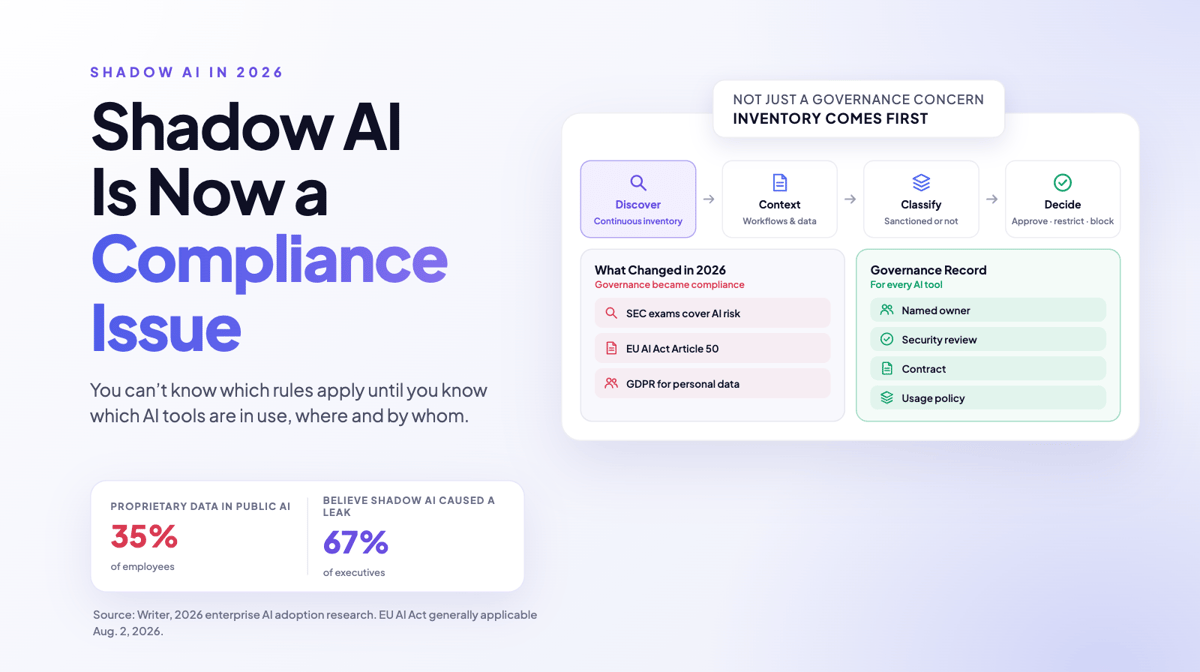

Shadow AI has long been a governance concern. In 2026, it also carries more explicit compliance implications as new AI transparency rules take effect and regulators put AI-related risks on the supervisory agenda. In some contexts, that makes visibility into which tools are being used, where, and by whom a compliance requirement rather than just a governance best practice.
Key Takeaways
- The EU AI Act creates specific transparency obligations, not a blanket AI inventory mandate. Article 50 assigns different responsibilities to providers and deployers depending on how an AI system is used.
- AI governance increasingly has to connect with existing compliance, security, and privacy processes rather than sit in a separate policy silo.
- AI governance needs visibility beyond approved tools because employee-adopted AI can bypass normal procurement and review.
What Changed in 2026
Enterprise AI regulations became more specific this year.
In the U.S., the SEC’s Division of Examinations says its fiscal year 2026 priorities include reviewing how registered firms identify and mitigate new risks associated with AI as part of their cybersecurity controls.
The EU AI Act generally became applicable on Aug. 2, 2026. Article 50 includes specific transparency rules for certain AI systems. Providers are responsible for informing people when they’re interacting directly with an AI system, unless that interaction is obvious, and for machine-readable marking of synthetic content. Organizations that use AI systems — which the Act calls deployers — have separate disclosure requirements for emotion recognition and biometric categorization systems, deepfakes, and certain AI-generated public-interest content .
The rules differ by jurisdiction, who they apply to, and what they require. Both reinforce a basic governance problem: an organization can’t determine which regulatory obligations apply if it doesn’t know which AI tools are being used.
The Inventory Problem Comes First
Keeping an accurate AI inventory gets harder when employees can start using tools without going through procurement.
Writer’s 2026 enterprise AI adoption research found that 35% of employees have entered proprietary information into public AI tools. It also found that 67% of executives believe their organization has already suffered a data leak or security breach because an employee used an unapproved AI tool.
An organization needs to know the tool exists before it can review data handling, enforce access policies, assess regulatory obligations, or decide whether a tool should be restricted.
Larridin’s AI Adoption platform surfaces approved and unapproved AI tools and shows how adoption varies across teams. Larridin also reports that enterprise monitoring commonly uncovers 3x to 5x more AI usage than organizations expected.
That inventory gives security, privacy, legal, and governance teams a place to start with compliance.
What a Useful AI Governance Record Should Cover
AI Tool Inventory and Access Footprint
Which AI tools are in use? Which teams use them? Which are approved, and which appeared outside the normal procurement process?
A point-in-time audit can answer that question for one moment. Continuous discovery gives governance teams a better view as the environment changes.
Usage and Data-Handling Context
Knowing that a tool exists is only the first step. Organizations also need enough context to determine what policies or regulatory obligations apply. That can include which teams use the tool, the workflows it supports, what types of data it can access, and whether it’s used in contexts covered by specific rules.
For example, Article 50 doesn’t require a generic enterprise usage log. Its obligations depend on the type of AI system and whether the organization is acting as a provider or deployer. GDPR separately requires controllers to be able to demonstrate compliance with its personal-data processing principles.
Sanctioned vs. Unsanctioned Classification
An enterprise deployment may already have a documented owner, security review, contract, and usage policy. An employee-adopted tool may have none of those.
Classifying the AI footprint helps governance teams determine which tools need additional review and which controls already exist.
Frequently Asked Questions
What does Article 50 of the EU AI Act require?
Article 50 assigns different transparency obligations to providers and deployers. Providers have duties related to direct AI interactions and machine-readable marking of synthetic content. Deployers have separate disclosure duties involving emotion recognition and biometric categorization systems, deepfakes, and certain AI-generated public-interest content. The exact obligation depends on the system and how it is used.
Does a breach have to happen before shadow AI creates a compliance problem?
No. Some regulatory obligations apply because of how a system or personal data is being used, not because an incident has already occurred. Whether a specific shadow AI use creates a violation depends on the tool, data, use case, jurisdiction, and applicable rules.
How often should an AI tool inventory be updated?
Continuously, if possible. Employees can adopt new AI tools at any time, so ongoing discovery gives governance teams a more accurate inventory than quarterly or annual reviews alone.
Does shadow AI governance mean banning unapproved tools?
Not necessarily. Once an organization knows which tools are in use, it can evaluate their data access, security, business need, and risk and decide whether to approve, restrict, replace, or block them.
Know What AI Is in Use Before Someone Asks
Larridin helps organizations discover sanctioned and unsanctioned AI tools and understand how they are being used across the enterprise.
Book a discovery call to see your AI tool inventory and identify where governance visibility is still missing.