
Enterprise AI Measurement Guide
Velocity
Output Breakdown
How is engineering output split between AI-Assisted, Human-Only, and Agent Output, and how is that split trending over time?
What it shows
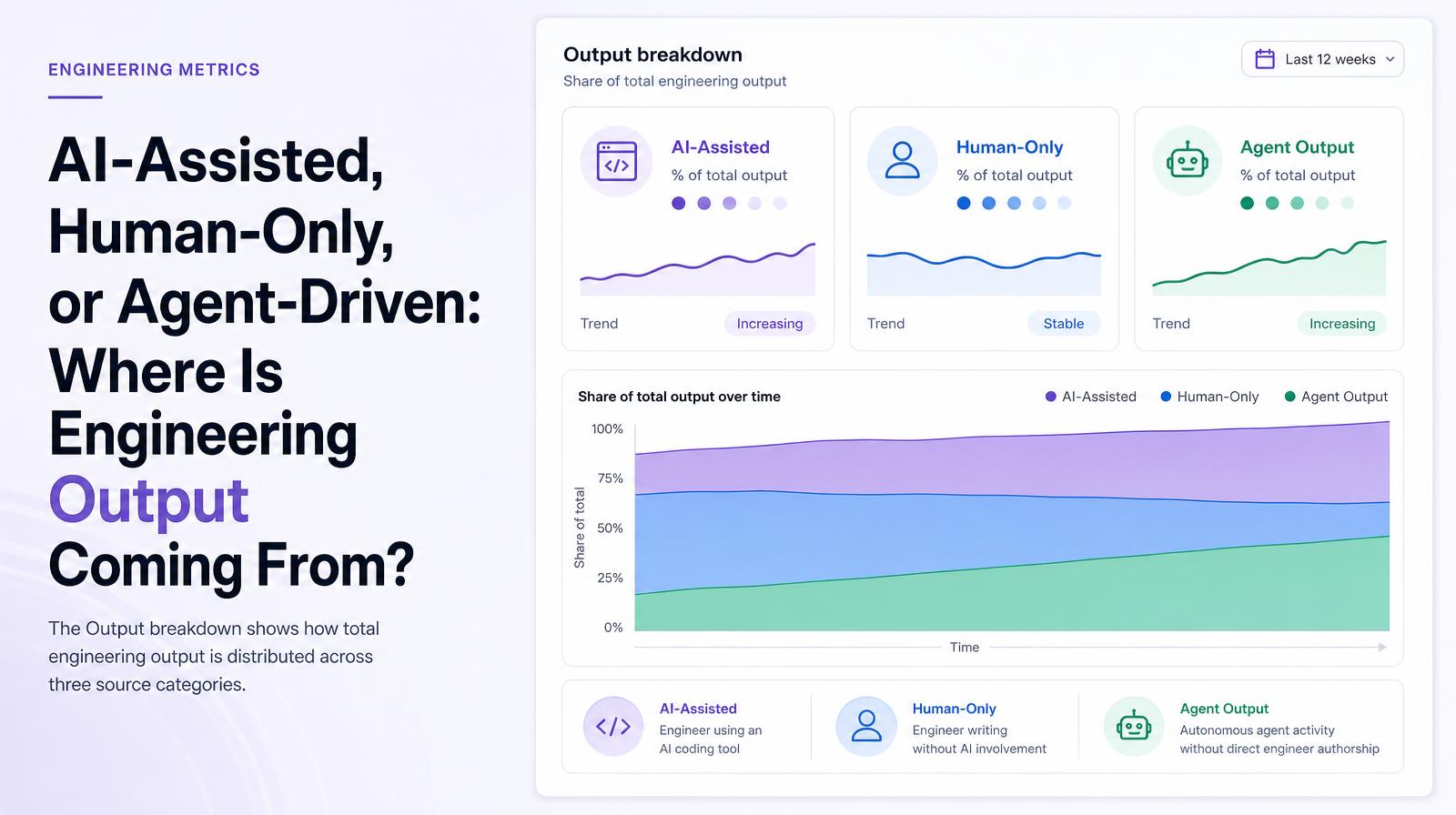
The Output breakdown splits total engineering output into three source categories, AI-Assisted (engineer using an AI coding tool), Human-Only (engineer writing without AI involvement), and Agent Output (autonomous agent activity without direct engineer authorship), each with its percentage of total output and a trend line. This three-way view shows not just how much AI is contributing, but which kind of AI contribution is growing fastest.
Why it matters
The distinction between AI-Assisted and Agent Output is becoming one of the most strategically important in engineering measurement. AI-Assisted output still involves an engineer making judgment calls; Agent Output is autonomous. As agentic coding tools proliferate, the share of Agent Output rising relative to AI-Assisted output signals a shift in how the team works, one that has implications for code review capacity, quality governance, and how much of the output can be attributed to human decision-making. No single aggregate "AI output share" number captures that distinction.
The Larridin angle
Larridin tracks Agent Output as a distinct category, not folded into AI-Assisted, which means engineering leaders can see the rise of autonomous agent contributions before it becomes visible in incident rates or review queue depth. The trend line on each category makes the trajectory of the transition visible in real time.
Related Velocity Metrics
Common questions
What does the Output Breakdown metric show?
The Output Breakdown metric shows the distribution of engineering output across AI-Assisted, Human-Only, and Agent Output, each with its percentage of total output and a trend line.
Why is the distinction between AI-Assisted and Agent Output important?
The distinction is important because AI-Assisted output involves human judgment, while Agent Output is autonomous, affecting code review capacity, quality governance, and human decision-making attribution.
How does Larridin's approach to tracking Agent Output differ?
Larridin tracks Agent Output as a separate category, allowing leaders to identify the rise of autonomous contributions before they impact incident rates or review queues.
Why should engineering leaders pay attention to the trend lines in the Output Breakdown?
Trend lines help leaders see the trajectory of AI-Assisted and Agent Output contributions, providing insights into shifts in team dynamics and output sources over time.